
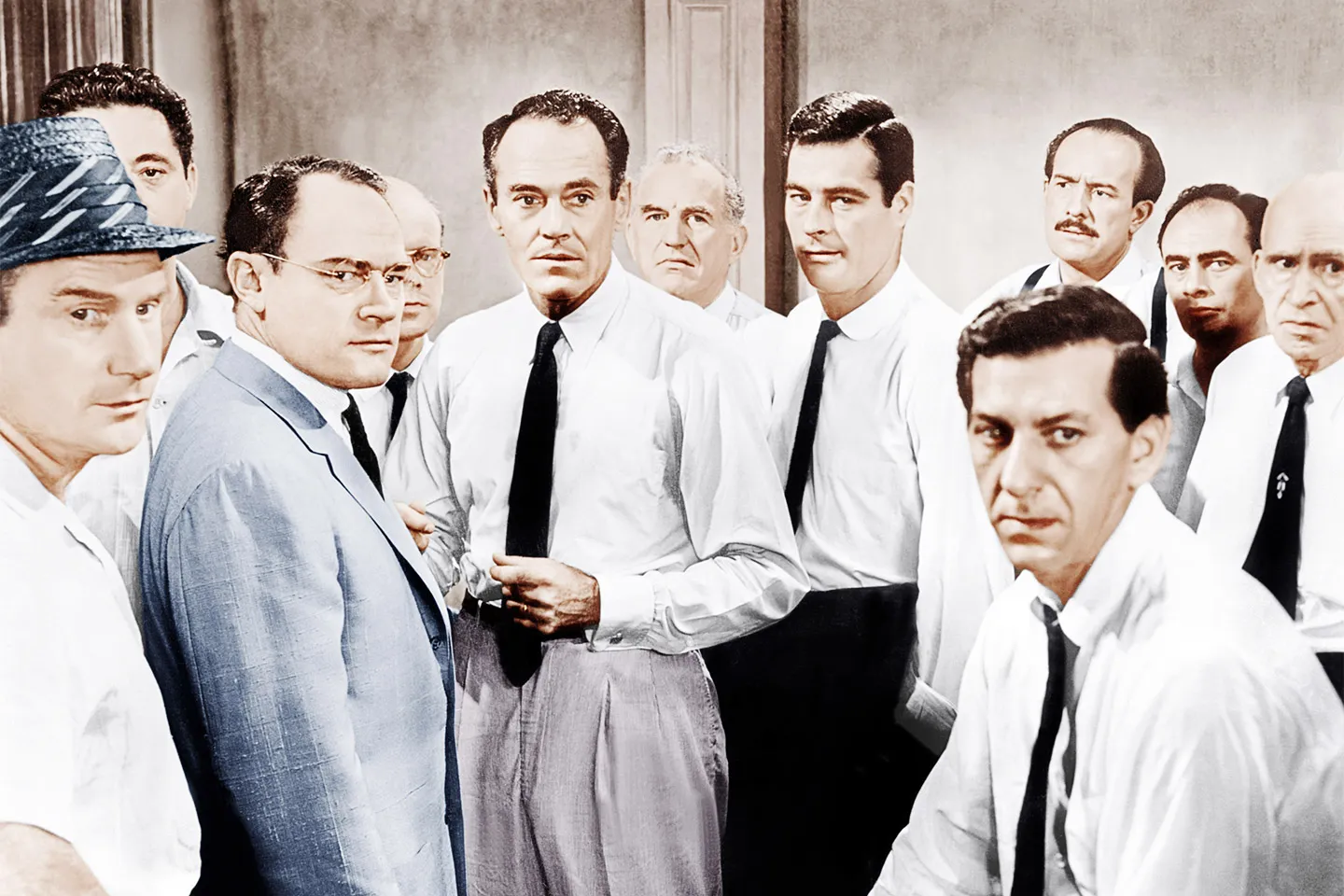
12 Angry Men is a landmark in American cinema, renowned not only for its compelling narrative but also for its minimalist yet powerful setting—a single jury room. Directed by Sidney Lumet and released in 1957, the film is a gripping courtroom drama that explores the themes of justice, prejudice, and the strength of individual conviction.
The story follows twelve jurors who are tasked with deciding the fate of a teenage boy accused of murdering his father. At first glance, the case seems straightforward, and the majority of the jurors are ready to deliver a guilty verdict. However, the narrative takes a pivotal turn when Juror #8, portrayed by Henry Fonda, voices his doubts about the boy’s guilt.
What follows is a tense, emotionally charged deliberation process. Juror #8 methodically questions the reliability of the evidence, urging the others to reconsider their initial judgments. As the discussion deepens, each juror’s personal biases, experiences, and character traits come to the fore, revealing the complex interplay between facts, assumptions, and the human psyche.
The film’s power lies in its simplicity—there are no dramatic flashbacks or courtroom theatrics. Instead, it relies on sharp dialogue, intense performances, and a gradually mounting sense of moral responsibility. Over time, the jurors confront their own prejudices and begin to see the case from new perspectives. What seemed like an open-and-shut decision evolves into a profound meditation on the meaning of justice.
With an IMDb rating of 9/10, 12 Angry Men continues to be celebrated as one of the greatest films ever made. It remains a staple in discussions about the American legal system and the ethical responsibilities of a jury. More than half a century after its release, its message about the importance of standing alone for what is right, even in the face of overwhelming opposition, still resonates powerfully.
In an age where quick judgments and snap decisions often dominate public discourse, 12 Angry Men serves as a timeless reminder of the need for patience, critical thinking, and empathy in the pursuit of justice.