

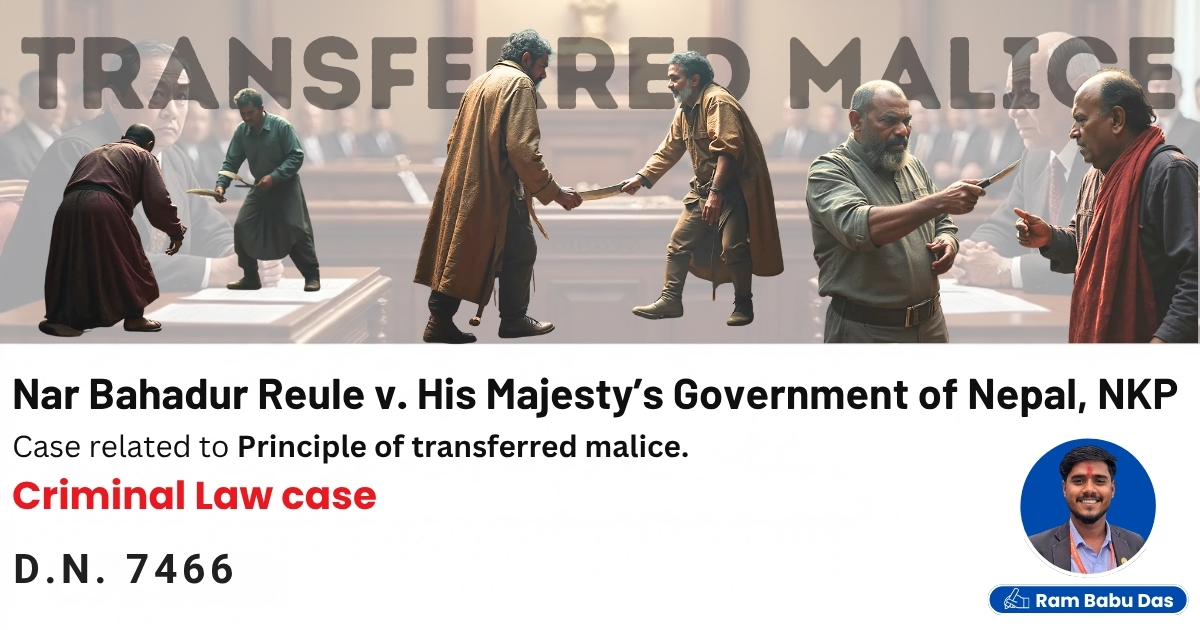
Criminal Law Case: Nar Bahadur Reule v. His Majesty’s Government of Nepal, NKP (2061), No. 11, DN: 7466
Case: Homicide
Plaintiff: HMG on the complaint of Tek Bahadur Reule
Defendant: Nar Bahadur Reule
Decision Number: 7466
This case is related to transferred malice.
Fact of the case:
During the traditional religious worship of the people belonging to the Reule community, a dispute arose about the division of the heads of the sacrificed goat and cock.
Nar Bahadur and Chadralal are siblings. During the dispute at the temple, Nar Bahadur Reule attempted to stab Megh Raj Sahu with a knife but accidentally struck his own brother, Chadralal Reule, instead. The elder brother was grievously hurt, which subsequently resulted in his death.
Nar Bahadur Reule confessed in front of the police that Chandralal Reule, who tried to intervene and separate us during the dispute, accidentally got wounded by the knife targeted against Megh Raj, resulting to his death.
Decision of Courts:
Salyan District Court Verdict: Nar Bahadur Reule was sentenced to 2 years of imprisonment on 2055/09/07 under Number 6(2) of the Chapter on Homicide, on the grounds of accidental death.
An appeal was later filed by His Majesty’s Government (HMG) in the Tulsipur Appeal Court, seeking to convict him under Number 13(1) based on the legal principle of “transferred malice.”
However, the Appeal Court of Tulsipur, on 2057/10/10, upheld the decision of the Trial Court, maintaining that the death was accidental and not intentional.
Supreme Court:
Then the case went to the Supreme Court. The Supreme Court granted permission to review the case. The Supreme Court, after revision, held that the accused was guilty of murder by application of transferred malice. If the strike made by a person to kill someone happened to hit another person, resulting in his death, the criminal intent is not considered to have ended; rather, it is believed to have been transferred.
As the knife targeted at Megh Raj by Nar Bahadur accidentally resulted in the death of Chandralal, his intention (malice) to kill Megh Raj can be rightly considered to have been transferred to Chandralal.
Accordingly, the Supreme Court convicted the accused under Number 13(1) of the Chapter on Homicide. However, considering the close relationship between the accused and the deceased and the absence of prior enmity, the Court found that imposing life imprisonment would be excessively harsh. Therefore, by exercising its discretionary power under Number 188 of the Muluki Ain, the Court reduced the punishment to 11 years of imprisonment.
Principle Established:
When an act intended against one person accidentally affects another, the same offense is considered to have been committed. If someone strikes with the intention to kill one person but the blow accidentally hits and kills another, the offender’s criminal intent is not considered lost but transferred to the unintended victim. Therefore, it still constitutes murder with intent (intentional homicide) under the principle of transferred malice.