
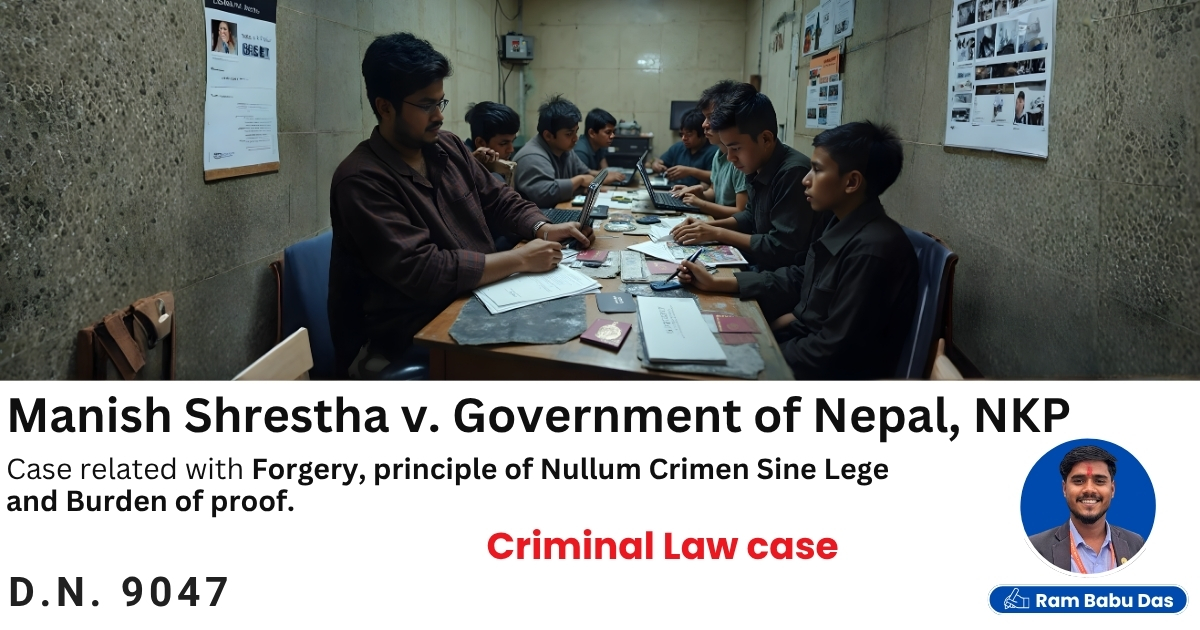
Criminal Law Case: Manish Shrestha v. Government of Nepal, NKP 2070, No. 8, DN: 9047
Case: Forgery/Sarkari Chhap Dasthakhat Kirte
Plaintiff: Government of Nepal
Defendant/Appellant: Manish Shrestha
Decision Number: 9047
This case is related with principle of Nullum Crimen Sine Lege and Burden of proof.
Fact of the case:
Manish Shrestha was convicted as per the crime of kirte/forgery. Police authority recovered a computer, CPU, 2 scanned visas and passports, 7 different types of CDs, 11 floppy disks, and a printed page of the passport and certificate of Jiwan Pradhan from the room of Manish Shrestha on 2061/11/11.
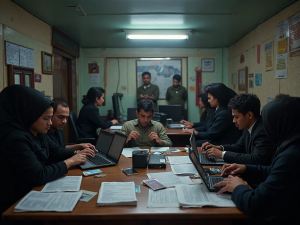
Manish Shrestha and others confessed before the police that there was much financial benefit and lesser punishment in preparing forged government documents, so they prepared forged documents, including a passport and certificate for Jiwan Pradhan and the other 4 accused with their connivance, charging Rs. 500 to Rs. 7000.
All 5 accused are arrested and charged under sec. 1, 9, and 12 of the chapter on forged documents for preparing forged documents relating to passport certificates, etc.
“Manish Shrestha denied the ownership of the object and CDs recovered from his office. Some customer might have left it there. His friend Jiwan had left his certificate with him, promising to collect it within 2/3 days,” the statement before the trial court.
The other 4 defendants denied their involvement in the alleged offense and said they confessed before the police due to their threat and coercion.
Decision of court:
Trial Court:
After hearing all the evidence and conducting examinations, the district court of Kathmandu convicted only Manish Shrestha under sections 1 and 9 of the chapter on forged documents, imposing a fine of Rs. 50 and sentencing him to 1 year of imprisonment according to sections 9 and 12.
Appellate Court:
Appeal court of Patan also upheld the decision of district court.
Supreme Court:
Manish Shrestha appealed again to the Supreme Court, arguing the lower courts misinterpreted the law, pointing out the presence of interpretative errors relating to sec. 184 of Muluki Ain as well as sections 3 and 54 of the Evidence Act, 2031.
The Supreme Court said, “In order to establish the commission of a criminal offense, there must have been a clear violation of criminal law. Simply scanning or printing an image of a passport does not amount to forgery of a government document under Sections 1, 9, and 12 of the Muluki Ain. The prosecution failed to establish any violation of criminal law beyond doubt.
The burden of proof lies on the claimant to prove the alleged violation of the criminal law. The prosecution could not prove for what purpose the appellant/defendant was likely to use the scanned page of the passport.”
Putting a scan copy of a passport without use and misuse cannot be a crime of counterfeiting a governmental stamp and signature.
So the Supreme Court overturned the previous judgments and acquitted Manish Shrestha, stating that the act of scanning passport pages did not constitute criminal forgery as defined by law. And finally, Manish Shrestha was cleared of all charges.
Principle Established:
A criminal offense cannot be proven unless there is a clear and specific violation of criminal law, and the burden of proof lies entirely on the prosecution. A person cannot be punished for an act that was not criminalized by law at the time it was committed(which support principle of Nullum Crimen Sine Lege).