A Click for Safety or a Violation of Privacy? Rethinking Section 295 of the Muluki Criminal Code, 2074
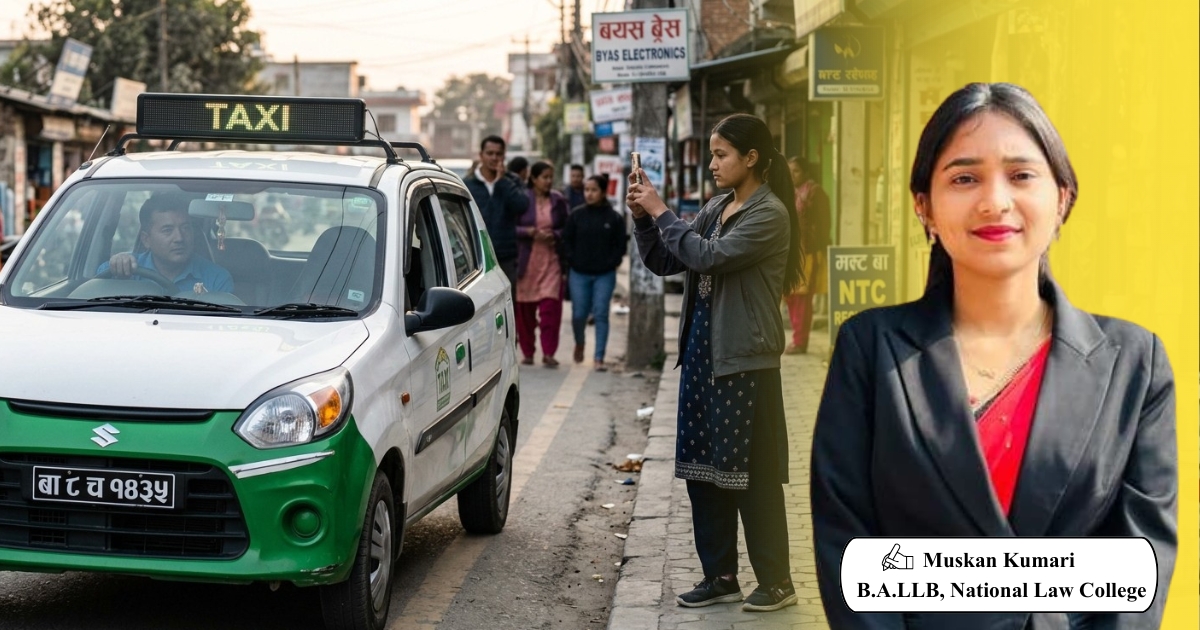
In contemporary Nepal, personal safety has become an increasing concern, particularly in urban areas where cases of harassment, kidnapping, and other forms of crime are frequently reported. Many people, particularly women and young travelers, have responded to these concerns by capturing a picture of the driver before or throughout their trip and sharing it with friends and family until they arrive safely.
What appears to be a simple act of caution has, however, raised a complex legal question:
“Does taking a driver’s photograph without consent for safety purposes amount to a violation of Section 295 of the Muluki Criminal Code, 2074?”
This question lies at the intersection of privacy rights, criminal liability, and personal security three critical pillars of modern constitutional and criminal law.
Legal Framework: Section 295 of the Muluki Criminal Code 2074
Muluki Criminal Code, 2074’s Section 295 forbids taking pictures of anyone without that person’s permission. This clause’s main goal is to safeguard people’s “right to privacy and dignity” by preventing unauthorized use, storage, or capture of private photos.
In the digital age, where photos can be readily shared, altered, or used for harassment, defamation, or exploitation, the law is more pertinent. The clause expresses the state’s desire to protect people against unwarranted access to their private lives.
At a prima facie level, the law appears strict: if a person’s photograph is taken without consent, it may constitute an offence punishable under the Code.
However, legal interpretation cannot be limited to the literal wording of a statute alone.
The Practical Reality: Safety Concerns in Modern Nepal
While privacy protection is essential, the lived reality of many citizens introduces a competing concern personal safety.
With rising fears of unsafe transportation, unknown drivers, and unpredictable travel conditions, passengers often rely on informal safety measures. Taking a driver’s photograph and sharing it with family has become one such precautionary step.
The intention behind this act is not surveillance, exploitation, or harm. Rather, it is rooted in:
- fear of potential harm,
- desire for traceability in emergencies, and
- Precautionary communication with family members.
This raises a crucial legal issue: Should an act motivated purely by self-protection be treated the same as an act intended to violate privacy?
The Role of Intention in Criminal Law
One of the foundational principles of criminal law is that liability is not determined solely by the act (actus reus), but also by the mental element or intention (mens rea).
In the context of Section 295, while the physical act of taking a photograph without consent may be established, the “intention behind the act becomes highly relevant”.
If the photograph is taken:
- without malicious intent,
- without any purpose of defamation or misuse, and
- solely as a safety precaution,
then the nature of the act changes significantly in terms of culpability.
Criminal law traditionally distinguishes between wrongful intent and good-faith conduct. Acts performed in “good faith for protection or necessity” are often treated differently from those committed with harmful intent.
Constitutional Balance: Privacy vs. Security
This issue also engages two fundamental constitutional rights guaranteed under the Constitution of Nepal (2015;
Right to Privacy: protecting individuals from unauthorized intrusion into personal life, image, and data.
Right to Life and Personal Liberty: ensuring safety, dignity, and protection from harm.
In situations such as photographing a driver for safety purposes, these two rights appear to be in tension.
On one hand, the driver has a legitimate expectation of privacy and control over their image. On the other hand, the passenger is exercising a fundamental right to personal security.
The challenge, therefore, lies in “balancing competing constitutional values” rather than prioritizing one at the absolute expense of the other.
A rigid interpretation of privacy law may undermine practical safety needs, while an overly flexible approach may weaken privacy protections.
Legal Ambiguity and Absence of Judicial Precedent
At present, Nepal lacks clear judicial precedent specifically addressing whether photographing a person (such as a driver) for safety purposes constitutes an offence under Section 295.
This absence of authoritative interpretation creates a ‘legal grey area’, where the application of the law depends heavily on context, intention, and prosecutorial discretion.
In comparative legal systems, courts often adopt a ‘contextual and purposive interpretation’ when dealing with conflicts between privacy and safety. Such an approach ensures that laws evolve with societal needs rather than remaining rigid and outdated.
In Nepal, similar interpretive reasoning would likely be necessary if such a case were ever brought before the judiciary.
Good Faith and Reasonable Necessity
Another important legal principle relevant here is ‘good faith conduct’. Actions performed with honest intention, especially for protection or necessity, are often treated differently under criminal jurisprudence.
Taking a driver’s photograph for safety communication with family may be argued as:
- a preventive safety measure,
- a reasonable response to perceived risk, and
- an act lacking any criminal intent.
Unless the image is misused, circulated, or used to harm the driver’s reputation or privacy, the harm element of the offence remains minimal or absent.
This further strengthens the argument that such conduct exists in a legally ambiguous but practically defensible zone.
Policy Considerations: Should the Law Evolve?
The issue also raises an important policy question: Is Section 295 sufficiently clear for modern social realities?
While the objective of protecting privacy is essential, the law may need clearer guidelines regarding:
- consent in public service interactions,
- safety-driven exceptions,
- and proportionality in enforcement.
Without such clarity, ordinary safety practices risk being misunderstood or misinterpreted as criminal conduct, which may create unnecessary fear among citizens.
A balanced legal framework should ensure that privacy is protected without discouraging reasonable safety measures.
Conclusion
The act of taking a driver’s photograph without consent for safety purposes occupies a complex legal space under Section 295 of the Muluki Criminal Code, 2074.
From a strictly literal interpretation, it may appear to fall within the scope of prohibited conduct. However, a deeper legal analysis reveals a more nuanced reality. The absence of malicious intent, the presence of good faith, and the underlying concern for personal safety significantly alter its character.
This issue ultimately reflects a broader tension within modern law: the need to balance ‘individual privacy rights with evolving security concerns’.
Therefore, while Section 295 plays a crucial role in protecting privacy, its application must remain sensitive to context and intention. In a society facing growing safety challenges, law must not only protect privacy but also recognize the legitimate efforts of individuals to protect themselves.
Ultimately, this “single click” is more than a photograph, it symbolizes the delicate and evolving balance between ‘privacy and protection in modern Nepal’.