

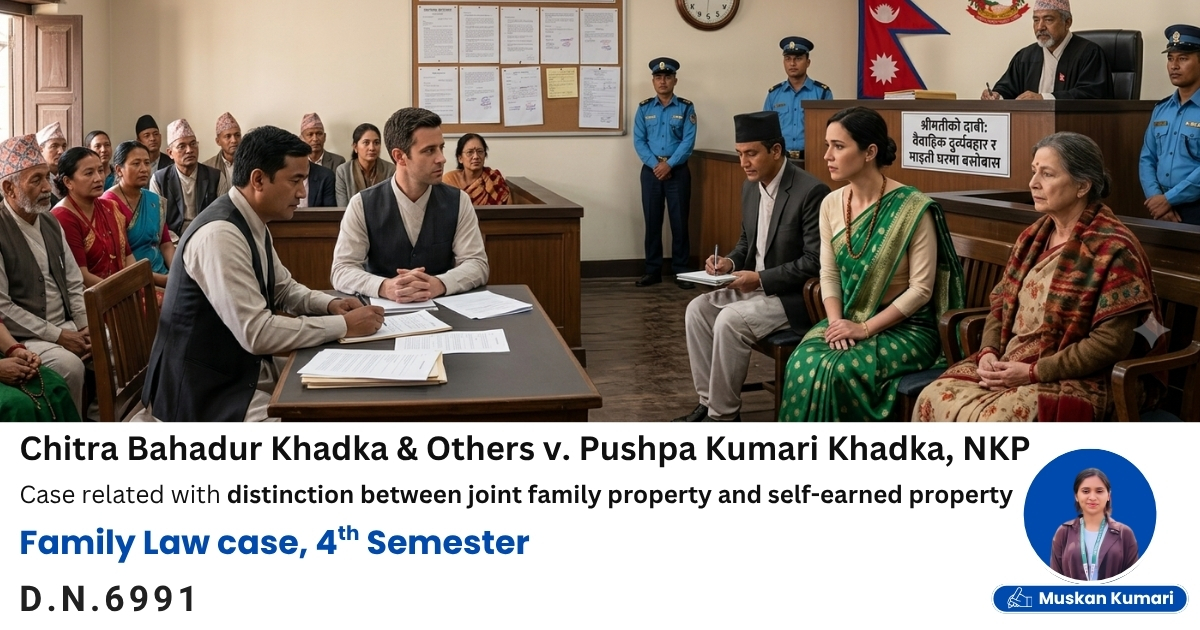
Family Law Case: Chitra Bahadur Khadka & Others v. Pushpa Kumari Khadka, NKP 2057, No. 3/4, D.N. 6991
Case: Partition (Ansha)
Plaintiff: Pushpa Kumari Khadka
Defendant: Chitra Bahadur Khadka et.al.
Decision Number: 6991
This case is related with partition of family property and distinction between joint family property (Sagol Sampatti) and self-earned/private property (Niji Aarjan) acquired through personal skill, profession, and effort.
Facts of the Case:
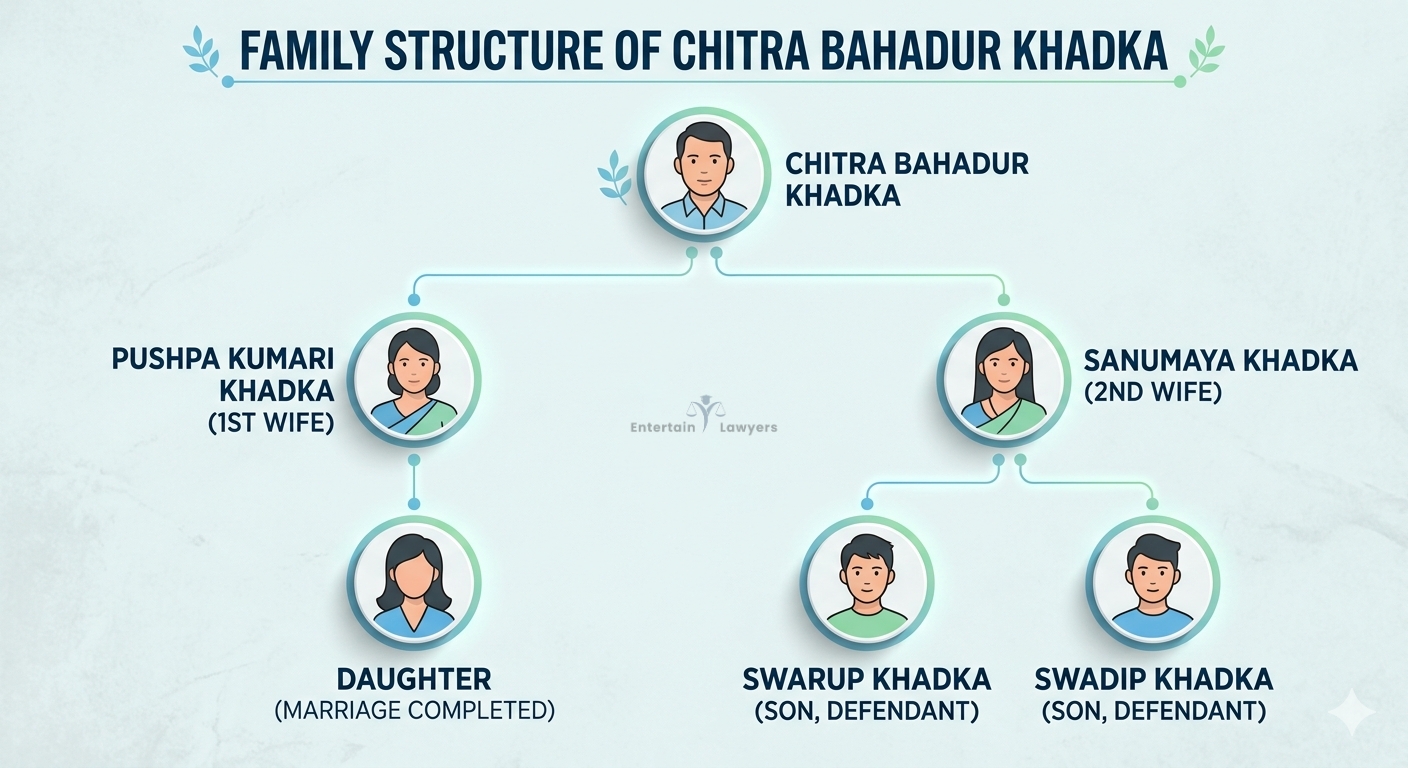
Pushpa Kumari Khadka was the first wife of Chitra Bahadur Khadka. Sanumaya Khadka was the second wife of Chitra Bahadur Khadka, and defendants Swarup Khadka and Swadip Khadka were the sons born from Sanumaya. Pushpa Kumari had one daughter from Chitra Bahadur whose marriage had already been completed.
Pushpa Kumari alleged that Chitra Bahadur had been working in Kathmandu Valley and, during that period, family property, grains, jewelry, and even timber from ancestral land were used to purchase land in Bhaktapur and Kavrepalanchok and to construct a house. She stated that when she visited Bhaktapur during Dashain in 2050 B.S., the defendants insulted her and told her that she no longer had any right to stay in the house or maintain family relations. Therefore, she filed a partition suit claiming her share from all movable and immovable properties held by the defendants.
The defendants argued that the ancestral property situated in Gorkha was the only joint family property subject to partition. According to them, the disputed properties in Bhaktapur and Kavrepalanchok were private/self-earned properties of Sanumaya Khadka. They stated that Sanumaya had been working as a staff nurse since 2031 B.S., later becoming an officer in the Nursing Service Group. During her service, she had received professional training in New Delhi under a USAID scholarship, earned additional income through nursing services, teaching classes, preparing question papers, and also obtained loans from the Employees Provident Fund for house construction. They further claimed that some of the lands had been obtained through Bakash Patra (gift deed).
The dispute mainly centered on whether the disputed properties standing in the name of Sanumaya Khadka were joint family properties or her private/self-earned properties acquired through personal skill and effort.
Legal Issues:
- Whether the disputed properties standing in the name of Sanumaya Khadka were joint family properties or self-earned/private properties.
- Whether property acquired through personal knowledge, skill, profession, and effort is subject to partition among coparceners.
- Whether property received through gift deed (Bakash Patra) can be partitioned among family members.
- Whether the Appellate Court had correctly interpreted the provisions of the Muluki Ain relating to partition and private property.
Decision of the Courts:
Gorkha District Court:
Gorkha District Court held that all movable and immovable properties mentioned in the inventory were joint family properties rather than private properties. Therefore, Court decided that Pushpa Kumari was entitled to receive one-fifth share after separating the marriage expenses of the sons.
Pokhara Appellate Court:
The defendants appealed before Pokhara Appellate Court. Appellate Court upheld the decision of District Court and held that the defendants had failed to reasonably prove that the disputed properties were acquired solely through private earnings. Therefore, the Court affirmed that the properties were subject to partition.
Supreme Court of Nepal:
The matter was then brought before Supreme Court of Nepal through a petition for review. Supreme Court examined the legal provisions under the Chapter on Partition (Anshabanda) and the provisions relating to women’s separate property (Stri Aanshadhan) under the Muluki Ain. The Court also analyzed Section 6(2) of the Evidence Act, 2031, which creates a presumption that property standing in the name of a coparcener is joint family property unless proved otherwise.
However, the Court found that Sanumaya Khadka was a highly skilled professional nurse who had independently earned income through government service, specialized nursing training, teaching activities, preparation of question papers, and additional professional work. Court further observed that she had also obtained housing loans from the Employees Provident Fund and had acquired certain lands through registered gift deeds.
Supreme Court held that the disputed lands in Kavrepalanchok and the house constructed in Bhaktapur were acquired through Sanumaya Khadka’s personal knowledge, skill, effort, profession, and independent earnings. Therefore, those properties constituted private/self-earned property (Niji Aarjan) under the law and were not subject to partition among coparceners.
Consequently, Supreme Court reversed the judgments of the lower courts to the extent that they had included those properties in partition.
Principle Established:
This case established an important principle regarding the distinction between joint family property and private/self-earned property.
This case established that:
- Property acquired through a person’s personal knowledge, skill, profession, effort, and independent earnings can constitute private/self-earned property.
- Property received through gift deed (Bakash Patra) may remain separate property and may not necessarily be partitioned among coparceners.
- Although property standing in the name of a coparcener is generally presumed to be joint family property under the Evidence Act, such presumption can be rebutted through proof of independent earnings and personal acquisition.
- Courts must carefully examine the source of income, professional capacity, loans, training, and independent effort while determining whether a property is joint or self-earned.