

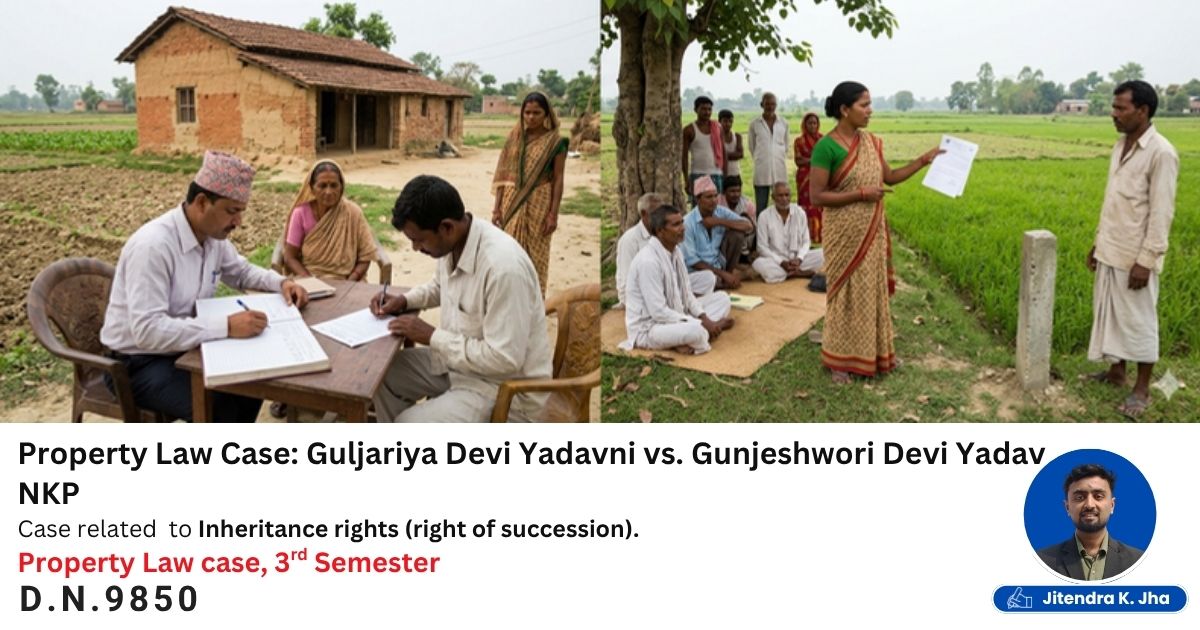
Property Law Case: Guljariya Devi Yadavni vs. Gunjeshwori Devi Yadav, NKP 2074 B.S D.N. 9850
Case: Establishment of Inheritance Rights
Plaintiff: Guljariya Devi Yadavni
Defendant: Gunjeshwari Devi Yadav (representing Bauwalal Yadav)
Decision Number: 9850
This case is related to inheritance rights (right of succession).
Facts of the Case
The plaintiff, Guljariya Devi Yadavni, was the only daughter of Nunuwati Devi. In 2021 B.S., Nunuwati Devi and the defendant’s side, particularly Baubalal Yadav, had already separated their ancestral property through partition and were living separately. Nunuwati Devi was possessing and using the land that had fallen to her share. Nunuwati Devi died in 2026 B.S. After her death, the disputed lands bearing Kitta Nos. 14 and 23, situated in Saptari District, were transferred and registered in the name of Baubalal Yadav in 2052 B.S. through the Land Revenue Office. The plaintiff claimed that she was the sole legal heir and only daughter of the deceased Nunuwati Devi. Therefore, she argued that she had an automatic inheritance right over her mother’s property. She filed a case seeking cancellation of the defendant’s registration and transfer of the property into her own name. The defendants argued that the plaintiff had failed to file the case within the 3-year limitation period prescribed under No. 20 of the chapter on inheritance (Aputali). They also argued that Nunuwati Devi had died many years earlier and that the plaintiff had not claimed her rights in time.
Thus, the central dispute of the case was whether the daughter’s inheritance right arose automatically after her mother’s death and whether such a right could be defeated merely because the claim was not filed within three years.
Legal Issues
- Whether a daughter automatically acquires inheritance rights over the property of her deceased mother.
- Whether the 3-year limitation period under No. 20 of the chapter on inheritance applies to the daughter’s automatically vested inheritance right.
- Whether another relative can legally transfer and register the property in his own name when the deceased’s daughter is alive and is the lawful heir.
Decisions of Different Courts:
Saptari District Court:
Saptari District Court dismissed the plaintiff’s claim on the ground that it was filed beyond the 3-year limitation period prescribed under No. 20 of the chapter on inheritance. Court held that since Nunuwati Devi had died long ago and the plaintiff had failed to assert her rights within the prescribed period, the claim was time-barred and could not be entertained.
Appellate Court, Rajbiraj:
Appellate Court reversed the District Court’s decision.The court observed that there was no dispute that the plaintiff was the only daughter and lawful heir of the deceased Nunuwati Devi. It held that the daughter’s inheritance right over her mother’s property arose automatically after the mother’s death.The court further held that merely because the plaintiff had not transferred the property into her name earlier, the defendant could not legally register the property in his own name. Therefore, the Appellate Court concluded that the limitation period under No. 20 did not apply in such a situation where the daughter already had an automatically vested right. Accordingly, the defendant’s registration was cancelled and the property was ordered to be registered in the plaintiff’s name.
Joint Bench of the Supreme Court:
The Joint Bench of the Supreme Court reversed the Appellate Court’s decision and upheld the District Court’s judgment. The court interpreted No. 20 of the inheritance chapter as applying equally to all claimants of inheritance rights. Since the plaintiff had not filed the case within the prescribed period, the court held that her claim could not succeed.
Full Bench of the Supreme Court:
The Full Bench of the Supreme Court reversed the earlier decision of the Joint Bench and upheld the judgment of the Appellate Court. The Full Bench held that after the death of Nunuwati Devi, her daughter, the plaintiff Guljariya Devi Yadavni, automatically acquired rights over the property. In such circumstances, her rights could not be extinguished merely because she had not filed a claim within three years.
The court also held that the defendant’s transfer and registration of the property in 2052 B.S. could not be legally recognized because the plaintiff, being the lawful heir, already had a vested right in the property. Accordingly, the registration in the defendant’s name was cancelled and the property was ordered to be registered in the plaintiff’s name.
Principle Established:
- This case established the important legal principle that the property rights of a deceased person pass automatically to the nearest lawful heir.
- The Supreme Court clarified that when a heir is alive, other relatives cannot claim inheritance over the deceased’s property.
- Inheritance right cannot be defeated merely because she did not file a claim within the 3-year limitation period.
- This case became an important precedent for the protection of women’s inheritance rights and for the interpretation of inheritance laws in Nepal.