

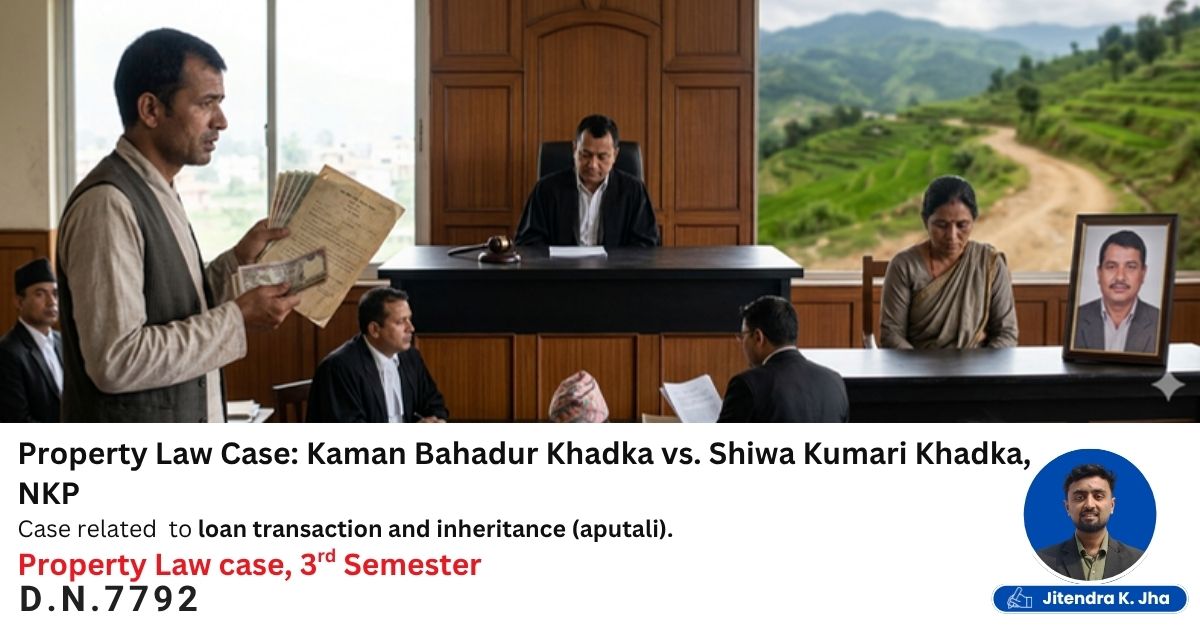
Property Law Case : Kaman Bahadur Khadka vs. Shiwa Kumari Khadka, NKP 2063 B.S, D.N. 7792
Case: Loan transaction
Plaintiff: Kaman Bahadur Khadka
Defendant: Shiwa Kumari Khadka
Decision Number: 7792
This case is related to loan transaction and inheritance (aputali).
Facts of the Case:
The plaintiff claimed that he had given NPR 40,000 to the deceased Sher Bahadur Khadka in relation to a land transfer agreement. Under the agreement, the land was supposed to be registered in the plaintiff’s name after receiving the amount. However, before the registration process was completed, Sher Bahadur died. After his death, the plaintiff claimed that the defendant, Shiwa Kumari (the widow of the deceased), being the legal heir entitled to inherit the property, should repay the loan amount with interest. The defendant denied the claim, stating that she had not taken any loan, the document was forged, and she had not yet inherited or registered any property of the deceased in her name. Both the District Court and the Appellate Court dismissed the plaintiff’s claim, and the matter reached the Supreme Court.
Legal Issues
- Is a legal heir responsible for the deceased’s debt before inheriting the property?
- Can a creditor demand repayment from a person who has not yet received the inherited property in their name?
- How does the law treat inheritance (aputali) in relation to debt?
Different Court Decisions:
District Court Decision:
District Court said the plaintiff’s claim was not valid. It found that there was no strong legal proof to make the defendant personally responsible for the debt.
Appellate Court Decision (Tulsipur):
Appellate Court agreed with the District Court. It said the deceased’s property was still in his name and had not been transferred to the defendant. So, she could not be forced to pay the debt.
Supreme Court Decision:
The Supreme Court also agreed with the lower courts and rejected the plaintiff’s claim. The Court said that a person is not considered to have inherited property unless it is officially transferred (registered) in their name.
Since the widow had not yet received the property, she could not be treated as the owner. Therefore, she was not responsible for paying the deceased’s debt at that time.
Principle Established
- A legal heir is not considered to have inherited property unless it is formally registered (mutated) in their name.
- Liability for the deceased’s debt arises only after actual inheritance is received.
- Under Section 22 of the Transaction Act, a creditor cannot directly enforce debt recovery against a person who has not yet received the inherited property.
- Just having the right to inherit is not enough to create liability.