

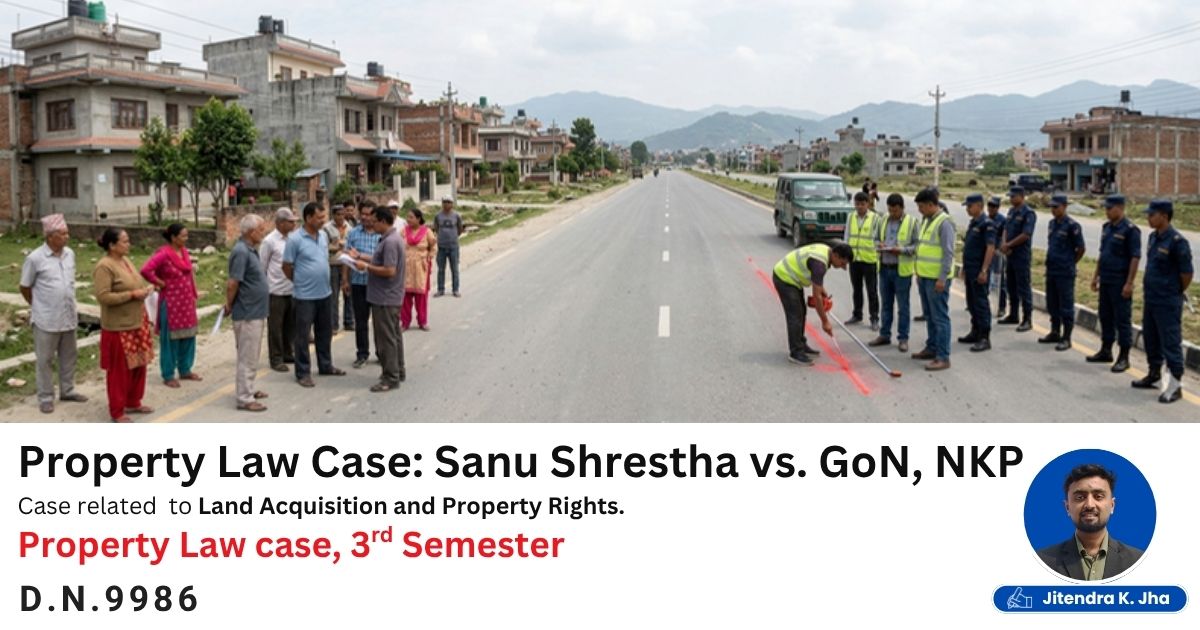
Property Law Case: Sanu Shrestha vs. GoN, NKP 2074 B.S, D.N. 9986
Case: Land Acquisition Dispute
Plaintiff: Sanu Shrestha and Others
Defendant: Government of Nepal, Office of the Prime Minister and Council of Ministers, Singhadurbar, Kathmandu, and Others (including the Department of Roads, Ministry of Physical Infrastructure and Transport, Kathmandu Valley Development Authority, District Administration Office Kathmandu, and Metropolitan Police)
Decision Number: 9986
This case is directly related to Land Acquisition and Property Rights.
Facts of the Case:
The petitioners are permanent residents who have lived for generations along both sides of the Kalanki–Nagdhunga road in Kathmandu district. Each of them holds a registered land ownership certificate in their own name and has constructed homes on their privately owned plots. When the Government of Nepal published an official notice in the Nepal Gazette on 2030/9/9 B.S., it acquired land measuring 8 meters on each side of the road centerline for the Kalankī–Thankot road widening, and duly paid compensation to the affected landowners. The petitioners thereafter built their homes leaving exactly 8 meters from the road centerline, in compliance with the government’s policy and directives at the time. On 2072/10/7 B.S., a group of persons arrived at the petitioners’ homes, surrounded by a police security cordon, and began marking structures indicating that the road would be widened to 11 meters on each side of the centerline, making the total road width 22 meters. When the petitioners inquired, they were simply told that road expansion was underway, without being given any detailed information. Upon further inquiry with the concerned authorities, the petitioners discovered that the Secretary-level decision of the Government of Nepal dated 2071/8/25 B.S. had directed that the road be widened without paying any compensation whatsoever.
The petitioners made it clear that they were not opposed to development or road expansion. Their sole grievance was that the government was required by law to first follow the prescribed procedure under the Land Acquisition Act, 2034, acquire the necessary land formally, and pay fair compensation before proceeding with the expansion. What made the matter more serious was that the Minister-level decision dated 2065/10/21 B.S. had already directed that preliminary proceedings be initiated for land acquisition and that compensation be paid before any expansion. That earlier decision was never implemented, and in its place, a Secretary-level decision was later issued in direct contradiction, ordering expansion without any compensation at all.
Legal Issues:
- Whether the Government of Nepal could forcibly extend the Kalanki–Nagdhunga road by demolishing the petitioners’ privately owned homes and land without paying compensation and without following the mandatory legal procedure prescribed under the Land Acquisition Act, 2034.
- Whether, once a road boundary has been officially demarcated, the government can undertake further road expansion without acquiring the additional land through due process.
- How the constitutionally guaranteed right to property under Article 25 of the Constitution of Nepal applies when the state seeks to take private land for a public purpose.
Court Decisions at Different Levels:
Interim Order by the Single/Division Bench:
When the writ petition was first filed, the Court issued notice to the respondents directing them to file a written reply within 15 days. On the question of interim relief, the Court heard both parties and issued an interim order on 2073/4/23 B.S. directing the respondents not to demolish or damage the petitioners’ homes and land until the final disposal of the case. The basis for this order was that if the structures were demolished before the case was decided, the petitioners would suffer irreparable harm that could not be undone. The Court applied the balance of convenience test and concluded that interim protection was necessary to preserve the status quo.
Referral to the Full Bench by the Division Bench:
The Division Bench decided to refer the matter to the Full Bench, recognizing that the legal questions raised went far beyond the facts of this individual case. The Court observed that issues concerning the right to property, the legal basis for compensation in road expansion cases, and the proper interpretation of the Land Acquisition Act recurred repeatedly in cases coming before it, and that a comprehensive and authoritative ruling from the Full Bench was necessary to settle these questions once and for all. The Division Bench also noted that a definitive pronouncement would reduce the need for citizens to approach the courts repeatedly on matters of the same nature.
Final Decision of the Full Bench (2074/6/2 B.S.):
The Full Bench, comprising Honourable Justices Kedarprasad Chalise, Harikrishna Karki, and Purushottam Bhandari, ruled in favour of the petitioners.
The Full Bench quashed the Secretary-level decision of the Government of Nepal dated 2071/8/25 B.S., along with all notices published and correspondence issued in furtherance of that decision, by issuing a writ of certiorari. The Court held that since the Minister-level decision of 2065/10/21 B.S. had already directed that preliminary land acquisition proceedings be initiated and compensation be paid, it was unlawful for a Secretary-level authority to later pass a contradictory decision ordering road expansion without any compensation. A subordinate authority cannot lawfully act contrary to a decision already taken by a higher authority within the same government. The Court further issued a writ of mandamus directing the government to determine and pay compensation for the additional 3 meters of land on each side that it sought to acquire for the road widening, in accordance with the options and procedures available under the Land Acquisition Act, 2034. At the same time, the Court acknowledged that since road expansion had already been completed along most of the route and only a limited section remained, stopping work entirely would cause disruption to public transport and harm the environment. Accordingly, the Court directed that the road expansion work and the compensation process must proceed simultaneously, without one being used as a reason to delay the other.
On the question of compensation for houses, the Court held that where there was no legal requirement to obtain a building permit at the time of construction, the year of construction and proof of payment of house tax should serve as the basis for determining compensation. The absence of a formally approved building plan should not be used to deny compensation to residents whose homes existed and were being taxed.
Principles Established:
- The state can acquire private property for public purposes, but only by following the law.
- Fixing a road boundary does not automatically transfer ownership of private land to the government.
- Compensation must be paid whenever private land is acquired by the government.
- Government authorities must act according to the Constitution and laws (Rule of Law).
- Lower authorities cannot contradict or ignore decisions made by higher authorities.
- Similar landowners must be treated equally; compensation cannot be given to some and denied to others in the same situation.
- Acquiring land through mutual agreement with landowners is the preferred method.
- Except in lawful emergencies or voluntary agreements, the full procedure of the Land Acquisition Act must be followed before taking private land.