

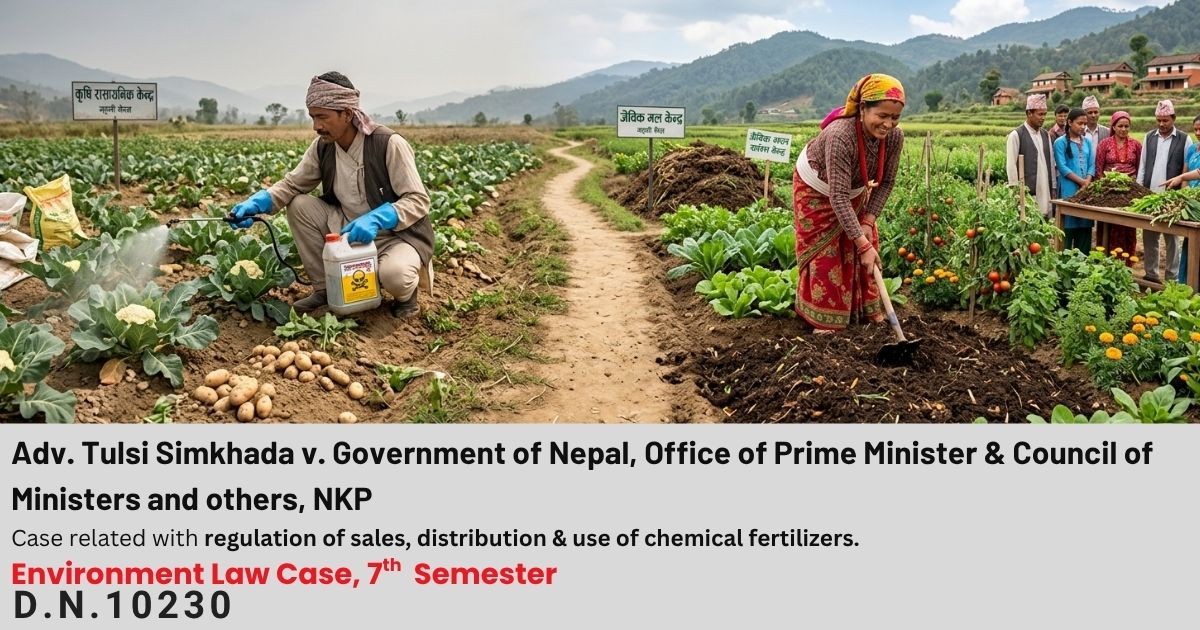
Environment Law Case: Tulsi Simkhada vs. PM and Council of Ministers & Others, NKP 2076, DN: 10230
Case: Protection of environment & human health
Plaintiff: Adv. Tulsi Simkhada
Respondent: Government of Nepal, Office of Prime Minister & Council of Ministers and others
Decision number: 10230
The case is related to regulation of sales, distribution & use of chemical fertilizers.
Facts of the case:
The petitioner filed the writ regarding the regulation of pesticides in the foods consumed by humans. The petitioner argued that the lack of organic farming and the over-reliance on chemicals directly contaminate foods, causing severe illness in human internal organs.
The petition seeks to make it mandatory for the government of Nepal to issue directives including a directive order to reduce the use of pesticides and chemical fertilizers in agricultural crops and promote the use of organic fertilizers, as chemical fertilizers and pesticides used in agricultural crops have an impact on human health, in accordance with Sections 7, 8(1)(b), 9 and 15 of the Pesticides Act, 2048 BS. The petitioner requested a writ of mandamus/prohibition under Article 133(3) of the Constitution of Nepal to direct government bodies to strictly enforce the Pesticides Act, 2048, penalize violators, establish a waiting period (withholding period) after spraying before crops can be consumed and systematically transition the country toward organic farming. Additionally, utilizing the Waste Management Act 2068, the petitioner requested an order for municipalities to strictly segregate waste and produce compost fertilizer as an alternative for farmers.
The petitioner further claims that since the provisions of the Pesticides Act, 2048 BS are not implemented, which is the obligation of government agencies, there is a pressing need to increase soil productivity by increasing awareness in organic and pesticide-free farming by the responsible agencies.
Legal issues:
- Has the Government of Nepal failed to implement its mandatory statutory duties, specifically the creation of a pesticide registration body as required under Section 7 of the Pesticides Act, 2048?
- Does the rampant, unregulated use of dangerous chemical pesticides and fertilizers violate citizens’ constitutional rights to health (Article 35), food rights (Article 36), and consumer rights (Article 44)?
- Is judicial intervention required to prevent the degradation of arable soil and its eventual transformation into desert due to chemical over-application?
Different Courts Decision:
Decision of supreme court:
The Supreme Court observed that there was no dispute that excessive use of chemical fertilizers and pesticides directly destroys soil fertility and severely harms human health by causing various diseases. Upon reviewing the law, the Court found that despite clear mandates in Sections 7, 8(1)(b), 9 and 15 of the Pesticides Act, 2048, the government had failed to establish the required pesticide registration unit to formally log, certify, and regulate the distribution and transport of these chemical agents.
Hence, the writ petition was upheld. The Supreme court issued order to:
- Build necessary infrastructure for competent, prudent and proper use of pesticides.
- Establish formal Pesticide Registration Body under Section 7.
- Implement mandatory registration and certification for any entity importing, exporting, manufacturing, using, or selling pesticides.
Principles established:
Excessive use of pesticides has a direct impact on human health and the environment, causing environmental destruction. In such a situation, the Government of Nepal should immediately form a body to regulate the purchase, sale and distribution of pesticides.
Relevance of case:
The case relates to Right to Health, Right to Food & Consumer Rights guaranteed by the constitution.