

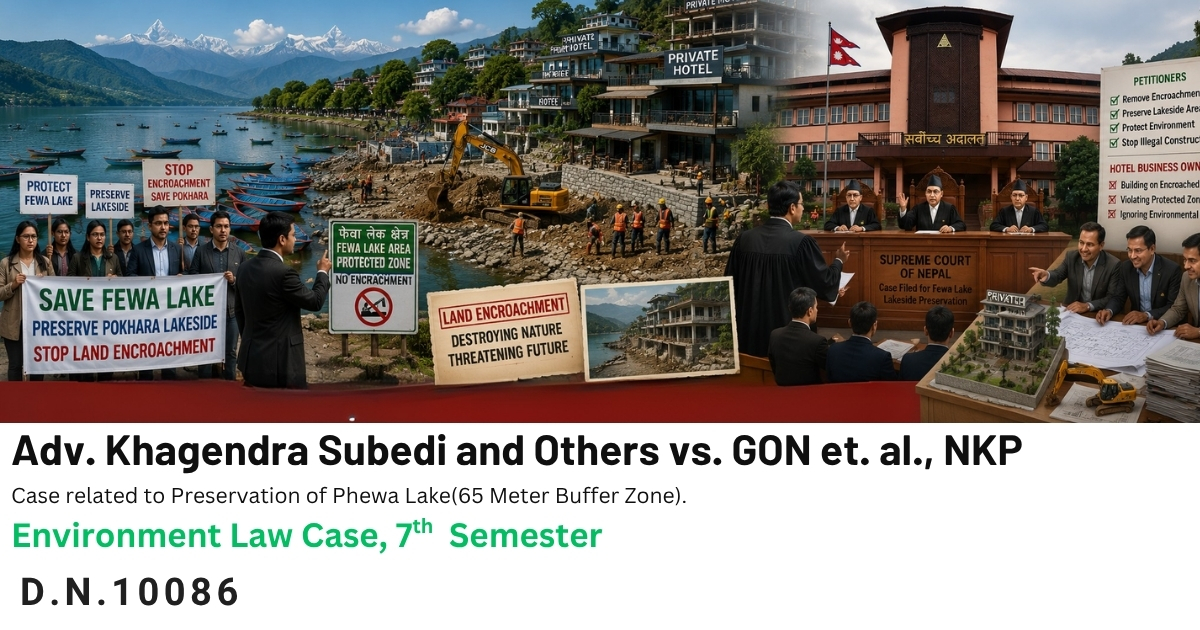
Environmental Law Case: Advocate Khagendra Subedi et al. v. Office of the Prime Minister and Council of Ministers, et al., NKP 2075, DN: 10086
Case: Protection of natural heritage
Plaintiff: Advocate Khagendra Subedi et al.
Respondent: Office of the Prime Minister and Council of Ministers, et al.
Decision Number: 10086
This case is related to the protection of public property, public trust doctrine and the conservation of natural, cultural and biological heritage.
Facts of the Case:
Phewa Lake which is situated in the Kaski District of Nepal, is a multi-dimensional natural asset possessed of immense ecological, cultural, religious and tourism significance. Over several decades, due to a combination of natural siltation and unauthorized human encroachment, the lake’s total area decreased massively, dropping drastically from an estimated 10.35 sq. km. in 1961 to roughly 4.25 sq. km. by 2001. The petitioners filed a public interest writ petition asserting that various government organs had failed to discharge their statutory duties to preserve this public asset.
The petitioners highlighted severe environmental degradation, including untreated sewage disposal, uncontrolled waste dumping, and the unlawful construction of a 2 km long, 13-foot-wide foot track/road along the lake’s edge from Barahi Chowk towards Khahare River. They further claimed that due to bureaucratic negligence, massive portions of the lake’s peripheral wetlands and silted lands had been unlawfully surveyed and registered under the private ownership of individuals, severely altering the lake’s original boundaries and threatening the survival of hundreds of migratory bird and aquatic species.
The respondents including the Ministry of Land Reform, Survey Department, and Pokhara Valley Development Committee sought to have the writ quashed. They claimed they were exercising proper due diligence, They claimed that the footpath was built in good faith to check further encroachment and promote tourism, and that any private land regularizations were tied to decades-old legal historical document variations that shouldn’t be summarily cancelled.
Legal Issues:
- Whether the systemic deterioration and private encroachment of a premier national asset like Phewa Lake violate the community’s constitutional right to a clean environment and heritage preservation?
- Whether public/government lands like lakes and wetlands, which have been transformed into landmasses via natural siltation, be validly registered under private ownership under Section 24 of the Land Revenue Act, 2034?
- Whether the Court can issue mandamus orders to compel the state to declare environmental protection zones, remove illegal structures built without environmental impact assessments?
Decision of the Courts:
Supreme Court:
The Supreme Court ruled in favor of the petitioners and issued a comprehensive Writ of Mandamus against the respondents, invalidating illegal land titles and establishing stringent preservation guidelines. The Court delivered the following specific orders to the Government of Nepal:
- To officially fix and declare the immutable boundaries and four corners of Phewa Lake within 6 months, relying principally on the detailed 2012 (2069 BS) investigation report submitted by the Bishwa Prakash Lamichhane Committee.
- Coordinated through the Ministry of Land Reform and Kaski Land Revenue Office, the state must investigate all individual land titles registered over silted lake areas within 1 year, cancel those illegal private deeds under Section 24(2) of the Land Revenue Act 2034, and restore ownership back to Phewa Lake.
- Establish a strict 65-meter “Buffer Zone” around the newly defined banks of the lake. All permanent or temporary houses, resorts, or commercial structures built unauthorisedly within this zone must be completely demolished and cleared out within 6 months.
- Formally declare the entire Phewa Lake Basin as a “Protected Watershed Area” under Section 3(1) of the Soil and Watershed Conservation Act, 2039, and further notify it as an “Environment Protection Zone” under Section 10(1) of the Environment Protection Act, 2053.
- Construct targeted physical check-dams along feed-rivers like the Harpan Khola within 3 years to filter out sand, stones, and debris before water enters the lake. Simultaneously stop all raw sewage entry and put a complete ban on chemical fertilizers and pesticides in nearby farming plots.
Principles Established:
- Development and construction activities are not inherently bad; however, development that jeopardizes nature’s very existence through the uncontrolled encroachment or exploitation of its vast resources is unsustainable. Therefore, true sustainable development lies in striking a balance between development and natural resources, minimizing the exploitation of nature, and passing on these natural gifts to future generations.
- To ensure that the natural resources currently being utilized meet present needs and remain available for future generations, it is essential to halt their uncontrolled exploitation and curb natural degradation. Furthermore, conservation efforts must be designed to preserve these resources in their natural state.
- The right to live with dignity encompasses all elements essential for a quality life, such as environmental balance, cleanliness, and an environment rich in biodiversity.
- Guided by the principle of intergenerational equity, one of the key responsibilities of the current generation is to safeguard the natural and cultural heritage, forests, environment, and biodiversity for future generations which they have inherited or currently enjoy. It is the responsibility of the present generation to pass on Phewa Lake, a naturally formed asset of immense economic, social, cultural, and environmental significance to future generations.
Relevance of Case:
This landmark judgment solidifies the stance that public water bodies cannot be lost to localized private corporate greed or political inertia, effectively using the framework of environmental rights to reverse historical illegal land grabbing and protect fragile wetland ecosystems.