

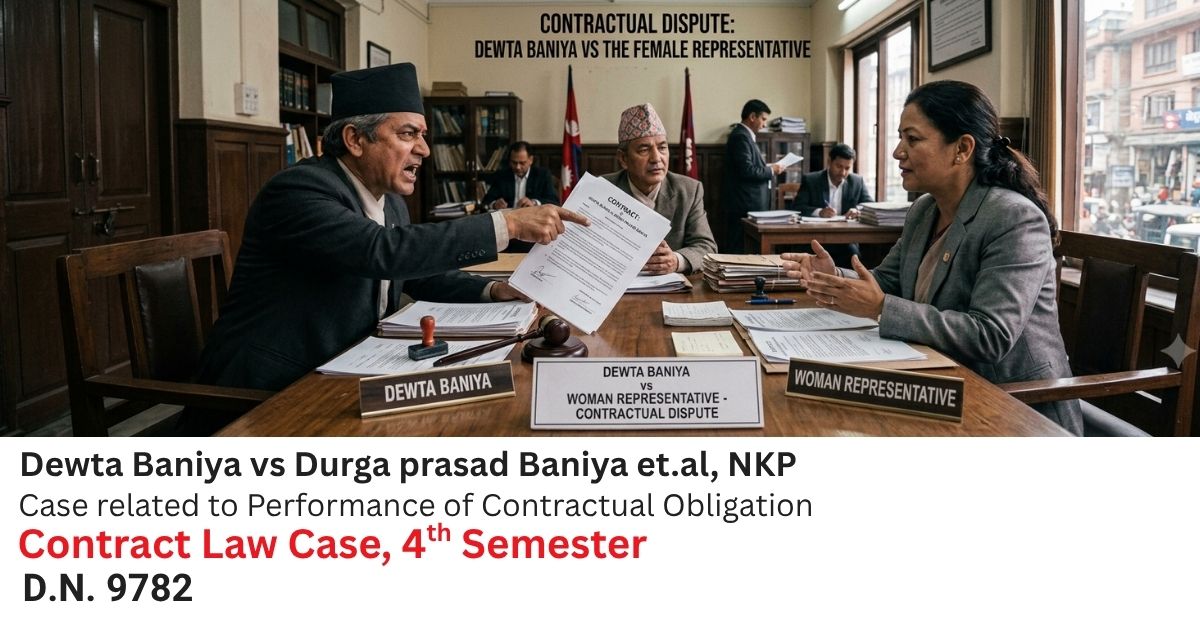
Contract Law Case: Dewta Baniya vs Durga prasad Baniya et.al, NKP, 2072, Vol. 3, DN. 9782
Case: Performance of Contractual Obligation.
Plaintiff: Dewta Baniya
Defendants: Durgaprasad Baniya, Munim Baniya (father), Gita Devi Baniya
Decision Number: 9782
This case is related to Performance of Contractual Obligation, Void Contract.
Facts of the Case:
Munim Baniya and his two sons, Deuta Baniya and Durgaprasad Baniya, had earlier settled their partition dispute through a court compromise in 2046 B.S. Under that compromise, some land was allotted to Munim Baniya, while the remaining land was divided between the two sons. Later, in 2049 B.S., the three family members executed a private agreement stating that the land remaining in Munim Baniya’s name would only be enjoyed by him during his lifetime. He would not sell or transfer it, and after his death the land would be equally divided between both sons. Despite this agreement, Munim Baniya donated the disputed land by registered gift deed to Gita Devi Baniya on 2062/04/25. Deuta Baniya claimed that this gift deed violated the earlier agreement and filed a lawsuit seeking enforcement of the contract and cancellation of the gift deed. Munim Baniya and the other defendants argued that the land was his own partition property, Gita Devi had cared for him and paid compensation to the tenant, and therefore he was free to gift the property.
Plaintiff’s Claim:
plaintiff claimed that defendant had voluntarily entered into a written agreement and it clearly prohibited Munim Baniya from selling or transferring the disputed land during his lifetime. The gift deed executed in favour of Gita Devi violated that agreement. Therefore, defendants should be compelled to perform the contractual obligation, and the gift deed should be cancelled.
Defendants’ Arguments:
Defendants argued that the disputed land was Munim Baniya’s own partition property and he had full ownership and legal authority to transfer or gift it. Gita Devi had looked after him and paid tenant compensation, and therefore he gifted the property voluntarily. A private family agreement cannot legally restrict the transfer of immovable property. Plaintiff had no enforceable legal right over the property during Munim Baniya’s lifetime.
Legal Issues:
- Can a private agreement prohibit the owner of immovable property from transferring property obtained through partition?
- Can a contractual agreement override a court-approved partition settlement?
- Is an unregistered private agreement restricting transfer of immovable property legally enforceable?
- Was the gift deed executed by Munim Baniya legally valid despite the earlier agreement?
Decisions of the Courts:
Bardiya District Court:
It held that Munim Baniya had violated the earlier agreement and cancelled the gift deed which was executed in favour of Gita Devi and allowed plaintiff’s claim.
Appellate Court:
It reversed the district court’s judgment and held that a private agreement cannot legally prohibit the transfer of immovable property. Therefore, dismissed plaintiff’s claim.
Supreme Court:
It upheld the Appellate Court’s decision and held that the father remained free to transfer property that he had received through partition also ruled that the private agreement restricting transfer of immovable property was legally ineffective and could not invalidate the registered gift deed and dismissed plaintiff’s appeal.
Established Principles:
- A clause stating that property will be equally divided among sons after the father’s death does not prevent the father from transferring the property during his lifetime.
- Property lawfully obtained through a court-approved partition remains the owner’s property, and a later private agreement cannot alter or override that legal ownership.
- A court-approved partition settlement cannot be displaced or modified by a subsequent private contract.
- Where the law requires registration or a particular legal procedure for contracts affecting immovable property, failure to comply makes the agreement unenforceable. (Contract Act, 2056, Section 88).