

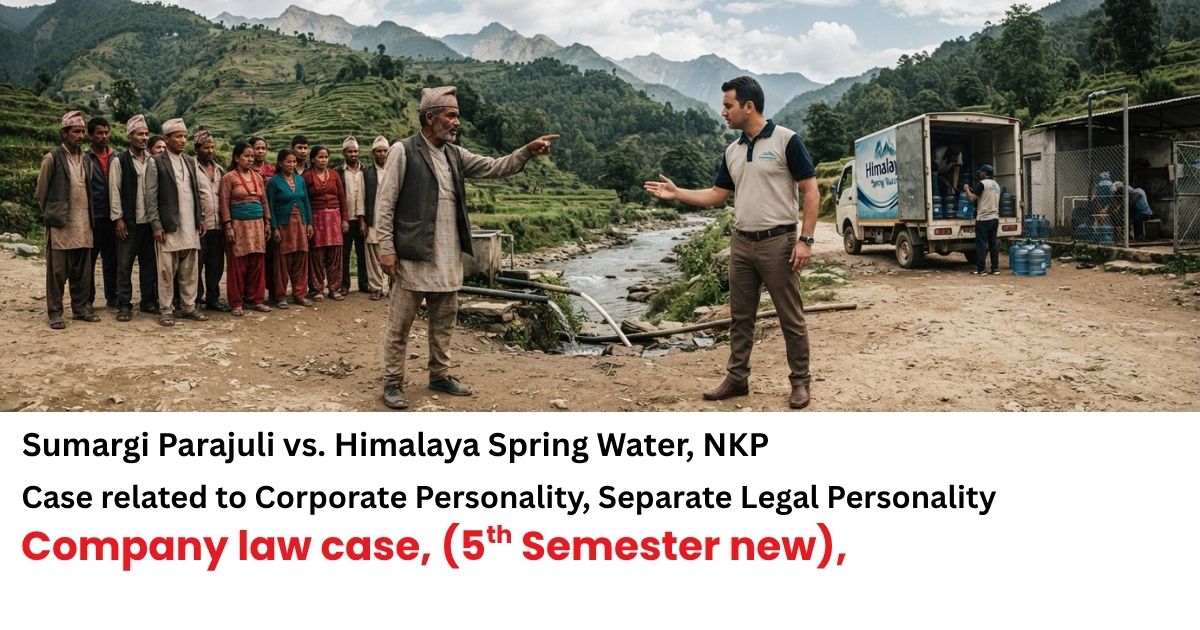
Company Law Case: Sumargi Parajuli vs. Himalaya Spring Water, NKP 2074 B.S, Vol.5, D.No. 9809, Pages 829
Case: Corporate Personality, Separate Legal Personality
Plaintiff: Ajeay Raj Sumargi Parajuli and others.
Defendant: Himalayan Spring Water Company Pvt. Ltd. and others.
Decision No: 9809
This case is related to Legal Personality, Corporate Personality, Separate Legal Personality or Separate Legal Entity, Distinct Personality, Limited Liability, Separate from its Members
Facts of the Case:
Himalayan Spring Water Company had 15 lakh shares, held by Vijay Malla (1 lakh), Birani Rana (4 lakh), Kedar Bhakta Shrestha (5 lakh), and Krishna Bahadur Shrestha (5 lakh). On 2064/08/14 BS, the shareholders entered into an agreement with Mukti Shree Pvt. Ltd. to sell the shares and the industry for Rs. 18 crore. Plaintiff paid Rs. 2.75 crore as part of the agreed amount. The agreement required defendants to fulfill several conditions within 45 days, including releasing shares under court restriction, settling outstanding electricity dues, providing an intention letter concerning shares pledged with Rastriya Banijya Bank, and renewing a 10-year agreement with the National Parks and Wildlife Conservation Department. Plaintiff claimed that these conditions were not fulfilled and sought transfer and registration of the shares, industry and company property in its name.
Plaintiff’s Claim:
Plaintiff argued that it had fulfilled its obligations under the agreement, while defendants had failed to fulfill the agreed conditions. Therefore, it sought enforcement of the agreement, payment of the remaining amount, transfer and registration of the shares in its name, and transfer of the company’s movable and immovable property and factory. Plaintiff also argued that since all shares were being transferred, the company’s property should ultimately come under its control as shareholder.
Defendant’s Arguments:
Defendants argued that the 2064/08/14 BS agreement was not made by Himalayan Spring Water Company Pvt. Ltd. The agreement concerned the personal shares of the shareholders, and the company itself was not a party to it. They contended that the company’s property could not be sold or transferred by shareholders personally and that the required approval of the company’s Board of Directors had not been obtained. Therefore, the company could not be held responsible for an agreement made personally by its shareholders.
Legal Issues:
- Whether the company could be held liable for an agreement entered into personally by its shareholders?
- Whether the shareholders’ agreement could require transfer of the company’s movable and immovable property?
- Whether plaintiff was entitled to specific performance and registration of the shares under the agreement?
- Whether the shares owned personally by the shareholders could be transferred through the agreement without making the company a party to it?
Decision of Courts:
Kathmandu District Court: The District Court dismissed plaintiff’s claim, holding that the claim for transfer and registration was not legally sustainable. It also noted that although plaintiff had stated that Rs. 2.75 crore had been paid, plaintiff had not made an appropriate claim for that amount in the plaint. Decision dated on 2065/03/15 BS.
Patan Appellate Court: The Appellate Court, Patan modified the District Court’s reasoning but ultimately held that plaintiff’s claim could not succeed. It held that privately purchased shares were the responsibility of the concerned shareholders, not the company, and that plaintiff had not followed the required process for purchasing the shares. Decision dated on 2066/11/03 BS.
Supreme Court: The Supreme Court dismissed the appeal and upheld the decision of the Appellate Court, Patan. The Court held that: A company and its shareholders are legally separate persons. The agreement did not contain an official decision or authorization of Himalayan Spring Water Company. The agreement did not bear the company’s official seal or authorized representative’s signature. Therefore, the shareholders’ personal agreement could not bind the company. Shares are the personal property of their holders and may be transferred according to law. The company’s own movable and immovable property is separate from its shares and cannot automatically become the property of shareholders merely because all shares are transferred. Since the Rs. 2.75 crore was paid to the individual shareholders for their shares rather than to the company, the company could not be made responsible for the shareholders’ agreement.
Established Principles:
The Supreme Court established that a company, its shareholders, directors and promoters are separate legal persons. A contract made personally by shareholders does not bind the company unless it is entered into by the company itself through proper authority. Further, shares are the personal property of shareholders, but the company’s assets belong to the company itself. Transfer of shares does not automatically transfer ownership of the company’s property to the shareholders.