
Gender and Inclusive Justice Case: Advocate Basundhara Thapa vs. Council of Ministers, NKP (2060), No. 5/6, P. 389, DN: 7217
Case: Certiorari
Plaintiff: Basundhara Thapa
Defendant: Council of ministers
Decision Number: 7217
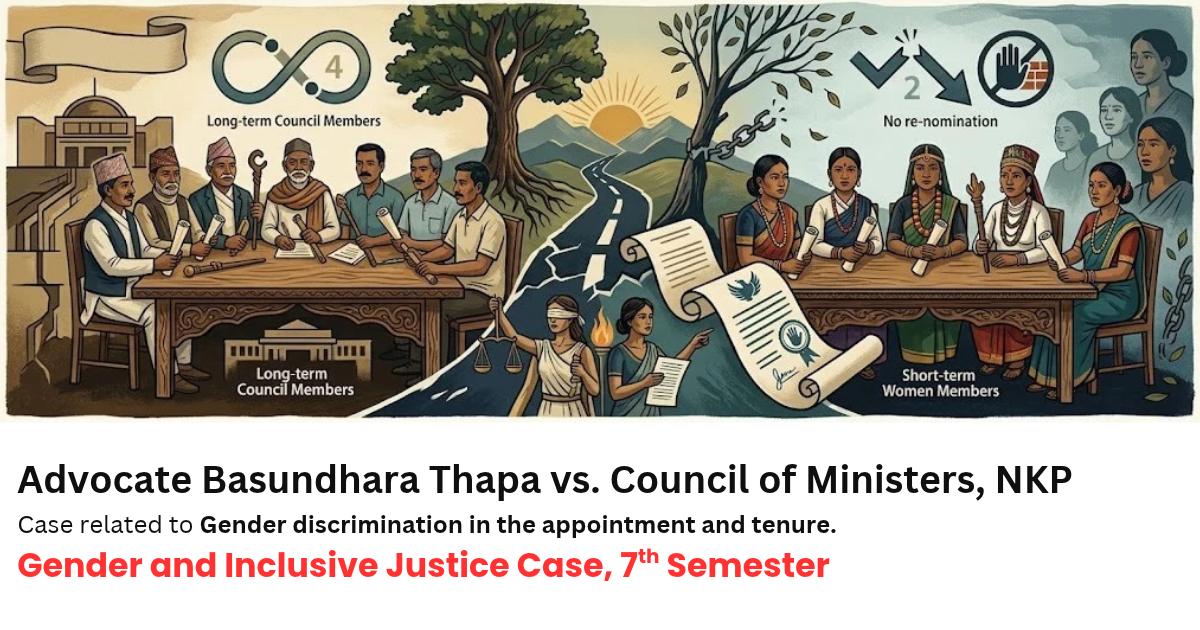
The case is relating to gender discrimination in the appointment and tenure of Indigenous women members of a government council.
Facts of the Case:
Basundhara Thapa, a lawyer and a woman from an Indigenous community, filed a constitutional petition before the Supreme Court challenging a provision of the Indigenous Nationalities Development and Promotion Act, 2002.
The Act established a Council with nominated members, including ten Indigenous women, two from each development region.
Under Section 7(3), most nominated members could serve for four years and be nominated again once. However, Indigenous women members could serve for only two years and could not be re-nominated.
Although women members had the same duties and responsibilities as other members, they were given shorter terms and fewer opportunities.
The petitioner argued that this provision was discriminatory and violated Nepal’s obligations under the Convention on the Elimination of All Forms of Discrimination Against Women (CEDAW).
Plaintiff’s Claims:
The petitioner claimed that the proviso to Section 7(3) was discriminatory and unconstitutional. She argued that members with similar duties and responsibilities should have the same term of office.
She said that giving women members only two years instead of four years, and preventing them from being nominated again, placed them in a weaker position than other nominated members.
She also argued that the provision was contrary to the equality guarantee under Article 11 of the Constitution of the Kingdom of Nepal, 1990. She relied on CEDAW and asked the Court to declare the discriminatory part of the law invalid.
Defendants’ Arguments:
The Government argued that the Act was created to improve the social, economic, and cultural position of Indigenous communities. It said that the special provision for women was intended to increase women’s participation.
The Government claimed that limiting the term to two years and preventing renomination would allow more Indigenous women to receive the opportunity to serve on the Council. It argued that the provision was a positive measure, not discrimination.
Legal Issues:
- Whether the petitioner had the right to challenge the constitutionality of the Act?
- Whether Section 7(3) of the Act discriminated against nominated Indigenous women members?
- Whether a shorter term and a ban on re-nomination violated the constitutional right to equality?
- Whether the provision could be justified as a measure to increase women’s participation?
Different Court Decisions:
Supreme Court Decision:
The Supreme Court held that the petitioner had the right to challenge the provision because she was an Indigenous woman affected by the law.
The Court accepted that special measures could be introduced to promote women’s representation. However, the disputed provision did not benefit women. Instead, it placed them at a disadvantage.
The Court noted that women members had similar duties and responsibilities as other nominated members. While others could serve for four years and be nominated again, women members were limited to two years and could not be renominated.
The Court rejected the Government’s argument that the restriction would create opportunities for more women. It held that this could not justify denying women equal opportunities.
The Court also referred to international instruments, including CEDAW, and held that Nepal must ensure equality and prevent gender discrimination.
The Court declared the proviso to Section 7(3) unconstitutional and invalid, as it imposed a shorter term and prevented the renomination of Indigenous women members.
Principles Established:
1. A person directly affected by a law has the right to challenge it if it allegedly violates constitutional rights.
2. Persons performing similar roles and responsibilities should receive equal treatment, terms and conditions.
3. A law cannot place women at a disadvantage merely because of their gender. Such unequal treatment may amount to discrimination.
4. Special measures for women must genuinely promote equality and should not create further disadvantages.
5. Any legal classification must have a reasonable constitutional basis. International instruments like CEDAW can guide the interpretation of equality rights.
6. Any law that is inconsistent with the Constitution is invalid to the extent of that inconsistency.