
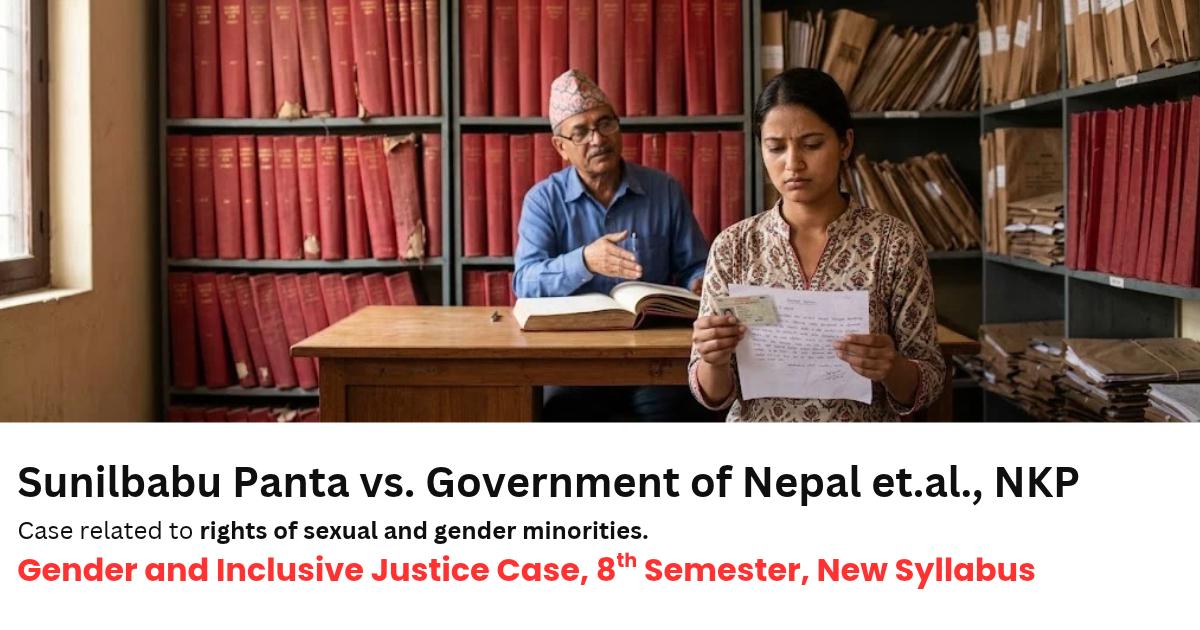
Gender and Inclusive Justice Case: Sunilbabu Panta vs. Government of Nepal et.al. , NKP 2074 B.S, No. 9, DN: 9875
Case: Mandamus
Plaintiff: Sunilbabu Panta et.al.
Defendant: Government of Nepal et.al.
Decision Number: 9875
The case is relating to gender identity, citizenship, dignity, equality, and the rights of sexual and gender minorities.
Facts of the Case:
Sunil Babu Pant and other members of the sexual and gender minority community filed a writ petition before the Supreme Court seeking recognition of their actual gender identity in citizenship certificates.
Sunil Babu Pant had received citizenship showing “male” based on his biological sex but later wanted it changed to “other”. However, the authorities did not process the request. Another petitioner also faced a similar problem.
The petitioners argued that people may understand their actual gender identity only later in life, even if they received citizenship at the age of sixteen. Although Nepal had a directive allowing sexual and gender minorities to obtain citizenship showing “other”, it did not clearly provide for correcting existing certificates.
They argued that forcing people to use documents that did not match their gender identity caused humiliation, discrimination and difficulties in education, employment and access to public services.
Plaintiff’s Claims:
The petitioners argued that everyone has the right to dignity, identity, and personal autonomy. They claimed that gender should not be determined only by biological characteristics. They asked the Court to allow existing citizenship certificates to be amended to “other” based on genuine gender identity and to correct other official documents accordingly.
Defendants’ Arguments:
The Government argued that existing laws already allowed eligible sexual and gender minorities to obtain citizenship showing “other”. It relied on the Citizenship Act, Rules, and the 2069 directive. It maintained that the petitioners should follow the existing procedure and argued that no discriminatory action had been taken.
Legal Questions:
- Whether a person has the right to have citizenship reflect their self-identified gender?
- Whether an existing citizenship certificate can be amended when its gender entry does not reflect the person’s gender identity?
- Whether refusing such amendment violates dignity, equality, privacy, and personal autonomy?
- Whether other personal documents should also be corrected after amendment of citizenship?
Different Court Decisions:
Supreme Court Decision:
Supreme Court held that every person has the right to live with dignity and have their gender identity recognised. Gender identity is based on a person’s own understanding and cannot be determined only by biological characteristics.
The Court clarified that refusing to recognise a person’s actual gender identity violates their rights to equality, dignity and identity. It may also lead to discrimination in education, employment and access to public services.
The Court also held that a person can seek correction of their gender identity in official documents even after receiving citizenship.
The Court therefore ordered the authorities to amend the petitioners’ citizenship certificates by recording “other” in the gender field.
The Court further directed the Government to make necessary arrangements to correct other official documents and prevent discrimination against sexual and gender minorities.
Principles Established:
1. Every person has the right to live with dignity and have their identity recognised, regardless of their gender identity or sexual orientation.
2. Gender identity is part of personal freedom and self determination and cannot be determined only by biological sex.
3. Sexual and gender minorities are entitled to equal constitutional protection, and the State must respect their self identified gender.
4. A person has the right to amend their citizenship certificate if the recorded gender does not reflect their actual gender identity.
5. The right to correct gender details also applies to existing citizenship certificates, including cases where a person understands their gender identity later in life.