

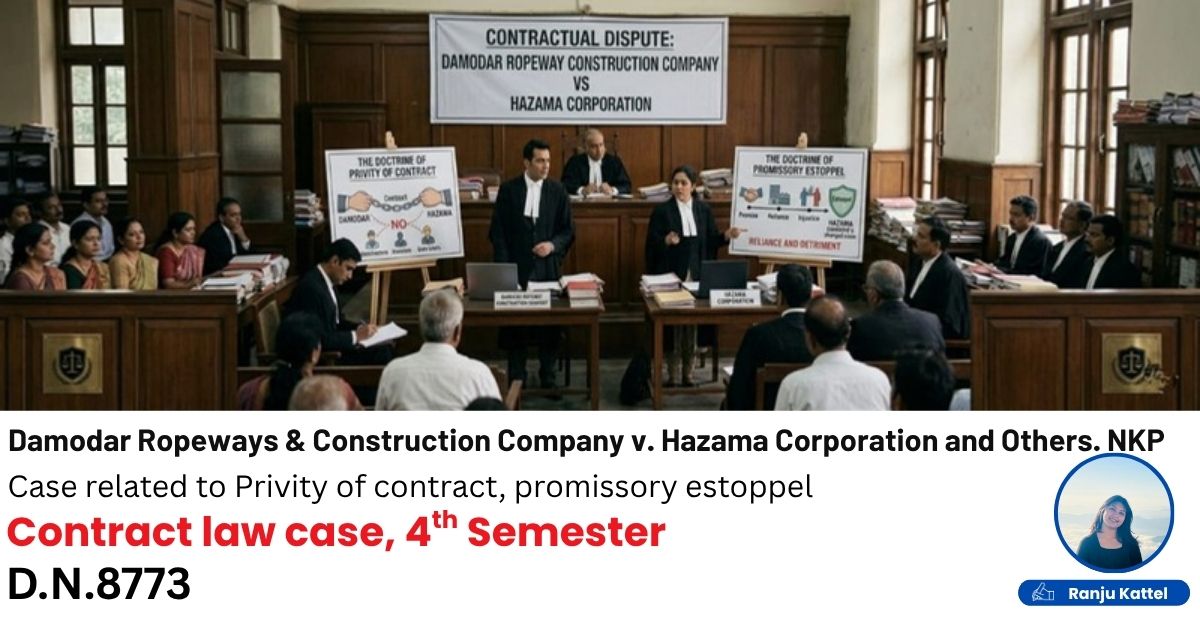
Contract law Case: Damodar Ropeways & Construction Company (DRCC) v. Hazama Corporation and Others. NKP 2069, No. 2, P. 131 D.N. 8773
Case: Privity of contract, promissory estoppel.
Plaintiff: Damodar Ropeways & Construction Company (DRCC), Kolkata, India.
Defendants:
-
- Hazama Corporation, Japan (Kathmandu Representative Office).
- Kawasaki Heavy Industries Ltd.
- Udayapur Cement Industry Ltd.
- Other related parties connected with the project- PWH, NBH
Decision No: 8773
This case is related with Jurisdiction, promissory estoppel, doctrine of privity of contract.
Facts of the Case:
In 1989, Udayapur Cement Industry contracted Kawasaki Heavy Industries to build a factory in Nepal, which was then delegated to Hazama Corporation. Hazama subcontracted the ropeway construction to PWH, which subsequently hired DRCC for material supply and construction.
While DRCC completed the work, payment for two consignments totaling Rs.362,072.71/-. When PWH failed to pay, citing a lack of funds from Hazama, DRCC contacted Hazama directly.
Between January and February 1993, Hazama sent several letters to DRCC:
- Acknowledging they had withheld payments from PWH due to the dispute.
- Promising to withhold future payments to PWH until DRCC was paid.
- Explicitly requesting that DRCC continue supplying materials and complete the work, with assurances regarding future payment via a new Letter of Credit.
Relying on these commitments, DRCC finished the project. However, Hazama failed to honor its assurances, leaving the debt unpaid. DRCC has since filed a lawsuit in the Kathmandu District Court to recover the outstanding balance.
Plaintiff’s Claim:
DRCC argued that, It fully supplied the required materials and completed the ropeway construction work and Payment for part of the supplied materials remained unpaid. Hazama expressly assured payment through its letters dated 15 January 1993 and later correspondence. DRCC relied on those assurances and continued performing the work. Therefore, Hazama became legally responsible for payment.
Relief Sought
Payment of Rs.362,072.71/- German Marks (or equivalent Nepali currency), Interest on the unpaid amount.
Defendant’s Arguments:
The defendants argued that: There was no direct contract between DRCC and Hazama. DRCC’s contract was only with PWH. Any claim should have been brought against PWH. PWH should have been made a defendant. the lawsuit was filed after the limitation period expired. Kathmandu District Court lacked jurisdiction. The letter of 15 January 1993 was merely a goodwill gesture and did not create any legal obligation. DRCC had already initiated proceedings before the Calcutta High Court and had not properly disclosed that fact.
Legal Questions
- Did Kathmandu District Court have jurisdiction to hear the case?
- Was the suit filed within the limitation period?
- Did Hazama’s letters create a legally enforceable obligation despite the absence of a direct written contract?
- Can Hazama be held liable on the basis of its assurances to DRCC?
- Does the doctrine of Promissory Estoppel apply in this case?
- Was it necessary to make PWH a party to the suit?
Decisions of the Courts
Kathmandu District Court: The court held that: DRCC was entitled to recover the unpaid amount of Rs.362,072.71/- German Marks from Hazama Corporation. However, DRCC was not entitled to interest, because the documents did not provide for interest.
Patan Appellate Court: The Appellate Court reversed the District Court judgment and dismissed the suit. It held that: There was uncertainty regarding when the cause of action arose. The claim was outside the limitation period. There were jurisdictional concerns. PWH, the direct contracting party, had not been made a defendant.
Supreme Court: Supreme Court reversed Appellate Court’s decision and restored the District Court judgment. Court held that, Kathmandu District Court had jurisdiction because Hazama had an office in Kathmandu and the transaction was connected with Nepal. The suit was not time-barred. Hazama’s letters of 15 January 1993, 18 January 1993, and 5 February 1993 created a legally enforceable obligation. Those letters amounted to an implied/deemed contract between Hazama and DRCC. DRCC relied on Hazama’s assurances and completed the work. Hazama was prevented from denying liability under the doctrine of Promissory Estoppel and Section 34(1) of the Evidence Act. It was not necessary to sue PWH for enforcement of Hazama’s own promise.
Final Order
Hazama Corporation must pay DRCC the equivalent Nepali currency of Rs.362,072.71/- German Marks calculated at the exchange rate existing when the suit was filed. The claim for interest remains rejected.
Established Legal Principles:
- Jurisdiction of court: Where a company maintains an office in Nepal and the transaction is connected with Nepal, Nepalese courts can exercise jurisdiction.
- Promissory Estoppel: When one party makes a promise or assurance and another party relies on that promise and performs work, the promisor cannot later deny responsibility.
- Any party by any means of action, or word if makes any assurance due to which the other party if performs any activity then the first party cannot step back from their obligations. Such assurances shall also be bound by law.