

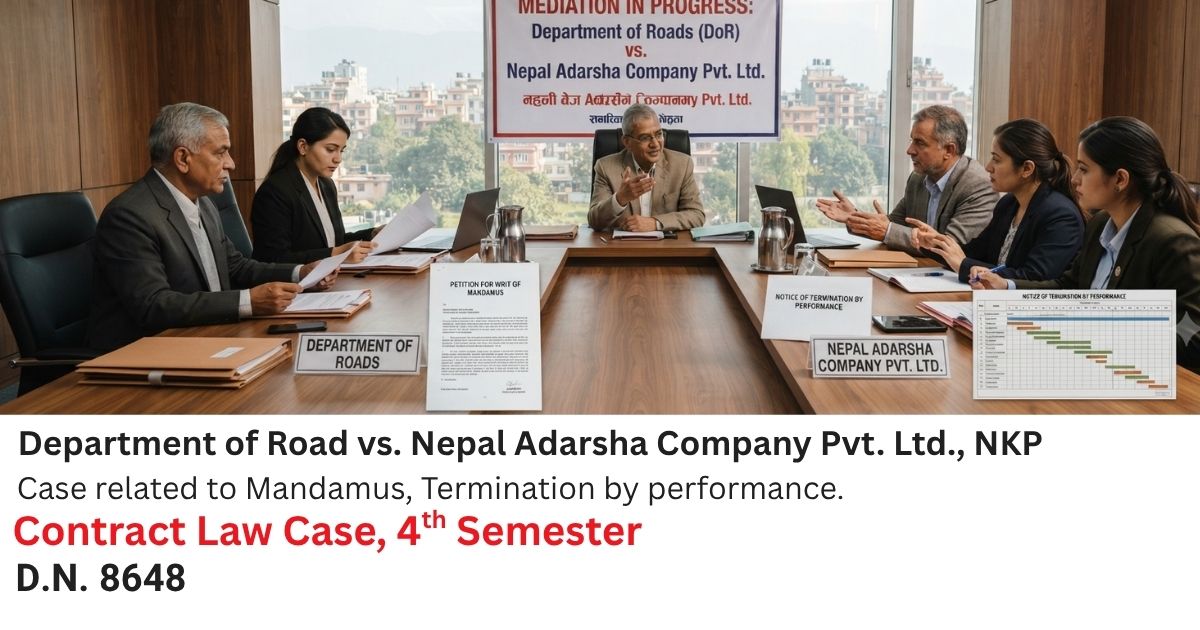
Contract Law Case: Department of Road vs. Nepal Adarsha Company Pvt. Ltd., NKP, (2068), No. 7, P. 1156, DN: 8648
Case: Mandamus, Termination by performance.
Plaintiff: Nepal Adarsha Company Pvt. Ltd.
Defendant: Department of Roads and Department of Buildings
Decision Number: 8648
This case is related to termination by Performance.
Facts of the Case:
The Department of Urban Development invited tenders on 2058/10/10 B.S. for construction works including fencing around Tundikhel, road construction, and maintenance. Nepal Adarsha Company Pvt. Ltd. was selected as the successful bidder and entered into a contract worth Rs. 3,28,70,039.69/-. Clause 6 of the contract stated that if additional funds became available, the contractor would carry out the remaining fencing work around Tundikhel at the same unit price. The company completed the contracted work, received full payment, obtained a Completion Certificate, and the Defect Liability Period also expired. Later, the government published another tender notice on 2062/09/20 B.S. for the remaining fencing work and invited only Class “B” contractors. The company argued that the remaining work should have been given to it under the earlier contract and challenged the new tender before the Appellate Court.
Plaintiff’s Claim:
Clause 6 of the contract entitled it to perform the remaining fencing work if additional funds became available. The government violated the contract by issuing a new tender and acted without following the procedure under Section 87 of the Contract Act, 2056. The new tender notice should be cancelled and plaintiff should be allowed to continue the remaining work under the original contract. The court should issue an order stopping the new tender process.
Defendant’s Arguments:
The original contract had already ended and plaintiff had completed all contractual work. Full payment had already been made. A Completion Certificate had already been issued. The Defect Liability Period had expired. The remaining work was a new project, funded under a different budget. Clause 6 only fixed the contractor’s obligation regarding price if extra work was assigned; it did not guarantee a right to obtain future work. Therefore, issuing a new tender was lawful.
Legal Issues:
- Does Clause 6 of the contract give the contractor a legal right to receive future additional work?
- Can a contractor seek an order under Section 87 of the Contract Act after the contract has already been fully completed?
- Does a contractual relationship continue after completion of work, payment, issuance of the completion certificate, and expiry of the Defect Liability Period?
- Can a court interfere with a new government tender after the original contract has ended?
Decisions of the Courts:
Patan Appellate Court:
Held that plaintiff was one of the qualified contractors. Ordered the government to include plaintiff in the tender process for the remaining work.
Supreme Court:
Supreme Court overturned the Appellate Court’s decision. It held that the contract had already been fully performed, payment had been completed, completion certificate had been issued and defect liability Period had expired. Therefore, no contractual relationship remained. Clause 6 created only an obligation regarding pricing if extra work was assigned, not a right to receive additional work. Section 87 of the Contract Act could not be invoked after the contract had ended. The government was legally entitled to issue a fresh tender for the remaining work.
Principles Established:
- Termination by Performance: Once contractual work is completed and a Completion Certificate is issued, the contract ends by performance. After termination of the contract, there is no continuing contractual relationship.