

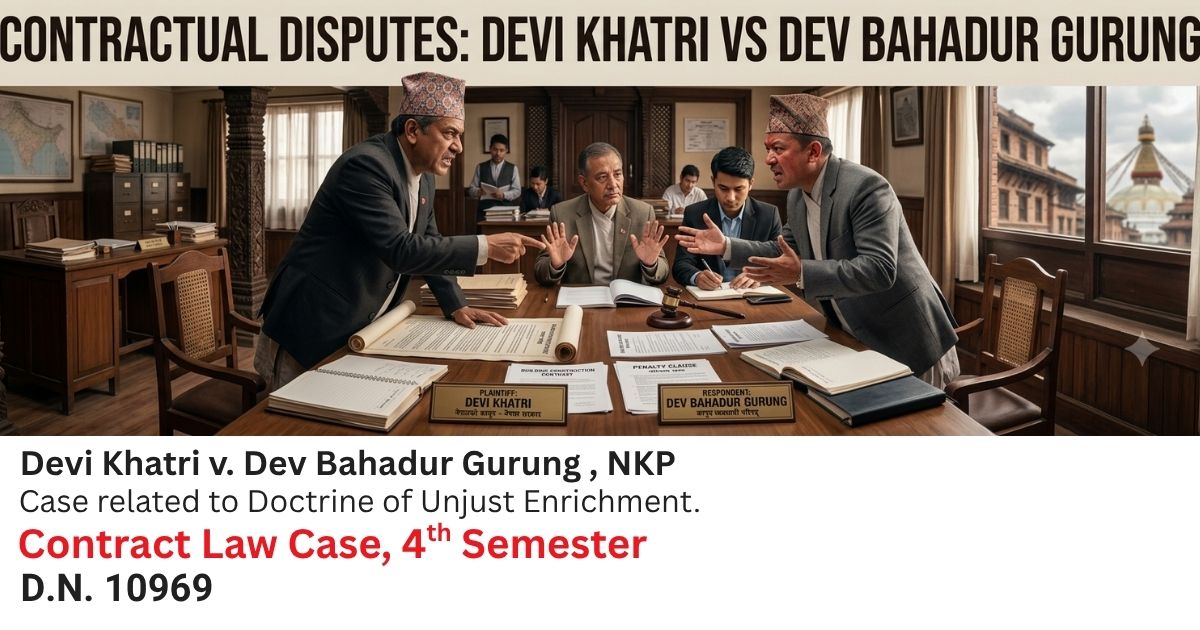
Contract Law Case: Devi Khatri v. Dev Bahadur Gurung, NKP, 2069, Vol. 11M, D.No. 10969.
Case: Doctrine of Unjust Enrichment.
Plaintiff: Dev Bahadur Gurung
Defendant: Devi Khatri (wife of Tek Bahadur Khatri)
Decision Number: 10969.
This Case is related with Recovery of advance payment, Doctrine of Unjust Enrichment.
Facts of the Case:
Devi Khatri offered to sell a piece of land registered in the name of her husband, Tek Bahadur Khatri. Dev Bahadur Gurung contacted Tek Bahadur, who was working abroad. Tek Bahadur reportedly told him that his wife would handle the transaction and that he would transfer the land after returning to Nepal. The parties agreed to sell the land for Rs. 32,00,000/- and on 26 Chaitra 2072 BS, Dev Bahadur paid Rs. 22,00,000/- as advance, They signed a written agreement under which the land would be transferred within 3 months. When the agreed time arrived, Devi Khatri neither transferred the land nor returned the advance money. Dev Bahadur later learned that the same land had been promised to another person after receiving another advance payment. After demanding either the land or the refund, Devi Khatri allegedly refused both. Therefore, Dev Bahadur filed a suit seeking recovery of the advance amount along with compensation.
Plaintiff’s Claim:
Plaintiff claimed that Devi Khatri agreed to sell the land and accepted Rs. 22,00,000/- as advance and she failed to transfer the land within the agreed period. She also refused to return the advance money. Therefore, she should be ordered to return Rs. 22,00,000/- and pay reasonable compensation, and reimburse court costs.
Defendant’s Arguments:
Devi Khatri: She denied receiving any money from plaintiff also claimed that plaintiff misled her into signing the document by promising to help her obtain her legal share from her husband. She argued that she signed the paper without knowing its contents. Since the land belonged to her husband, she had no legal authority to sell it. As the agreement was legally invalid and later cancelled, she argued that she should not be required to refund any money.
Tek Bahadur Khatri: He denied authorizing his wife to sell his land. He argued that his wife’s agreement had no legal effect because the land was registered solely in his name. Therefore, he claimed that he should not be held liable.
Legal issues:
- Can a person who received an advance payment avoid repayment simply because the contract became void?
- Does the principle of unjust enrichment require repayment of benefits received under a cancelled contract?
- Is compensation payable together with the refund under Section 84 of the Contract Act, 2056?
Decisions of the Courts:
Kaski District Court:
It held that Devi Khatri had no legal authority to sell land which is registered in her husband’s name, so the agreement was legally invalid. However, under Section 84 of the Contract Act, she had to return the Rs. 22,00,000/- advance payment. It ordered payment of the advance amount together with 5% compensation from the date of the agreement until repayment. Initially held both defendants liable.
High Court Pokhara:
Agreed that Tek Bahadur Khatri was not a party to the contract and reversed district court’s decision only to the extent of removing Tek Bahadur’s liability and confirmed that Devi Khatri alone must refund the advance amount with 5% compensation.
Supreme Court of Nepal:
Held that Devi Khatri failed to prove that she never received the money or that she had been fraudulently induced to sign the agreement. Applied the doctrine of unjust enrichment, holding that one party cannot keep money received under a cancelled contract while avoiding contractual obligations and upheld the High Court’s judgment.
Established Principles:
- A cancelled contract does not allow a party to keep money received under that contract: If a contract becomes void, invalid, or is cancelled, any money, goods, or benefits received under it must be returned.
- The doctrine of unjust enrichment applies: A person cannot retain a financial benefit without performing the promised obligation, as this would unfairly enrich one party at the expense of the other.
- When a contract is cancelled or becomes void, any money or benefit received under that contract must be returned; otherwise, retaining it would amount to unjust enrichment, which is prohibited by law.