

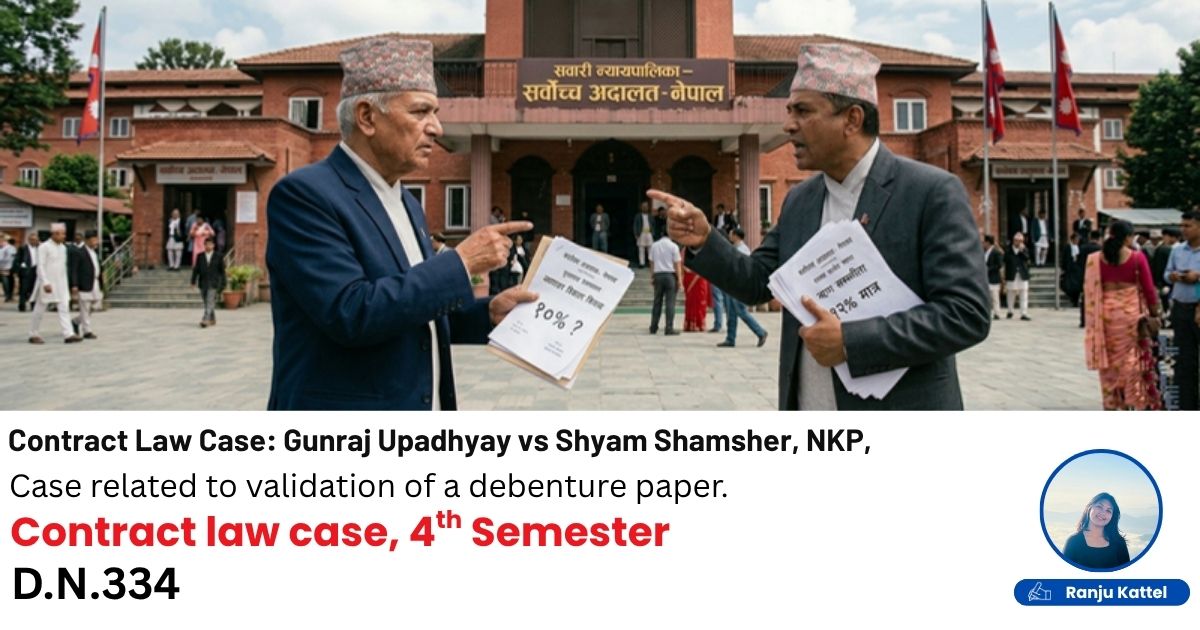
Contract Law Case: Gunraj Upadhyay vs Shyam Shamsher, NKP, 2023, No.06, P.145, D.N. 334
Case: Transaction
Plaintiff: Shyam Shamsher J.B. Rana
Defendant: Gunraj Upadhyaya
Decision No: 334
This case is related with validation of a debenture paper.
Facts of the Case:
On 2009/01/20 B.S defendant executed a Tamasuk acknowledging a loan of Nepalese Rupees 30,000/- from plaintiff, Shyam Shamsher J.B. Rana. The written agreement stated that loan was taken for “trade and business purposes” at annual interest rate of 15%, with a maturity period of 6 months. However, the document lacked the thumbprints of the debtor but contained his signature and handwriting. The loan remained unpaid for 10 years, which led plaintiff to file a formal lawsuit on 2019/01/14 B.S.
Plaintiff’s Claim:
Plaintiff argued that defendant borrowed Rs. 30,000/- in cash and failed to repay it even after 10 years. Although the contract explicitly stated an interest rate of 15%, the plaintiff claimed his total principle amount with interest amount.
Defendant’s argument:
Defendant initially made a denial stating he did not recall taking a loan or executing such a document. He claimed Tamasuk was a dummy document created solely as temporary security for a partnership. The plan was to open a cinema hall in the Kathmandu Valley where plaintiff would hold a 4-anna share and defendant a 12-anna share. The project was halted due to a legal dispute with General Agni Shamsher. Defendant also argued that Tamasuk was legally invalid and un-enforceable because it lacked his thumbprints. Defendant asserted that since the agreed interest rate (15%) exceeded the statutory legal limit of 10% which violated Section 5 of the Sahu Asami law, meaning no interest should be paid at all.
Legal Issues:
- Does a Tamasuk become completely invalid if it lacks the thumbprints of the debtor?
- If a loan deed specifies an interest rate higher than the maximum statutory limit permitted by law, does the creditor lose the right to collect any interest at all, or is the court required to adjust it to the legally permitted rate?
Decisions of the Courts:
Kathmandu Special Court: Held that defendant’s denial was baseless therefore, plaintiff was entitled to recover the principal amount of Rs. 30,000/-, Disallowed the interest fully. It ruled that because the contract explicitly stipulated a 15% interest rate which violated Section 5 of the Sahu Asami law incurring of interest at 10%, court could not recognize an illegal interest.
Division Bench of the Supreme Court: Upheld the recovery of the Rs. 30,000/- principal. It held that an excessive interest clause does not wipe out interest completely. The court adjusted the interest rate down to the statutory maximum of 10% per annum. Over 10 years, this equaled the principal amount (Rs. 30,000/-). Thus, it ordered the defendant to pay a total of Rs. 60,000.
Full Bench of Supreme Court: Full Bench upheld the Division Bench’s decision in its entirety, ruling it completely fair and legally sound. It ordered that plaintiff must recover the full Rs. 60,000/- (Rs. 30,000/- principal + Rs. 30,000/- interest) from the defendant. Additionally, it directed defendant to pay plaintiff’s legal expenses totaling Rs. 35/- (Rs. 20 for the Advocate and Rs. 15/- for the Pleader) if claimed within 5 years.
Established Principles:
- Procedural Flaws do not Nullify a Written Instrument: If a debtor executes a document in their own handwriting and signs it, the absence of thumbprints on the top or bottom edges does not invalidate the entire transaction.
- Adjustment of Illegal Interest Rates: When a loan agreement contains an interest rate higher than the statutory limit, the entire claim to interest is not destroyed.