

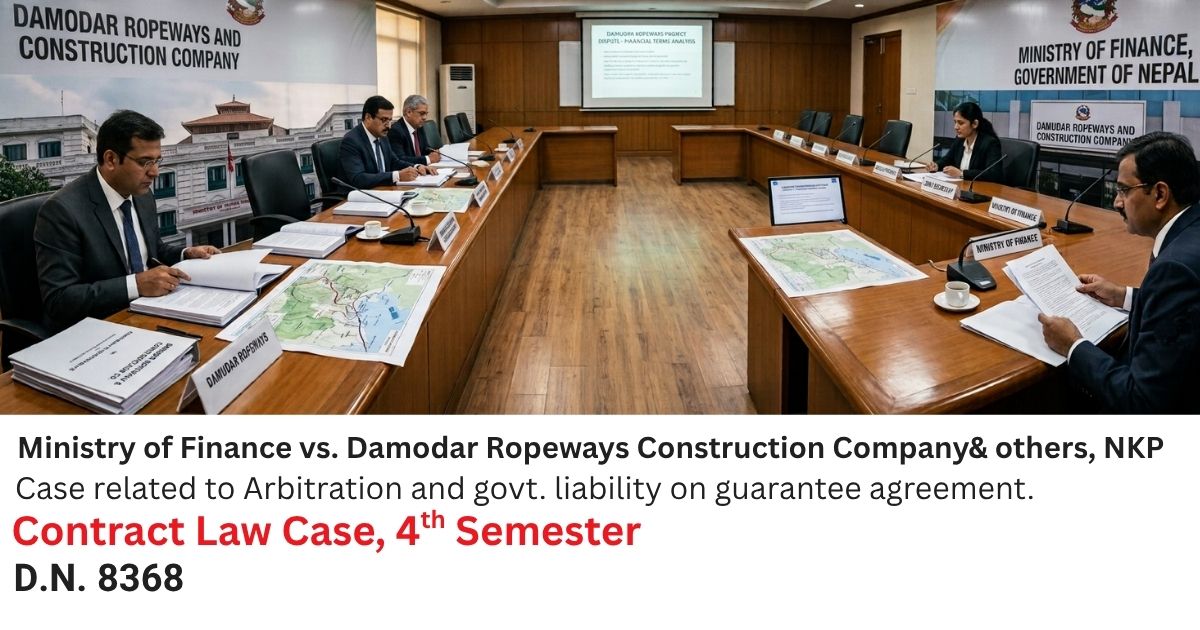
Contract Law Case: Ministry of Finance v. Damodar Ropeways & Construction Com., NKP 2067, No. 5, P. 742, DN. 8368
Case: Arbitration.
Plaintiff: Government of Nepal, Ministry of Finance
Defendant: Damodar Ropeways & Construction Company, Nepal Orind Magnesite Pvt. Ltd.
Decision No: 8368
This case is related with Arbitration and government liability on guarantee agreement.
Facts of the Case:
On 14 January 1983, Nepal Orind Magnesite Pvt. Ltd. entered into a turnkey contract with Damodar Ropeways & Construction Company to construct a 10.5 km monocable ropeway from Kharidhunga to Lamosangu. Under the turnkey contract, the contractor had to complete the entire project, including survey, design, supply, transportation, civil construction, installation, commissioning, testing, insurance, and performance guarantee. The total contract price was US$4,018,577.60, and the project had to be completed within 25 months. On 16 September 1983, the Government of Nepal (Ministry of Finance) signed a Guarantee Agreement guaranteeing payment up to US$2,583,646.60, but only according to the terms of the construction contract. Disputes later arose regarding whether the contractor had completed the project according to the contract. The dispute was referred to arbitration, and the arbitral tribunal ordered the Government to make payment under the guarantee. The Ministry of Finance challenged the arbitral award, arguing that the contractor had not completed the project and that the arbitration decision violated both the contract and the Arbitration Act.
Plaintiff’s Claim:
The ropeway project was never completed according to the turnkey contract. Government liability under the guarantee would arise only after proper completion of the work. The arbitral tribunal wrongly treated the Government’s guarantee as an absolute and unconditional guarantee. The arbitration was started without first attempting amicable settlement, which was a mandatory contractual requirement. The contractor’s claim was filed beyond the legal time limit. The claim before the arbitrators was filed by an unauthorized person. The arbitrators ignored important contractual conditions and legal procedures. Therefore, the arbitral award should be cancelled.
Defendant’s Arguments:
The ropeway work had been substantially completed. Government guarantee was a separate agreement, so payment could not be refused merely because of disputes regarding construction. The project could not be fully tested because the employer failed to provide stable electricity, sufficient materials, and necessary support. Minutes of meetings between the parties showed that the work had been accepted. Courts should interfere with an arbitral award only on the limited grounds provided by the Arbitration Act. The Government had voluntarily participated in arbitration and could not reject the award simply because it lost.
Legal Issues:
- Can an arbitral award be set aside when it is contrary to the terms of the contract?
- Did the arbitral tribunal exceed its jurisdiction by ignoring contractual conditions?
- What is the proper scope of judicial review over arbitral awards?
Decision of the Courts:
Arbitral Tribunal:
The arbitral tribunal held that Damodar Ropeways & Construction Company was entitled to payment under the construction contract. It concluded that the Government of Nepal (Ministry of Finance), as guarantor, was liable to pay the guaranteed amount. The tribunal treated the Government’s guarantee as enforceable despite disputes regarding completion of the project. Accordingly, the arbitral tribunal allowed the contractor’s claim and issued an award in its favour.
Patan Appellate Court:
The Ministry of Finance challenged the arbitral award before the Patan Appellate Court under the Arbitration Act, 2038. Appellate Court refused to set aside the arbitral award. It held that there was no sufficient legal ground under the Arbitration Act to interfere with the arbitrators’ findings. Therefore, appellate Court upheld the arbitral award in favour of Damodar Ropeways & Construction Company.
Supreme Court:
Supreme Court reversed the decisions of both Arbitral Tribunal and Patan Appellate Court. It held that the arbitral tribunal misinterpreted the turnkey construction contract. The ropeway project had not been completed in accordance with the contract. The Government’s guarantee was not an unconditional guarantee; its liability depended upon fulfillment of the terms of the principal contract. The arbitrators ignored important contractual provisions and therefore acted contrary to the contract. Since the arbitral award fell within the grounds mentioned in Section 21(2) of the Arbitration Act, 2038, it could legally be set aside. Consequently, the Supreme Court quashed both; the arbitral award and Patan Appellate Court’s judgment. The Court further held that, if the parties wished, the dispute could be referred to a newly constituted arbitral tribunal in accordance with the contract.
Established Principles:
- Judicial and Arbitral Decisions Must Be Based on Evidence: Courts and arbitrators should not reach conclusions merely on assumptions. Findings must be supported by facts and contractual documents.
- 2.Turnkey Project Requires Complete Delivery: A turnkey project means the contractor must deliver a fully operational project ready for use, including design, construction, testing, commissioning, and handover.