

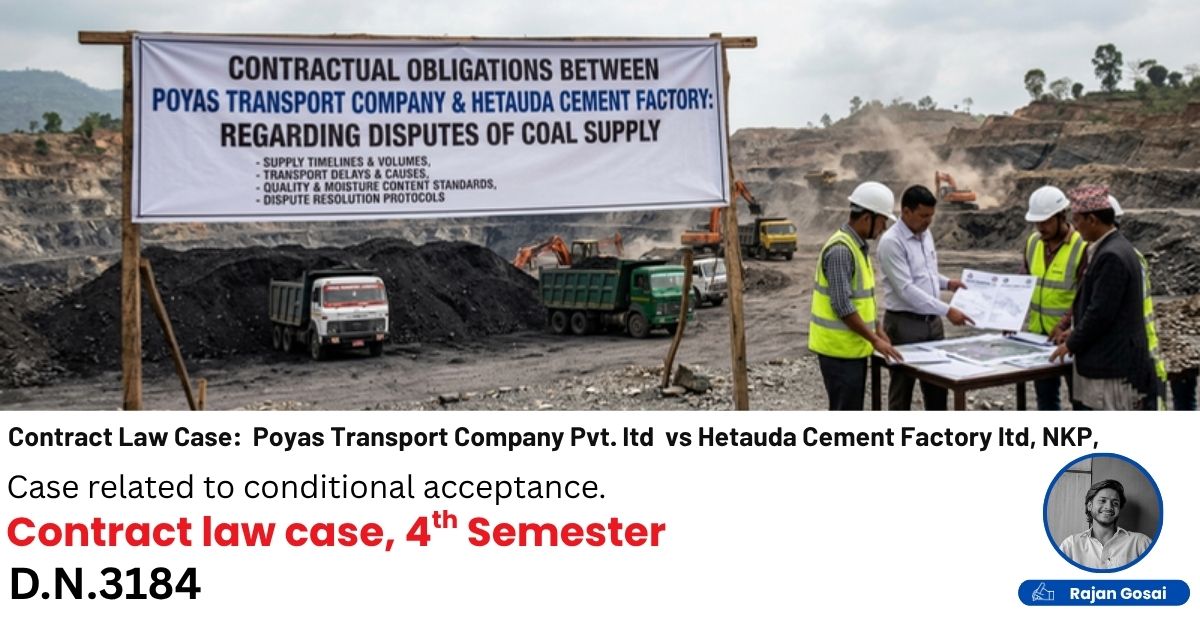
Contract law case, Poyas Transport Company Pvt. ltd vs Hetauda Cement Factory ltd, NKP, 2044, No. 08, P. 857, D.N. 3184
Case: Certiorari, mandamus (writ)
Plaintiff: Poyas Transport Company Pvt. Ltd.
Defendant: Hetauda Cement Industries Ltd.
Decision No: 3184
This case is related with conditional acceptance .
Facts of the Case:
Hetauda Cement Industry Ltd. invited tenders for transporting coal from India to its Nepal factory. Poyas Transport Company Pvt. Ltd. submitted a Rs. 2,24,50,000/- bid, depositing a Rs. 6,50,000/- bank guarantee as earnest money. During subsequent negotiations, a major dispute arose regarding coal quality; Poyas stated it would only transport whatever quality Coal India Limited supplied and refused liability for any specification mismatches. On July 13, 1985, Hetauda Cement accepted the tender but rejected Poyas’s quality condition, ordering them to sign the agreement by July 15 with a Rs. 22,45,000/- performance bond or face earnest money forfeiture.
Poyas received this letter on July 14, leaving them minimal time to arrange the funds. Simultaneously, Hetauda Cement instructed the bank to block the bank guarantee, which Poyas argued made it impossible to extend the guarantee or complete the contract. On July 19, the applicants maintained that the quality conditions must be an integral part of the contract. However, because Poyas failed to sign within the deadline, Hetauda Cement confiscated Rs. 6,50,000/- guarantee and formally notified Poyas of the forfeiture via a letter dated 2042/04/16. In response, the transport company filed a writ petition before the Supreme Court.
Plaintiff’s Claim:
The petitioner, Poyas Transport Company Pvt. Ltd. argued that the tender had not been legally accepted because the industry rejected the company’s important condition regarding coal quality. The company stated that the issue about coal quality was not a new condition but only a clarification requested by the industry itself during negotiation meetings.The petitioner further argued that it was unreasonable and impractical to ask the company to arrange a performance bond of Rs. 22,45,000/- within one day. The company also claimed that the industry itself created obstacles to the agreement by instructing the bank to block the guarantee. According to petitioner, since no proper agreement had been completed between the parties, the confiscation of the bank guarantee was illegal, unfair, and against the principles of justice. Therefore, petitioner requested the Supreme Court to cancel the decision and order the return of the Rs. 6,50,000/- bank guarantee.
Defendant’s arguments:
Hetauda Cement Industry Ltd. argued that petitioner’s tender had been properly accepted according to the tender conditions. The industry claimed that petitioner introduced new conditions regarding coal quality only after submitting the tender, and those conditions could not be accepted. The respondent also argued that petitioner already knew the rules of the tender process, including the requirement to provide a performance bond after acceptance of the tender. According to the industry, the petitioner was given enough time because the bank guarantee could have been extended until July 25, and the agreement could have been signed by July 22. Since, petitioner failed to come for signing the contract within the required time, the industry argued that it had the legal right to confiscate the earnest money. Therefore, respondent requested the Court to dismiss the writ petition.
Legal Issues:
- Whether the respondent had legally and fairly confiscated the petitioner’s bank guarantee?
- Whether the petitioner’s statements regarding coal quality were new conditions or only clarifications of unclear tender terms?
- Whether the respondent acted fairly by giving very little time for signing the agreement and arranging the performance bond?
Decisions of the Courts:
Supreme Court: Found that there was still disagreement between the parties regarding the quality of coal to be transported. Court held that Hetauda Cement Industry had only two proper choices: either reject the tender completely or accept the petitioner’s condition regarding coal quality. Instead, the industry accepted the tender while rejecting an important condition, which the Court considered improper.
The Court also held that the respondent failed to provide sufficient time for the petitioner to arrange the performance bond and sign the agreement. Moreover, by asking the bank to block the guarantee, the respondent itself created a situation that made it difficult for the petitioner to proceed with the contract.
Therefore, Court decided that the confiscation of the bank guarantee was unfair, unreasonable, and against the principles of justice and good conscience. The Court cancelled the decision of Hetauda Cement Industry and ordered the return of the Rs. 6,50,000/- bank guarantee to the petitioner.
Established Principles:
- Mutual Agreement is Necessary for Contract Formation: If important terms of a contract remain disputed between parties, a valid and enforceable agreement cannot be considered complete.
- Fair Opportunity Must Be Given Before Enforcing Contractual Obligations: A party must be given sufficient and practical time to fulfill contractual requirements such as arranging performance bonds.
- One Party Cannot Create Obstacles and Then Blame the Other Party: If a party itself creates circumstances that make contract performance impossible, it cannot later penalize the other party for non-performance.