

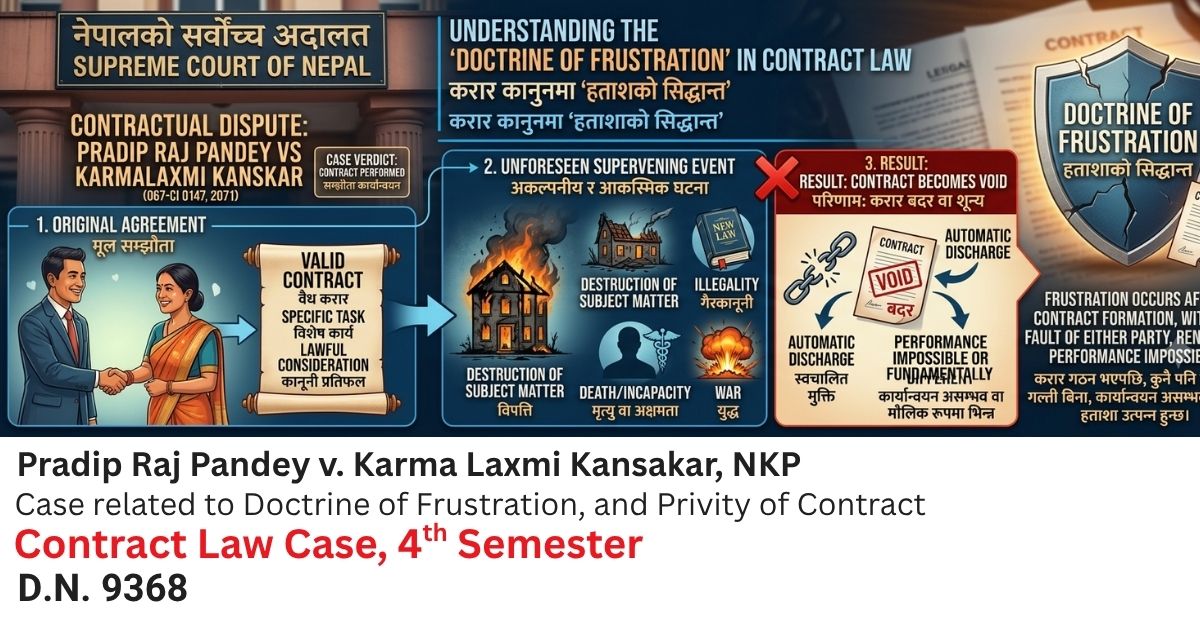
Contract Law Case: Pradip Raj Pandey v. Karma Laxmi Kanshakar, NKP 2071, Vol.10, D.N: 9368
Case: Doctrine of Frustration, and Privity of Contract
Plaintiff: Karma Laxmi Kansakar
Defendant: Pradip Raj Pandey
Decision Number: 9368
This case is related with Specific Performance of a Contract, Limitation Period, Doctrine of Frustration, and Privity of Contract.
Facts of the Case:
The disputed land originally belonged jointly to Pradip Raj Pandey and his two brothers. On 2049/06/09 B.S., Pradip Raj Pandey entered into a written agreement with Karma Laxmi Kansakar to sell 1 Ropani 8 Aana of the land for Rs. 45,00,000/– At the time of the agreement plaintiff paid Rs. 26,00,000/- as earnest money. The remaining Rs. 19,00,000/-was to be paid when the sale deed was executed. Since the land had not yet been divided among the brothers, the agreement stated that the sale deed would be executed within 35 days after Pradip Raj Pandey received ownership and the land ownership certificate in his own name. Later, in a partition case between the brothers, court awarded Pradip Raj Pandey his one-third share. On 2051/04/10 B.S, the land was partitioned, registered in his name, and he received the land ownership certificate. Although plaintiff repeatedly requested him to complete the sale and was ready to pay the remaining amount, defendant refused to execute the sale deed. Plaintiff therefore deposited the remaining purchase price in court and filed a suit seeking specific performance of the contract.
Plaintiff’s Claim:
Plaintiff argued that the valid written contract was made on 2049/06/09 BS, She had already paid Rs. 26,00,000/- as earnest money. Defendant obtained ownership of the agreed land after partition. Despite repeated requests, defendant refused to execute the sale deed. She deposited the remaining Rs. 19,00,000/- in court. Therefore, court should order defendant to transfer the agreed 1 Ropani 8 Aana land according to the contract.
Defendant’s Arguments:
Defendant argued that, no valid contract existed and the alleged agreement was forged. At the time of the agreement, the land was jointly owned and his ownership had not yet been determined, so the contract was uncertain and unenforceable. The land described in the contract was not specifically identifiable. The lawsuit was filed beyond the legal limitation period. Since the land had later been transferred and circumstances had changed, the contract had become impossible to perform under the Doctrine of Frustration. Plaintiff was entitled, if anything, only to compensation and not specific performance. The principle of Privity of Contract prevented enforcement because ownership had already been transferred to another person.
Legal issues:
- Does the principle of Privity of Contract apply in this case?
- Does the Doctrine of Frustration discharge the defendant from performing the contract?
- Is the plaintiff entitled to specific performance of the contract?
Decisions of Courts:
Kathmandu District Court:
District court held that the agreement dated on 2049/06/09 BS, was genuine and legally valid It also found that plaintiff had fulfilled her contractual obligations by depositing the remaining purchase price and ordered defendant to execute the sale deed and transfer the agreed land to plaintiff.
Patan Appellate Court:
Appellate Court agreed that the contract was valid, It held that the lawsuit was filed within the statutory limitation period and ruled that defendant could not rely on the Doctrine of Frustration because the alleged impossibility resulted from his own actions It further confirmed that defendant remained bound to perform the contract.
Supreme Court of Nepal:
Supreme Court held that the agreement dated on 2049/06/09 BS, was a valid contingent contract and stated that plaintiff had filed the suit within the legal limitation period because the cause of action arose after defendant failed to execute the sale deed within the agreed 35 days. Defendant’s later transfer of the land to his wife did not amount to frustration and could not defeat plaintiff’s contractual rights. The Doctrine of Frustration was not applicable, since performance was not prevented by any event beyond the parties’ control. Therefore it ordered that the appropriate remedy was specific performance, requiring defendant to transfer the agreed land.
Established Principles:
- A party cannot escape contractual liability by transferring the property after breaching the contract: Such a voluntary transfer does not defeat the rights of the other contracting party.
- The Doctrine of Frustration applies only when performance becomes impossible due to events beyond the parties’ control, such as: destruction of the subject matter, change in law making performance illegal, death or incapacity where personal performance is essential, or failure of an essential contemplated event.
- Frustration does not apply where impossibility is self-created: A party cannot deliberately make performance impossible and then rely on frustration.
- Where the contract can still be performed, the proper remedy is specific performance rather than damages.