

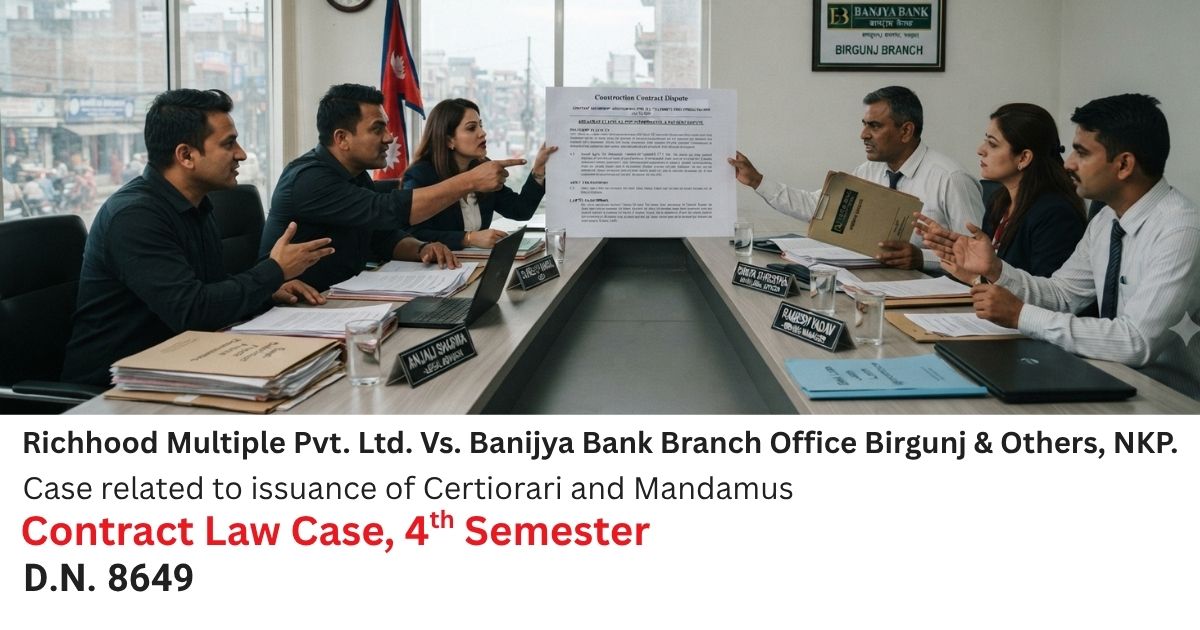
Contract Law Case: Richhood Multiple Pvt. Ltd. Vs. Banijya Bank Branch Office Birgunj & Others, NKP 2068, No. 7, P. 1162, D.N. 8649
Case: Certiorari and Mandamus
Plaintiff: Richhood Multiple Pvt. Ltd. (represented by Director Rekha Kumari Mittal Marwari).
Defendant: Rastriya Banijya Bank, Birgunj Branch, and other related bank departments.
Desision Number: 8649
This case is related with invitation vs. offer, Mirror Image Rule, Breach of contract.
Facts of the case:
The Bank published an auction notice on 2062/06/02 BS, to sell collateral properties of defaulting borrowers. Plaintiff submitted a bid of Rs. 33,620,500/- with specific conditions: They would pay Rs. 10 million within four months, requested a loan from the bank at a 7% interest rate secured by the same property, and stated that if these terms were not accepted, the bid should be rejected and the deposit returned.
The Bank’s committee decided to “accept” the bid but explicitly rejected plaintiff’s conditions (specifically the loan request and payment schedule), demanding full payment instead. When the plaintiff did not pay the full amount under these changed terms, the Bank forfeited plaintiff’s initial deposit (10% of the bid amount).
Plaintiff’s Claim:
The bank fundamentally altered the terms of the offer. Since the bank did not accept the offer in the terms it was made, no binding contract was formed. Therefore, the bank had no right to forfeit the deposit, and it should be returned.
Defendant’s Arguments:
The bank argued that the bidder had committed to following all bank rules and regulations. They claimed the auction notice was clear, the bid was accepted based on the highest offer, and since the bidder failed to pay the balance, the forfeiture of the deposit was lawful per their internal guidelines.
Legal issues:
- Is an “auction notice” an “offer” under the Contract Act, 2056?
- If an offeree (the bank) accepts a bid but changes or rejects the bidder’s conditions, does a valid contract exist?
- Does the bank have the legal right to forfeit a deposit if the bidder rejects the bank’s counter-offer?
Decision of the Courts:
Supreme Court: ruled in favor of the Plaintiff (Richhood Multiple Pvt. Ltd.): Court held that because the Bank rejected plaintiff’s conditions and imposed new terms (demanding full payment and denying the requested loan), the Bank effectively rejected the original bid. Since there was no “meeting of the minds” (consensus ad idem) on the terms, no legal contract was ever formed. Consequently, the Bank’s decision to forfeit the deposit was illegal. The Court ordered the Bank to immediately return the deposit of Rs. 3,362,050/- to plaintiff.
Established Principles:
- Invitation vs. Offer: An auction notice is merely an “invitation to treat” (an invitation to make an offer), not an offer itself.
- Mirror Image Rule: For a contract to be formed, the acceptance must strictly match the terms of the offer. If the offeree adds or changes conditions, it is not an acceptance; it is a counter-offer, which rejects the original offer.
- Contractual Obligation: No binding contract exists if the parties do not agree on the exact same terms.