

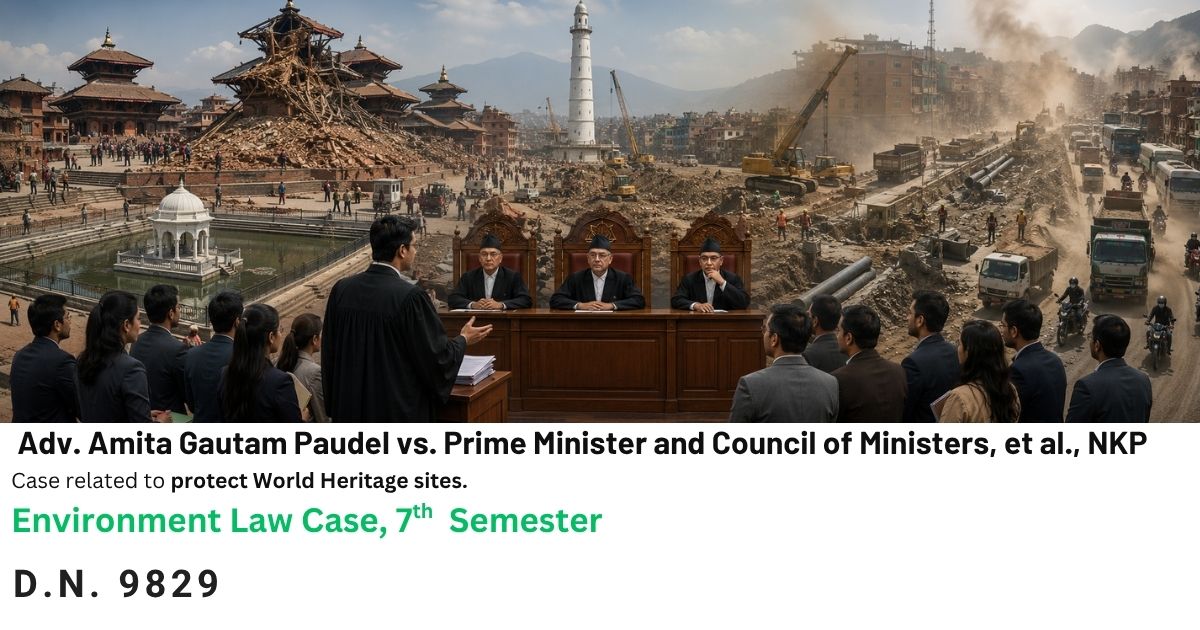
Environmental Law Case: Advocate Amita Gautam Paudel v. Office of the Prime Minister and Council of Ministers et. al., NKP 2074, Writ No. 073-WO-0830, DN: 9829
Case:Protection of World Heritage sites
Plaintiff: Advocate Amita Gautam Paudel
Respondent:Office of the Prime Minister and Council of Ministers, et al.
Decision Number:9829
This case is related to the state’s obligation to protect World Heritage sites, manage urban development, and mitigate severe environmental pollution affecting public health.
Facts of the Case:
Following the devastating earthquake of 2072 B.S. (2015), critical archaeological and UNESCO World Heritage listed sites in the Kathmandu Valley, including Basantapur Durbar Square, Ranipokhari, and Dharahara suffered extensive damage. The reconstruction of these structures faced severe delays. Concurrently, massive infrastructure projects, including road expansion, sewage installation, and laying the Melamchi drinking water pipeline, were undertaken simultaneously without inter-governmental coordination. This lack of planning resulted in extreme air pollution, blanketed the Kathmandu Valley in dust and smoke, and threatened the health, well-being, and existence of its residents. The petitioner filed a public interest litigation seeking judicial intervention to accelerate heritage reconstruction and mandate immediate pollution control measures.
Legal issues:
- Whether the state is under a mandatory legal obligation to reconstruct and preserve damaged historical and World Heritage structures in their original form and traditional design?
- Whether the unchecked rise of severe urban air pollution caused by uncoordinated development projects violates the constitutional rights to life and a clean environment?
Decision of the court:
Supreme Court:
The Supreme Court issued a writ of Mandamus against the respondents. The court emphasized that development must be balanced, stating that infrastructure projects that compromise human existence cannot be justified and ultimately turn into a curse.
The Supreme Court issued specific directive orders categorized into immediate and long-term actions:
- Establish a permanent body or a separate Public Works Department to coordinate road excavations and pipeline installations; conduct daily road sweeping and water sprinkling; implement “Vehicle Holidays” or odd-even traffic systems if necessary; strictly enforce the ban on public vehicles older than 20 years; deploy separate biodegradable and non-biodegradable waste bins across the city; and provide free medical treatment to citizens suffering from pollution-induced illnesses while initiating mandatory urban afforestation.
- Introduce a congestion charge to discourage private vehicle use in urban zones; develop robust mass transportation networks (trains and high-capacity buses); promote alternative fuel by offering tax and customs exemptions on electric and CNG vehicles; build bicycle-friendly lanes; and form a permanent expert task force for ongoing environmental research and pollution control.
Principles Established:
- Development that seriously affects the environment poses a threat to human existence. It is the common responsibility of everyone to maintain appropriate environmental standards to ensure quality living in the present, to protect our future, and to ensure the safety of future generations.
- It is undeniable that the main responsibility for ensuring compliance lies with the government and its subordinate bodies. This is also one aspect of the commitment expressed by the Government of Nepal in various international forums related to the environment. Various laws have also been formulated with awareness towards the environment. However, it cannot be considered that the state’s responsibility towards environmental protection has been fulfilled by formulating laws.
- The loss of life and property caused by the earthquake of 12th of Baisakh, 2072 BS is irreparable. The ancient monuments of cultural and archaeological importance that were damaged by the earthquake are considered equally important for the study of history, informing future generations about age-old traditions, technologies, and traditional knowledge.
Its importance will remain only if it is reconstructed in its original form using the same technology. While all the concerned bodies of the state should work together in the reconstruction of such important monuments, it is not acceptable to assume that the tendency of one side shifting responsibility onto the other is a good thing.
Relevance of the Case:
This case serves as a landmark precedent establishing the judiciary’s role in enforcing administrative accountability, defining the threshold where development infringes upon the right to life, and outlining actionable, structural solutions for urban environmental management and heritage conservation in Nepal.