

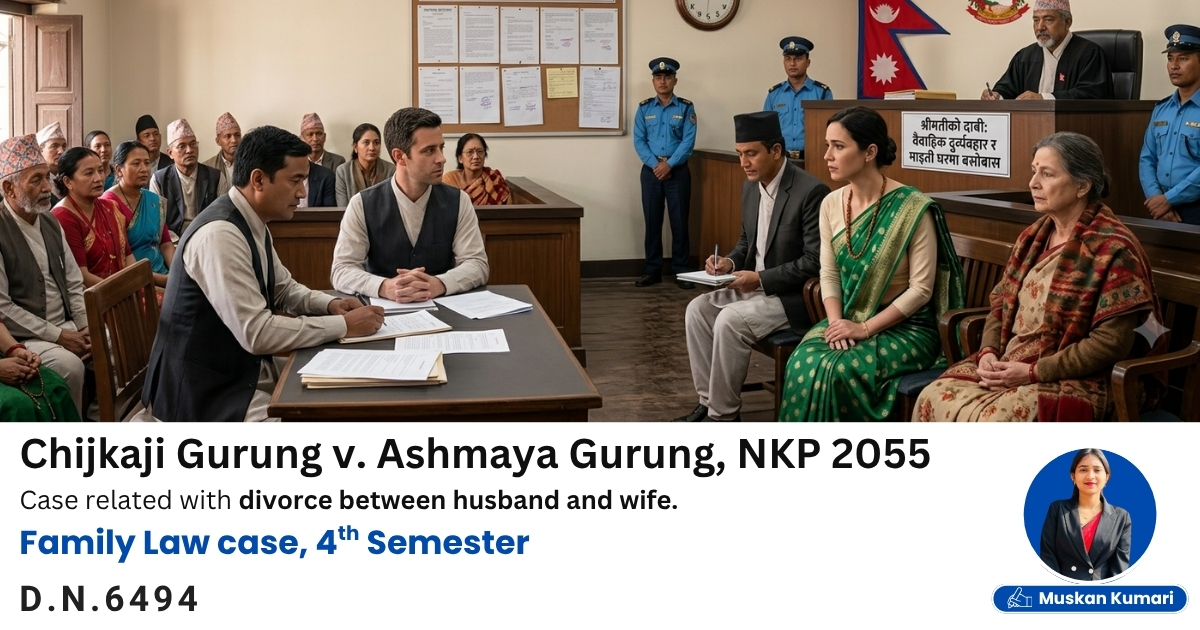
Family Law Case: Chijkaji Gurung v. Ashmaya Gurung, NKP 2055, No.1, D.N. 6494
Case: Divorce (Relationship Dissolution)
Plaintiff: Chijkaji Gurung
Defendant: Ashmaya Gurung
Decision Number: 6494
This case is related with divorce between husband and wife and the conditions under which a husband can seek relationship dissolution when the wife is living separately.
Facts of the Case:
Chijkaji Gurung was serving in British Army since 2036 B.S. His marriage with Ashmaya Gurung was performed in 2037 B.S. through a customary arrangement using his photograph while he was abroad. Later, he accepted Ashmaya as his wife. According to Chijkaji, after marriage Ashmaya did not permanently stay at his home and instead continued to live at her maternal home (Maiti). He claimed that when he returned on leave in 2043 B.S., he tried to bring her back to live with him, but she refused and continued to stay separately according to her own wishes. He further alleged that because of her conduct, even his elderly parents were not properly cared for. He said even he gathered Pancha Baladami to convince her to stay in his home but she refused to return. On this basis, he filed an application before Pokhara Municipality seeking divorce under the provisions of the Muluki Ain (Chapter on Husband and Wife).
Pokhara Municipality attempted reconciliation between the parties but concluded that there was no possibility of restoring the marital relationship. The matter was then forwarded to Kaski District Court for legal determination.
During proceedings before the District Court, Chijkaji stated that although the couple had a son named Asit Gurung born in 2040 B.S., Ashmaya had been living away from him for more than six years.
Ashmaya Gurung opposed the divorce claim. She argued that she had not voluntarily abandoned her husband. According to her, she was compelled to live at her maternal home because of mistreatment, physical abuse, and pressure from her in-laws. She also stated that her husband worked abroad and that she and her son continued to receive financial support from his salary through the British Gurkha pension system. She mentioned that she was willing to live with her husband, but he himself refused to take her with him after marrying another woman. She also submitted documents (evidence) showing that he had contracted a second marriage with another woman named Kul Shobha Gurung.
Legal Issues:
-
- Whether the wife had lived separately from her husband without his consent for more than three years under the Muluki Ain.
- Whether the husband could seek divorce when he himself had contracted a second marriage.
- Whether the wife’s separate residence at her maternal home amounted to desertion in the circumstances of the case.
Decision of the Courts:
Kaski District Court:
Kaski District Court held that Ashmaya Gurung had stayed separately from her husband for more than three years. Court concluded that the conditions under the Chapter on Husband and Wife of Muluki Ain were satisfied and therefore granted divorce between the parties.
Pokhara Appellate Court:
Ashmaya Gurung filed an appeal against District Court’s decision. On 2052/02/19, Pokhara Appellate Court reversed the judgment of Kaski District Court. The Court held that Ashmaya could not be considered to have deserted her husband without consent because Chijkaji was employed abroad, had contracted a second marriage, and had continued to provide financial support to Ashmaya and their son. The Court further observed that the husband himself had refused to take her along with him. Therefore, the claim for divorce was dismissed.
Supreme Court of Nepal:
The matter was then brought before Supreme Court of Nepal through appeal by Chijkaji Gurung. Supreme Court examined the evidence, including the marriage registration showing Chijkaji’s second marriage with Kul Shobha Gurung, letters exchanged between the parties, and proof that Ashmaya and her son continued receiving maintenance expenses from Chijkaji’s salary.
Supreme Court held that in the circumstances of the case, Ashmaya’s residence at her maternal home could not legally be treated as separation without the husband’s consent. The Court emphasized that after contracting a second marriage and staying abroad for employment, the husband himself had created a situation in which normal marital cohabitation was difficult. Since the wife had attempted to maintain the relationship and husband had refused to take her with him, the legal ground for divorce was not established.
Consequently, Supreme Court upheld the judgment of Pokhara Appellate Court and dismissed the appeal filed by Chijkaji Gurung.
Principle Established
This case established that mere separate residence of a wife at her maternal home does not automatically amount to desertion or a legal ground for divorce. The surrounding circumstances and conduct of both spouses must be carefully examined.
This case established that:
-
- A wife cannot be considered to have deserted her husband when circumstances created by the husband himself forced her to live separately.
- A husband who contracts a second marriage cannot easily claim divorce on the ground that the wife is living apart.
- Financial support and continued marital connection may indicate that the marital relationship has not been completely abandoned.
- Courts must consider social realities and practical circumstances before granting divorce.