

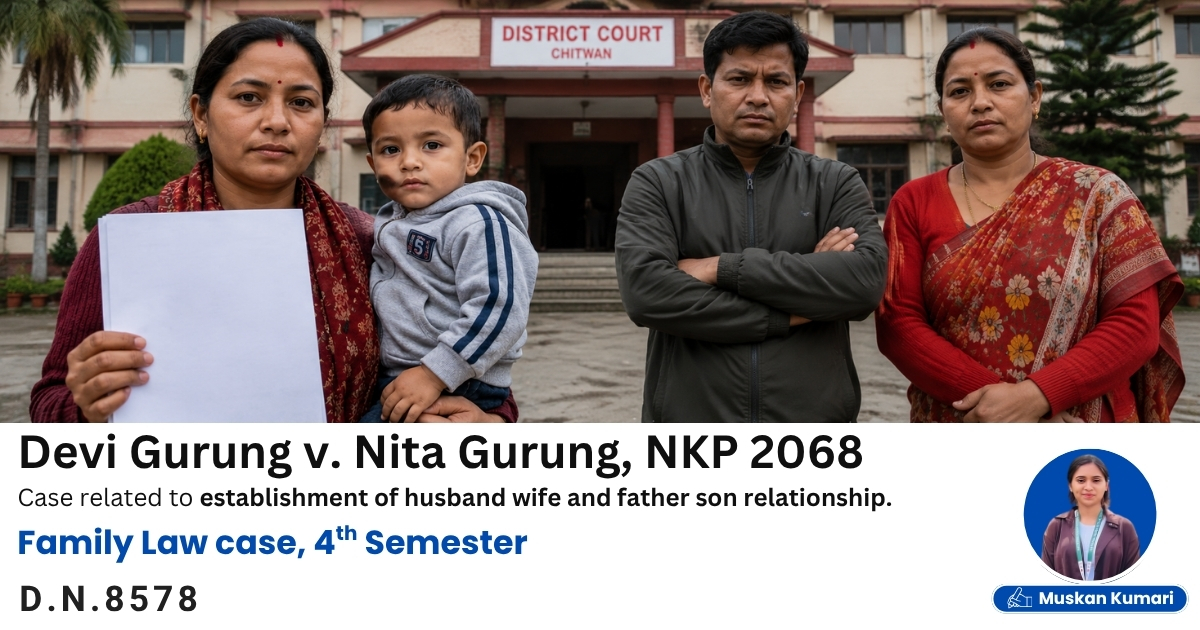
Family Law Case: Devi Gurung v. Nita Gurung, NKP 2068, No.3, P.454, D.N. 8578
Case: Relationship Establishment (Nata Kayam)
Plaintiff: Nita Gurung and minor Rabin Gurung
Defendant: Devi Gurung
Decision Number: 8578
This case is related to the establishment of husband wife relationship and father son relationship, along with the evidentiary value of DNA testing in paternity disputes.
Facts of the case:
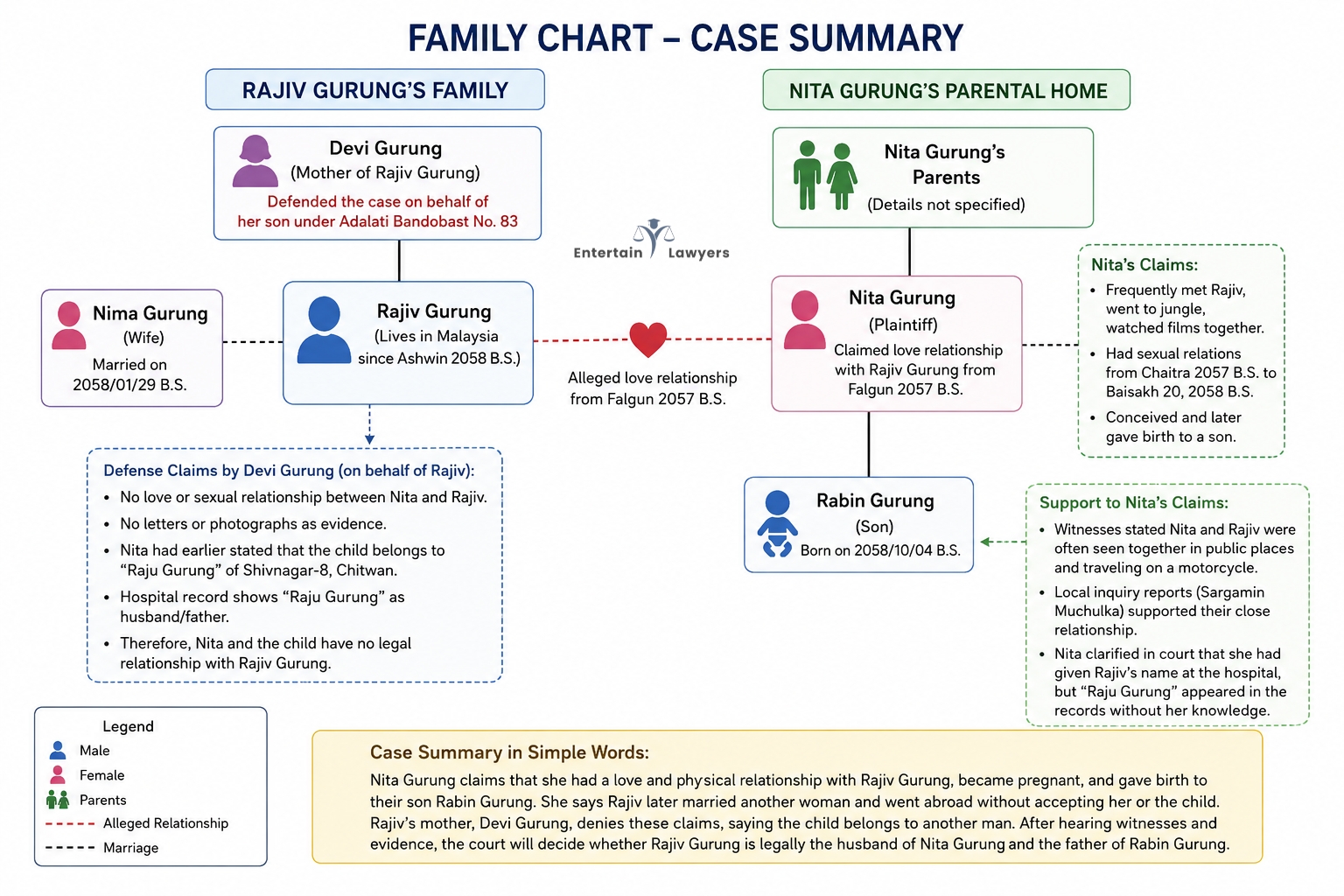
(Note: Devi Gurung, the mother of Rajiv Gurung, defended the case on behalf of her son under Adalati Bandobast No. 83-a legal provision allowing representation for a person staying abroad or unable to personally appear before court.)
Nita Gurung filed a suit claiming that she and Rajiv Gurung were residents of the same locality and had developed a love relationship beginning around Falgun 2057 B.S. According to her, they frequently met each other, went to the jungle together, watched films together, and eventually established repeated sexual relations from Chaitra 2057 B.S. until Baisakh 20, 2058 B.S. She stated that after Baisakh 2058 B.S., her menstruation stopped due to pregnancy, and when she informed Rajiv Gurung about it and requested him to take her to his home as his wife, he delayed and avoided doing so. Meanwhile, Rajiv Gurung married another woman named Nima Gurung on 2058/01/29 under pressure from his parents. Nita further claimed that Rajiv occasionally visited her maternal home and gave her small amounts of money, but later went to Malaysia in Ashwin 2058 B.S. without informing her. She stated that when she went to Rajiv Gurung’s house on 2058/07/04, his family did not allow her to enter or stay there. Thereafter, she returned to her maternal home and, on 2058/10/04, gave birth to a son named Rabin Gurung. Since Rajiv Gurung neither accepted her nor the child and his parents also refused to allow her into their house, she filed the present suit seeking establishment of husband-wife relationship between herself and Rajiv Gurung and father-son relationship between Rajiv Gurung and Rabin Gurung.
In response, Devi Gurung filed a written defense on behalf of Rajiv Gurung claiming that no love relationship or sexual relationship had ever existed between Nita and Rajiv. She argued that if such a relationship truly existed, Nita would have produced evidence such as letters or photographs. She further contended that Nita herself had previously stated in the community that the child belonged to another man named Raju Gurung of Shivnagar-8, Chitwan. It was also argued that when Nita was admitted to Bharatpur Hospital for delivery, the hospital records mentioned Raju Gurung as husband/father, thereby disproving Rajiv Gurung’s paternity. On this basis, defense claimed that neither Nita nor child had any legal relationship with Rajiv Gurung and requested dismissal of the case.
During proceedings, witnesses produced by Nita supported her version and stated that Nita had consistently maintained that Rajiv Gurung was the father of the child. Local inquiry reports (Sargamin Muchulka) and witness testimonies also indicated that Nita and Rajiv were frequently seen together in public places and traveling together on a motorcycle. Nita later clarified before the court that while she had stated Rajiv Gurung’s name at the hospital during childbirth, the name “Raju Gurung” somehow appeared in the hospital records without her knowledge.
Legal Issues:
- Whether Devi Gurung could legally defend the case on behalf of Rajiv Gurung under Adalati Bandobast No. 83.
- Whether the DNA report excluding Rajiv Gurung as the biological father was admissible and reliable evidence.
- Whether the mother’s statement and surrounding circumstances were sufficient to determine paternity.
Decision of the Courts:
Chitwan District Court:
Chitwan District Court held that, in disputes relating to paternity, statement of the mother carries significant evidentiary value. Court found sufficient surrounding evidence supporting Nita Gurung’s claim and established husband-wife relationship between Nita Gurung and Rajiv Gurung as well as father-son relationship between Rajiv Gurung and Rabin Gurung.
Hetauda Appellate Court:
On 2060/12/09, Appellate Court affirmed the decision of Chitwan District Court. It held that the available evidence adequately supported the plaintiff’s claim and that the lower court’s reasoning was correct.
Supreme Court:
Rajiv Gurung then challenged the decision before the Supreme Court, arguing that the lower courts had failed to properly evaluate evidence and had relied solely upon the woman’s disputed statement without conducting scientific examination. He requested DNA testing and argued that paternity could not be determined merely on presumption. Upon review, Supreme Court ordered DNA testing through the National Forensic Science Laboratory. The DNA report concluded that Rajiv Gurung was not the biological father of Rabin Gurung.
However, serious controversy arose regarding the DNA collection process. It was alleged that another unauthorized person had entered the laboratory together with Rajiv Gurung during sample collection, while Nita Gurung was not allowed to remain present. The plaintiff’s side argued that the DNA sample might therefore have been tampered with and that the integrity of the testing process was doubtful.
Supreme Court also found that Devi Gurung had improperly represented Rajiv Gurung under Adalati Bandobast No. 83 despite the fact that Rajiv was in regular telephone contact with his family while staying in Malaysia. Court observed that Adalati Bandobast No. 83 was intended mainly for persons who were incapable of protecting their own legal interests, such as minors, persons with mental incapacity, or persons whose whereabouts were genuinely unknown, and not for healthy adults living abroad but maintaining communication with family members.
Ultimately, despite the DNA report excluding Rajiv Gurung as the biological father, Supreme Court held that the report could not be relied upon because of serious doubts regarding the authenticity and integrity of the sample collection process. The Court emphasized that in paternity disputes, the mother’s statement has special importance, particularly when it is supported by surrounding circumstances and witness testimony.
Relying upon the mother’s statement, witness testimonies, surrounding circumstances, local inquiry reports, and established legal principles relating to paternity disputes, the Court concluded that Rajiv Gurung was the husband of Nita Gurung and had a marital relationship and that Rabin Gurung was the legitimate child of Rajiv Gurung.
Accordingly, Supreme Court upheld the judgments of the Chitwan District Court and Hetauda Appellate Court and dismissed the appeal.
Principle Established:
Paternity disputes are often determined through circumstantial evidence because direct proof of consensual sexual relations is rarely available. In such disputes, mother’s statement carries significant evidentiary value when supported by surrounding circumstances and witness testimony.
This case established that:
- A person residing abroad but maintaining regular communication with family cannot ordinarily be represented under Adalati Bandobast No. 83.
- The mother’s statement is an important form of evidence in paternity disputes.
- DNA evidence is important and scientifically valuable, but it cannot be relied upon if the sample collection process is suspicious or compromised.
- Courts must carefully evaluate the fairness and authenticity of scientific testing procedures before relying upon DNA reports.
- Circumstantial evidence and witness testimony may be sufficient to establish paternity and legitimacy of a child.