

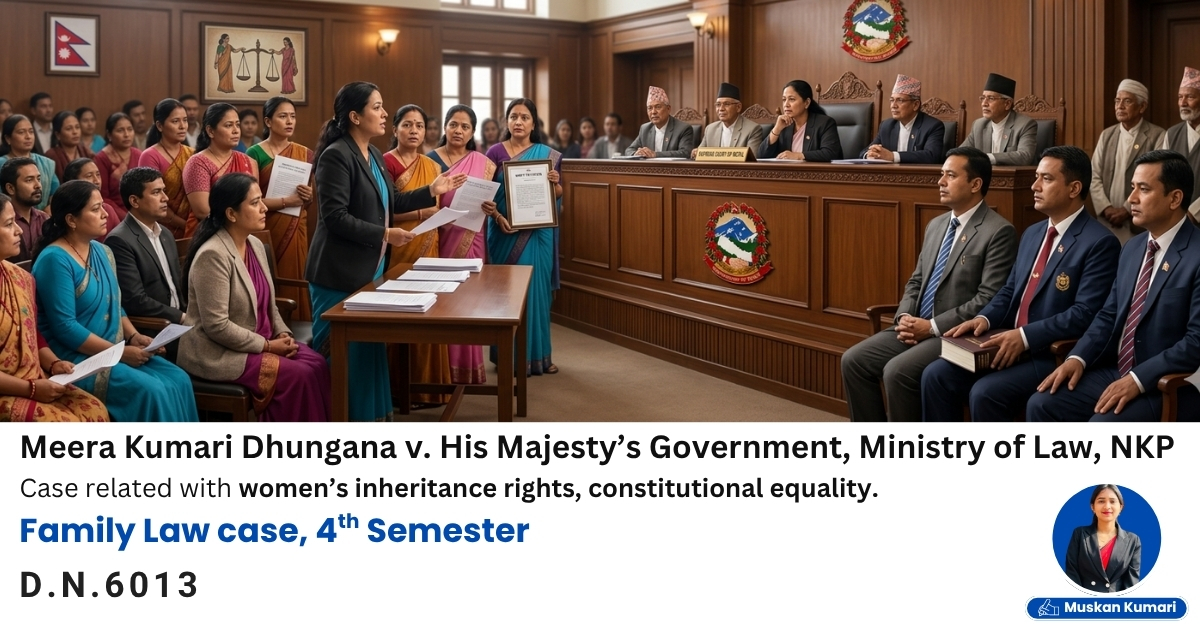
Family Law Case: Meera Kumari Dhungana v. His Majesty’s Government, Ministry of Law, Justice and Parliamentary Affairs, NKP 2052, No.6, D.N: 6013
Case: Gender Equality and Partition Rights
Plaintiff: Meera Kumari Dhungana et.al.
Defendant: His Majesty’s Government et.al
Decision Number: 6013
This case is related with women’s inheritance rights, constitutional equality, and the validity of discriminatory partition laws under the Muluki Ain.
Facts of the case:
Meera Kumari Dhungana and another petitioner filed a writ petition before the Supreme Court of Nepal challenging No. 16 of the Chapter on Partition (Ansabanda) under the Muluki Ain, 2020. According to the existing law(No.16), only an unmarried daughter who had completed 35 years of age could obtain partition property equal to a son. If she married after receiving the property, the remaining property after deducting marriage expenses had to be returned to the rightful heirs.
The petitioners argued that this legal provision was discriminatory because sons obtained rights in ancestral property from birth, whereas daughters could obtain similar rights only after staying unmarried until the age of 35. They claimed that this violated Article 11 of the Constitution of the Kingdom of Nepal, 2047, which guaranteed equality before law and prohibited discrimination based on religion, sex, caste, race, tribe or any of these. They mentioned, Convention on the Elimination of All Forms of Discrimination against Women (CEDAW), arguing that Nepal was obligated to ensure equal property rights for women.
Government defended the law by arguing that daughters were not completely deprived of inheritance rights. According to the existing legal structure, unmarried daughters could inherit from their father, while married daughters could inherit from their husband’s side. Government further argued that if the law was immediately invalidated, daughters could inherit from both the paternal and marital sides, whereas sons inherited only from the paternal side, which could create imbalance in inheritance rights. The Government also emphasized Nepal’s traditional social and family structure and argued that sudden legal reform could create practical and social complications.
Since the case involved important constitutional and social questions regarding equality and women’s property rights, the matter was heard by a Special Bench of the Supreme Court of Nepal.
Legal Issues
- Whether No. 16 of the Chapter on Partition under Muluki Ain, 2020 violated Article 11 of the Constitution of Nepal, 2047.
- Whether requiring an unmarried daughter to attain 35 years of age before obtaining partition rights amounted to gender discrimination.
- Whether the Supreme Court should declare the disputed legal provision unconstitutional and void.
Decision of the Courts:
Supreme Court of Nepal (Special Bench):
Supreme Court of Nepal acknowledged that there was a clear difference between sons and daughters regarding inheritance rights because sons obtained property rights by birth, whereas daughters had to fulfill conditions such as staying unmarried until 35 years of age. However, Court held that daughters were not completely deprived of inheritance rights because the legal system contained separate provisions through which unmarried daughters could inherit from their father and married daughters could inherit from their husband’s side.
Court further observed that inheritance and partition laws were interconnected with the broader structure of family and property law. According to the Court, invalidating only one provision without comprehensive legal reform could disturb the entire inheritance system and create practical as well as social complications. The Court also emphasized that Nepalese society had long followed traditional family structures and social practices, and sudden legal changes without broader public discussion and preparation might not be practically workable.
Therefore, instead of immediately declaring the provision unconstitutional, the Court issued a directive order to the Government to consult women’s organizations, sociologists, legal experts, and social organizations, study comparative laws of other countries, and introduce an appropriate bill before Parliament within one year to reform the law relating to women’s inheritance rights. Consequently, the writ petition was not fully allowed, and the challenged provision was not immediately struck down.
Later 11th amendment of the Muluki Ain, 2020 made the provision to address this issue. This established the equal parental rights of the women.
Principle Established:
Equality before law does not always require immediate judicial invalidation of socially connected legal provisions if broader legislative reform is necessary. The Court recognized that women’s inheritance rights required reform, but such reform had to be made carefully after considering the entire legal structure and social realities.
This case established that:
- Discriminatory inheritance laws affecting women can be challenged under the constitutional right to equality.
- Supreme Court may issue directive orders to the Government instead of immediately invalidating a law when broader legal reform is required.
- Social realities and interconnected property laws may be considered while interpreting constitutional equality in family law matters.