

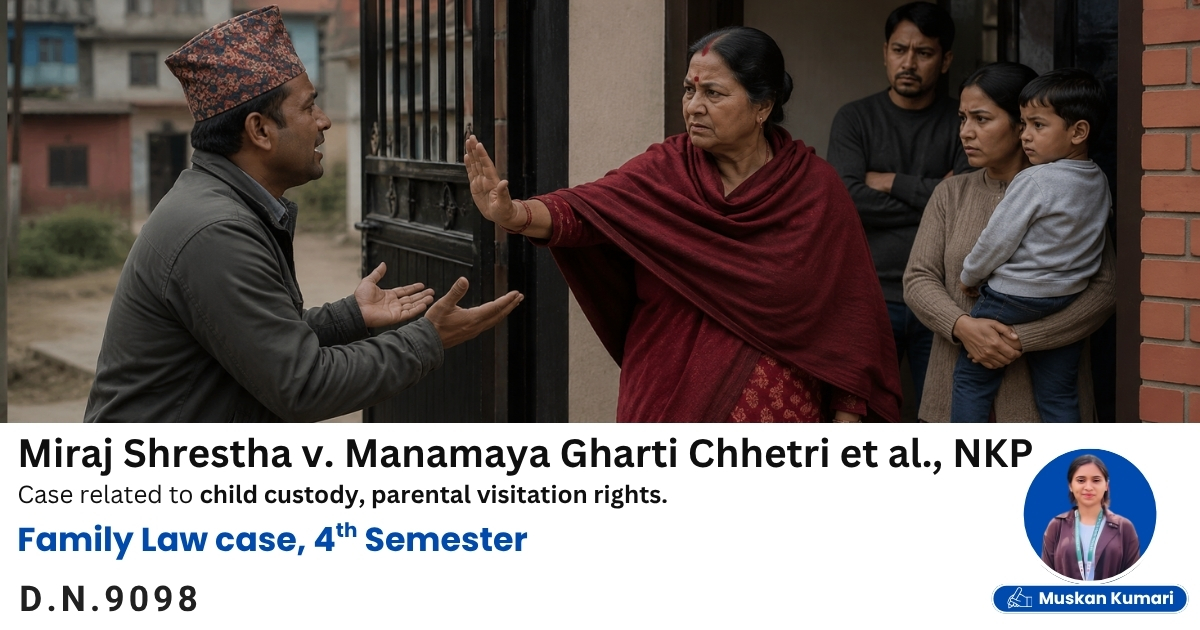
Family Law Case: Rajesh Prasad Shrestha (on behalf of Miraj Shrestha) v. Manamaya Gharti Chhetri et al., NKP 2070, No. 12, P. 4370, D.N: 9098
Case: Habeas Corpus
Petitioner: Rajesh Prasad Shrestha (on behalf of minor Miraj Shrestha)
Respondent: Manamaya Gharti Chhetri et al.
Decision No: 9098
This case is related to child custody, parental visitation rights, and habeas corpus jurisdiction.
Facts of the Case:
Rajesh Prasad Shrestha and Meena Gharti Chhetri were married according to social custom & rituals on 2058/01/13, and a son named Miraj Shrestha was born from their relationship. After living together for nearly ten years, disputes arose between them, and their marital relationship was eventually dissolved through a compromise before Kathmandu District Court on 2069/12/20. According to the compromise agreement, minor child Miraj would remain under the custody, care, and guardianship of his mother, Meena Gharti Chhetri, who would also bear responsibility for his upbringing, education, and maintenance.
After the divorce, Meena began living separately with the child. Later, Rajesh Prasad Shrestha attempted to meet his son, but according to him, his mother in law, Manamaya Gharti Chhetri prevented him from meeting the child and informed him that neither Meena nor Miraj wished to maintain contact with him. Rajesh claimed that his son was being unlawfully confined and kept away from him without legal justification.

On this basis, Rajesh Prasad Shrestha filed a writ petition of habeas corpus before Supreme Court seeking an order to produce the minor child and allow him to meet and stay with his father.
In response, the respondents argued that the marital relationship between Rajesh and Meena had already been legally dissolved through mutual consent and that the compromise deed clearly mentioned that Miraj would remain with his mother. They further stated that the child was lawfully residing under the custody and guardianship of his natural mother and therefore there was no illegal detention.
Legal Issues
- Whether a minor child living under the custody of his mother can be considered illegally detained.
- Whether habeas corpus can be invoked in matters relating to child custody and visitation rights.
- Whether adequate alternative legal remedies existed under prevailing laws regarding parental visitation rights.
Decision of the Court:
Supreme Court of Nepal:
Supreme Court held that a mother is the first and natural guardian of a child. Court stated that a child residing with his biological mother under her custody and protection cannot ordinarily be considered to be under illegal detention. Court further observed that it is difficult even to imagine that a mother would intentionally act against the welfare and interest of her child.
Court emphasized that the compromise agreement between the parents had clearly stated that Miraj would remain with his mother and that she would be responsible for his upbringing and education. Therefore, the child staying with his mother could not be interpreted as unlawful confinement.
The Court also recognized that a father has the right to meet his child. However, it explained that existing laws already provided adequate and effective legal remedies regarding visitation rights. Referring to the Muluki Ain and the Children’s Act, 2048, the Court stated that a parent denied access to a child may approach the District Court for appropriate relief.
Since an effective alternative legal remedy was available, Supreme Court held that extraordinary writ jurisdiction under habeas corpus could not be invoked in the this case.
Accordingly, the writ petition was dismissed.
Principle Established:
This case established that:
- The mother is the first and natural guardian of a minor child.
- A child living with his mother under lawful custody cannot ordinarily be considered illegally detained.
- Habeas corpus is not maintainable where adequate and effective alternative legal remedies are available.
- A father’s visitation right should generally be enforced through ordinary legal procedures before the District Court rather than through extraordinary writ jurisdiction.