


Family Law Case: Narayan Prasad Tharu v. Harendra Kumar Chaudhary, NKP 2076 B.S., Vol. 61, DN: 10394
Case: Establishment of Inheritance Right (Aputali Hak Kayam)
Plaintiff: Indra Kumari Devi Chaudhary (through her authorized representative, Harendra Kumar Chaudhary)
Defendant: Narayan Prasad Tharu
Decision Number: 10394
This case is related to the inheritance rights over a deceased woman’s property, where the Supreme Court decided whether a married biological daughter or a stepson has the stronger legal claim to inherit her estate.
Facts of the Case:
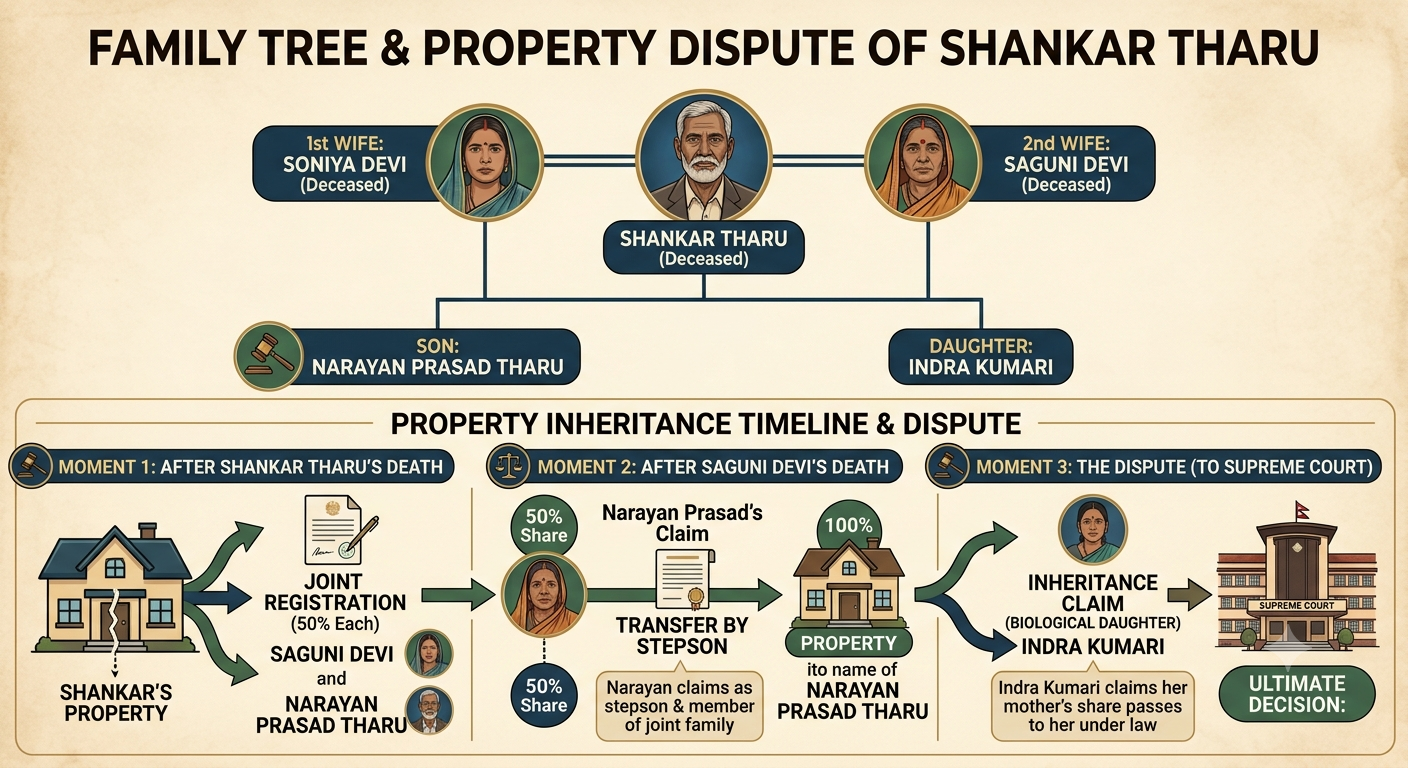
Shankar Tharu had two wives. His first wife, Soniya Devi, had a son, Narayan Prasad Tharu, while his second wife, Saguni Devi, had one daughter, Indra Kumari. After Shankar’s death, his property was jointly registered in the names of Saguni Devi and Narayan Prasad. When Saguni Devi later died, Narayan Prasad transferred her share solely into his own name, claiming that as her stepson and a member of the joint family, he alone was entitled to inherit it. Indra Kumari, Saguni Devi’s only biological daughter, claimed that her mother’s share should pass to her under the law of inheritance. The dispute ultimately reached the Supreme Court.
Legal Issues:
- Whether a married biological daughter or a stepson is the closer legal heir to inherit the property of a deceased woman.
- Whether the absence of partition between co-sharers prevents inheritance rights from arising.
- Whether joint ownership of property automatically transfers the deceased co-owner’s share to the surviving co-owner.
- Whether marriage disqualifies a biological daughter from inheriting her mother’s property.
Decision of the Courts:
Nawalparasi District Court:
The District Court dismissed the plaintiff’s claim. It held that since Saguni Devi and Narayan Prasad had never partitioned their property and remained members of the same joint family, the married daughter could not claim inheritance over Saguni Devi’s share.
Butwal Appellate Court:
The Appellate Court affirmed the District Court’s judgment. It agreed that the married daughter had no inheritance right because the deceased’s share had not been separated before her death.
Supreme Court (Joint Bench):
The Joint Bench reversed the decisions of both lower courts. It held that Saguni Devi’s half share in the jointly owned property formed part of her estate and, after her death, passed to her only biological daughter, Indra Kumari, under the law of inheritance.
Supreme Court (Full Bench):
The Full Bench upheld the Joint Bench’s decision. It ruled that a married biological daughter is the nearest legal heir to her mother’s property and has priority over a stepson. The Court further held that inheritance and partition are separate legal concepts, joint ownership does not extinguish an individual’s share, and marriage does not take away a daughter’s inheritance rights.
Principle Established:
A married biological daughter remains the nearest legal heir to her mother’s property and cannot be excluded from inheritance merely because she is married. The Court clarified that inheritance rights are independent of partition rights, and a surviving joint owner cannot automatically acquire the deceased co-owner’s share simply because the property remained jointly owned.
Relevancy of the Case:
This case is an important precedent in Nepalese inheritance law. It clarifies that a married biological daughter has a superior inheritance right over a stepson in respect of her deceased mother’s property. It also distinguishes inheritance from partition rights and reinforces the constitutional principle that a daughter’s inheritance rights cannot be denied merely because she is married.