

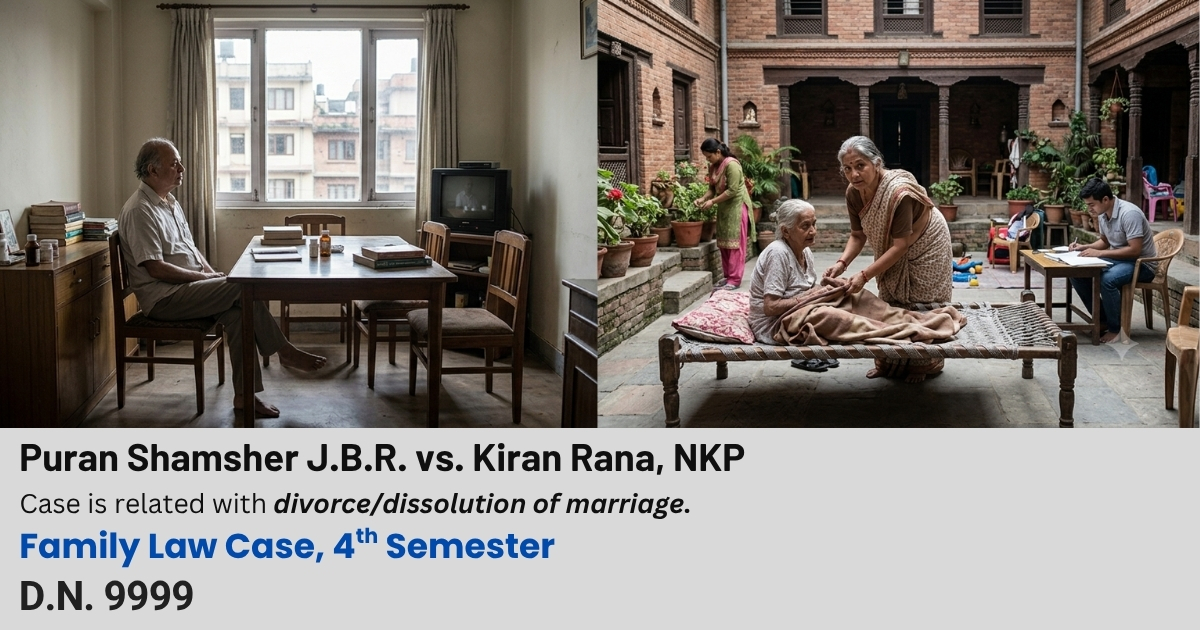
Family Law Case: Puran Shamsher J.B.R. vs. Kiran Rana, NKP 2075 B.S., Vol.4 , DN: 9999
Case: Divorce (Relationship Dissolution)
Plaintiff/Respondent: Puran Shamsher J.B. R.
Defendant/Appellant: Kiran Rana
Decision Number: 9999
This case is related to the interpretation of the statutory grounds for divorce, particularly whether a husband who voluntarily leaves the matrimonial home can seek divorce on the ground of three years’ separation and whether a wife’s lawful claim for partition of property constitutes a valid ground for dissolution of marriage.
Facts of the Case:
Puran Shamsher J.B. Rana and Kiran Rana were legally married according to Hindu religious customs and had one son and one daughter. The husband filed a divorce petition claiming that his wife had lived separately for about 15–16 years, failed to care for him during his illness, mentally harassed him, and had also obtained partition of family property. On this basis, he sought dissolution of their marriage.
Kiran Rana denied the allegations and stated that she had never left the matrimonial home. Instead, it was her husband who voluntarily left the family house and started living elsewhere. She continued to live in the family home, looked after her mother-in-law and children, and opposed divorce because she wished to preserve the marriage and family relationship.
Legal Issues:
- Whether a husband who voluntarily leaves the matrimonial home can seek divorce under the legal provision applicable when the wife leaves without his consent.
- Whether obtaining partition (inheritance/property share) by the wife automatically creates a right to divorce.
- Whether long-term separate residence alone is sufficient to dissolve a marriage.
- Whether the Appellate Court correctly interpreted the law relating to divorce.
Decision of the Courts:
District Court:
District Court held that the wife had not left the matrimonial home; rather, the husband himself had left the house. Therefore, the legal provision allowing divorce was not applicable. It also held that obtaining partition does not automatically entitle a husband to divorce. Hence, the husband’s claim was dismissed.
Appellate Court:
Appellate Court reversed the District Court’s decision. It held that the parties had been living separately for many years and granted divorce in favour of the husband.
Supreme Court:
Supreme Court restored the District Court’s decision. It held that a husband who himself leaves the matrimonial home cannot seek divorce under the provision applicable when the wife leaves without his consent. It further held that receiving partition does not automatically give a right to divorce. Therefore, the husband’s claim was dismissed.
Principle Established:
A husband who voluntarily abandons the matrimonial home cannot seek divorce under the statutory provision applicable when the wife lives separately without his consent. Moreover, a wife’s lawful exercise of her right to claim partition of property does not by itself constitute a valid ground for dissolution of marriage.
Relevancy of the Case:
This case is an important precedent in Nepalese family law. It clarifies that divorce cannot be granted by misapplying the statutory provision relating to separation and emphasizes that receiving partition of property does not automatically end the marital relationship. It also reinforces that judicial precedents must be applied only when the material facts are similar.