

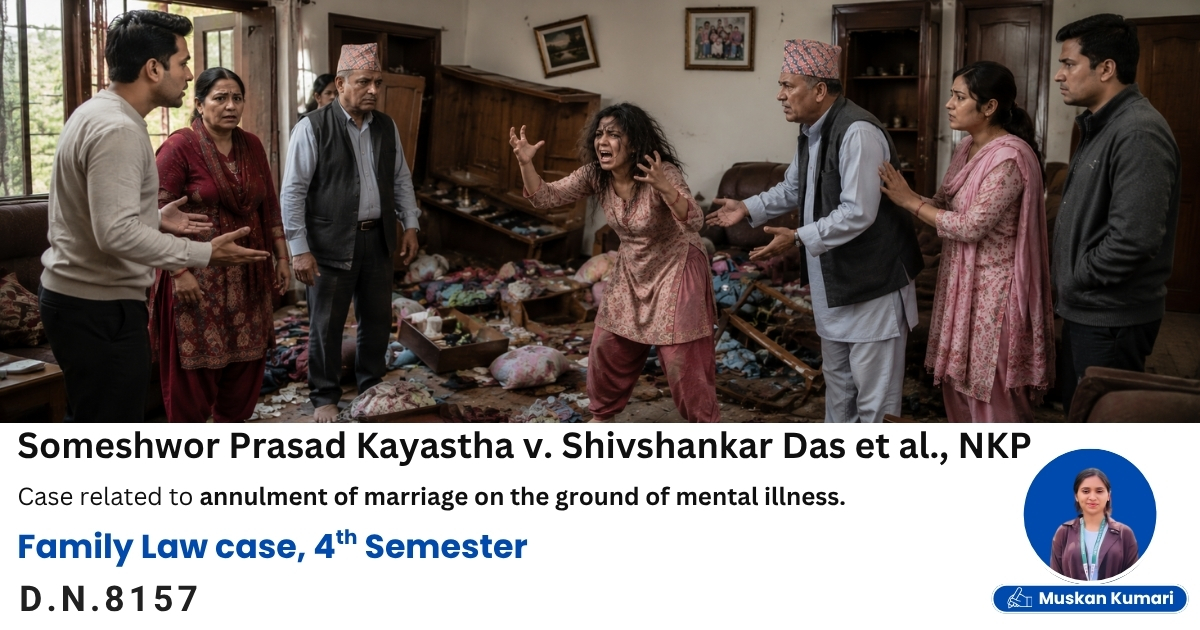
Family Law Case: Someshwor Prasad Kayastha v. Shivshankar Das et al., NKP 2066, No.5, P.7431, D.N: 8157
Case: Annulment of Marriage (Vivaha Badar)
Plaintiff: Someshwor Prasad Kayastha
Defendant: Shivshankar Das et al.
Decision No: 8157
This case is related to annulment of marriage on the ground that the wife was suffering from mental illness prior to marriage and such fact was concealed from the husband.
Facts of the case:
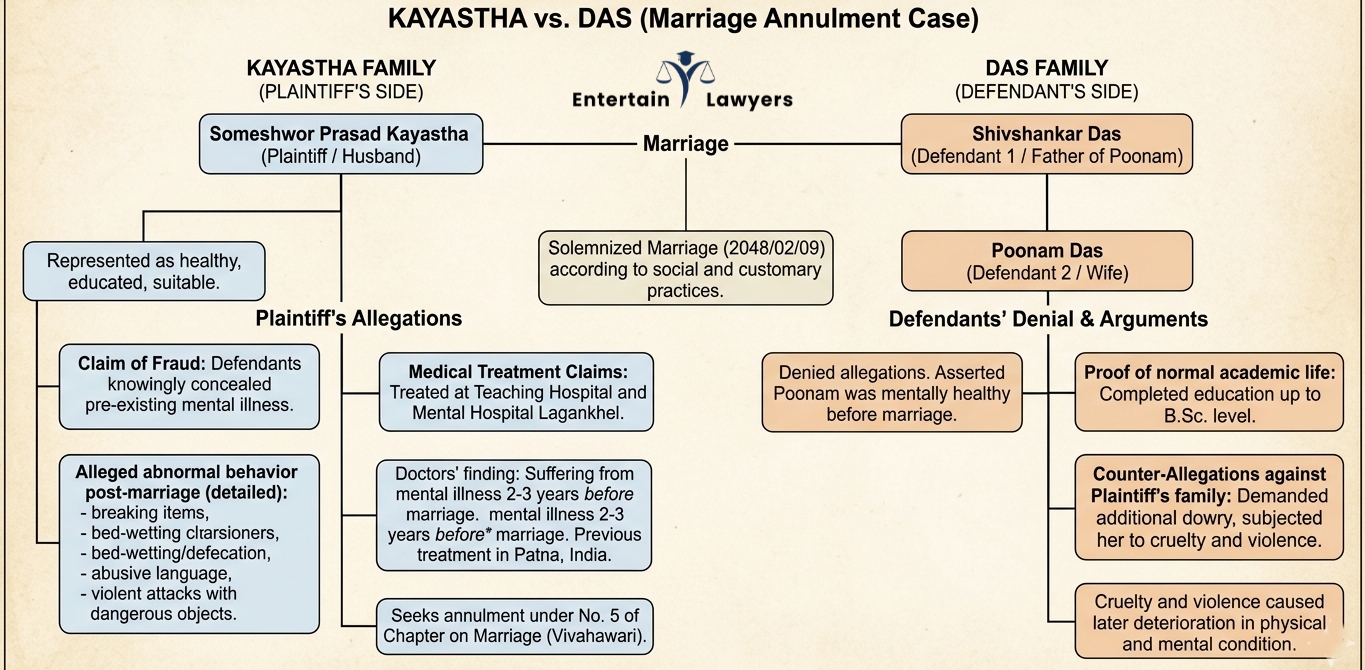
The plaintiff, Someshwor Prasad Kayastha, filed a suit seeking annulment of his marriage with Poonam Das. He claimed that the marriage was solemnized (performed) on 2048/02/09 according to social and customary practices, rituals and tradition after the defendant Shivshankar Das, represented that his daughter was healthy, educated, and suitable for married life.
However, after the marriage, plaintiff alleged that Poonam Das began showing abnormal behavior such as breaking household items, urinating and defecating on bed, using abusive language, attacking people with dangerous objects, and behaving violently. Due to such conduct, she was taken for medical treatment at different hospitals including Teaching Hospital and Mental Hospital, Lagankhel.
According to plaintiff, doctors informed him that Poonam Das had already been suffering from mental illness for two to three years before the marriage and had previously undergone treatment in Patna, India. He further claimed that the defendants knowingly concealed this fact and fraudulently arranged the marriage by falsely representing her as mentally sound. Therefore, he sought annulment of the marriage under No. 5 of the Chapter on Marriage (Vivahawari).
Defendants denied the allegation and argued that Poonam Das was mentally healthy before marriage. They stated that she had successfully completed her education up to B.Sc. level and had performed normally in academic life. They further alleged that the plaintiff’s family demanded additional dowry and subjected her to cruelty and violence, which later affected her physical and mental condition.
Legal Issues:
- Under what circumstances can a marriage be annulled under prevailing Nepalese law?
- Whether Poonam Das was suffering from mental illness (Acute Psychosis).
- Whether the mental illness existed before the marriage and was concealed from the plaintiff.
- Whether concealment of such illness amounts to fraudulent marriage under No. 5 of the Chapter on Marriage.
Decision of the Courts:
Bara District Court:
District Court held that the plaintiff failed to prove that Poonam Das was mentally ill before marriage. The Court relied upon her educational achievements and surrounding circumstances and concluded that the marriage could not be annulled merely because she later received psychiatric treatment. Accordingly, the plaintiff’s claim was dismissed.
Hetauda Appellate Court:
Appellate Court upheld the judgment of the District Court. It held that there was insufficient conclusive evidence proving that the defendant suffered from mental illness before marriage. The Court further reasoned that traditional marriages usually involve inquiry into the bride’s family background, making concealment less believable. Therefore, the plaintiff’s claim for annulment was rejected.
Supreme Court (Division Bench):
Supreme Court reversed the judgments of the lower courts and allowed the plaintiff’s claim.
Court closely examined medical records from Mental Hospital, Lagankhel, Teaching Hospital, and related psychiatric evaluations. It found that while admitting Poonam Das for treatment, her father Shivshankar Das himself had provided a history stating that she had suffered from “Psychosis” in 2046 BS and had previously received treatment in Patna, India.
Court held that such medical records and hospital history were reliable evidence under the Evidence Act. It further observed that educational qualifications alone could not prove mental soundness because a person suffering from mental illness may still continue studies while under treatment.
Supreme Court concluded that Poonam Das had been suffering from Acute Psychosis prior to marriage and that this fact had been knowingly concealed from the plaintiff. Therefore, the marriage fell within the category of voidable marriage under No. 5 of the Chapter on Marriage.
The Court emphasized that marriage deeply affects personal life, dignity, emotional stability, and social existence. It held that a person deceived into marriage through concealment of serious physical or mental illness has the personal right to reject such marital relationship under the broader concept of Right to Life.
Accordingly, Supreme Court annulled the marriage according to No. 5 of the Chapter on Marriage and imposed Rs. 200 fines upon the each defendants under the relevant legal provision.
Principle Established:
If a spouse was suffering from serious mental illness before marriage and such fact was concealed by falsely representing the person as mentally sound, the marriage becomes voidable under No. 5 of the Chapter on Marriage.
This case established that:
- Concealment of pre-existing serious mental illness amounts to fraudulent marriage.
- Medical history and hospital records are strong and reliable evidence in determining mental illness.
- Educational achievement alone cannot prove mental soundness.
- A person deceived into marriage has the personal right to reject such marital relationship as part of the Right to Life and dignified living.