
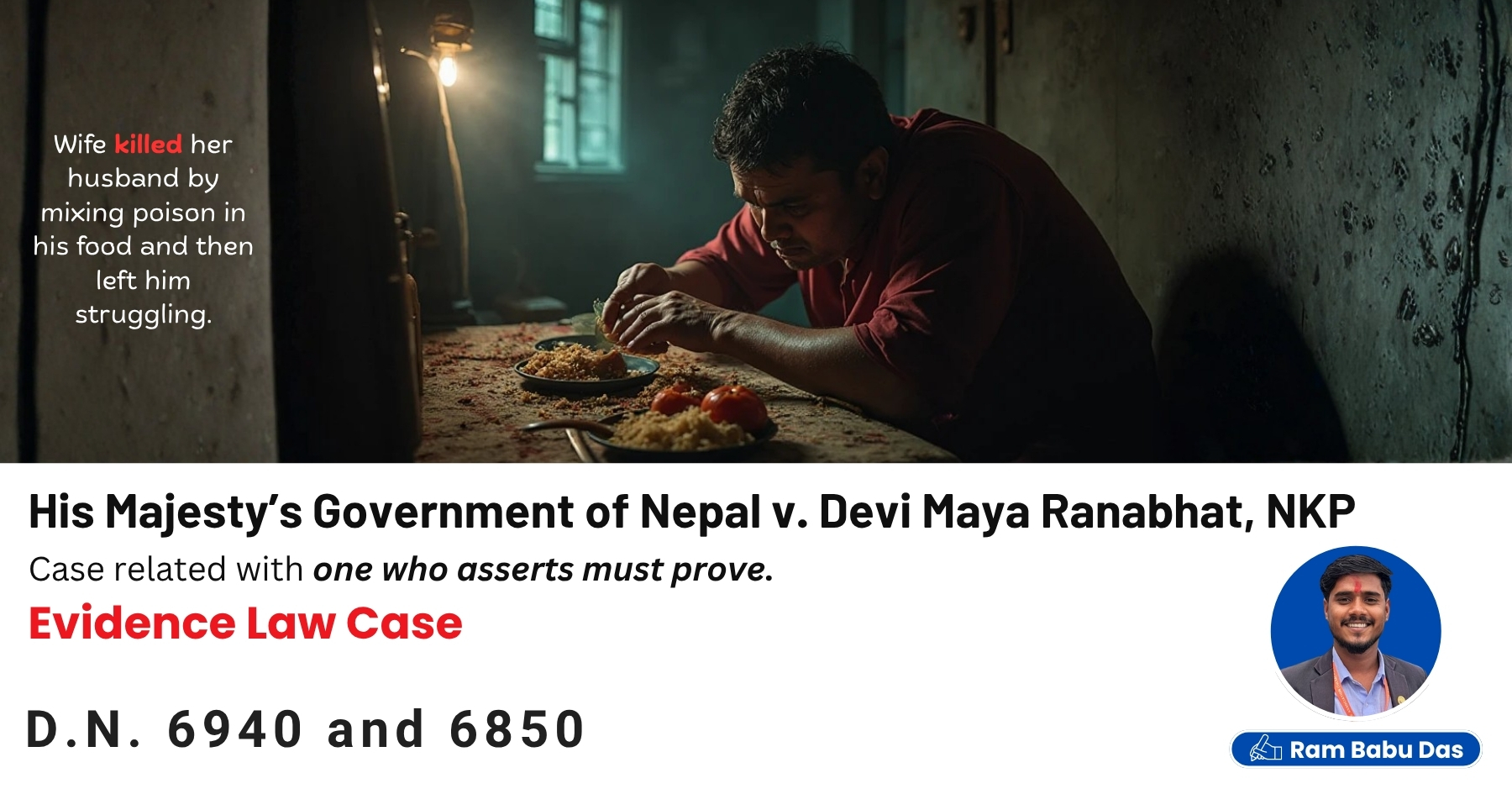
Evidence Law Case: His Majesty’s Government of Nepal v. Devi Maya Ranabhat, NKP 2057, No. 1, 8, DN: 6940 & 6850
Case: Homicide by Poisoning
Plaintiff: His Majesty’s Government of Nepal
Appellant/Defendant: Mithu aka Devi Maya Ranabhat
Decision Number: 6940 and 6850
This case is related with one who asserts must prove.
Fact of the case:
Devi Maya Ranabhat and Dolnath Ranabhat are married to each other; Sumitra BK is the mediator between the marriage of Devi Maya and Dolnath Ranabhat. Sumitra BK made all the arrangements, and Devi Maya eloped with Dolnath. Sumitra said Dolnath was ‘pensione’ Lahuri and had no children, but later it came to be known that he had two children and his wife was dead. I was deceived by Sumitra BK.
In 2052 Poush 21, Dolnath went to watch the local dance in Ranabhat Dhungade and returned home. Her wife, Devi Maya, bought rat poison from Sapre, aka Rukmini Ranabhat, at around 12 AM and used it in the green vegetable curry. She gave the food and curry to him and left the scene when he started struggling due to poison. She said, “My heart was very gloomy, and I was not able to control myself because I am aware he is married and has children, so I killed him by giving poison.”
In the morning, when Donalath’s mother went to see her son, she found her son was dead and her daughter-in-law, Devi Maya Ranabhat, was not at home, and his mother suspected Devi Maya of poisoning and murdering her son.
Devi Maya stated, “Sumitra had nothing to do with it; she did not suggest me to poison him.” The claimant claims they have violated No. (1) and 13(2) of the chapter on homicide, so they both should be punished under section 13(2) of the same chapter.
Decision of Tanahun District Court:
Devi Maya Ranabhat has violated No. 1 & 13(2) of the chapter on Homicide, so she was liable to punishment of life imprisonment along with the confiscation of the entire property.
Since the claimant was unable to present enough evidence to prove the alleged accusation, Sumitra was acquitted of the accusation charged upon her.
Appeals to the court of Pokhara:
HMG filed an appeal stating that Sumitra should be punished pursuant to No. 13(2) of the chapter on Homicide on the basis of immediately expressed facts expressed by Devi Maya in the course of inquiry and according to the statement of Surya Bd. Ranabhat.
Devi Maya appealed in court, stating that minimum punishment should be given considering several principles, including the reformative principle propounded by the Supreme Court and in pursuance of No. 188 of the chapter on court management.
Regarding the appeal of HMG, the appellate court approved the decision of Tanahun DC. Regarding the appeal of Devi Maya, the case was referred to the Supreme Court as per the Administration of Justice Act 2048, section 10, Referral Jurisdiction.
Supreme Court:
The Supreme Court upheld the decision of the district and appellate courts that she was subject to punishment of imprisonment for life, along with confiscation of the entire property, as per section 13(2) of the chapter on homicide.
Defendant Devi Maya made a counterclaim in the supreme court but could not present sufficient evidence to prove her claim, so the supreme court upheld the decision of the lower court, saying, “According to section 27 (1) of the Evidence Act, 2031, ‘if the defendant makes a counterclaim (Jikir) regarding remission from the penalty or acquittal from the charge (penalty) pursuant to prevailing law, the burden of proof of proving such fact shall lie on the defendant him/herself.'”
Principle Established:
Whoever asserts must prove. sec (25 & 26)
Immediately expressed facts (sec. 10)