

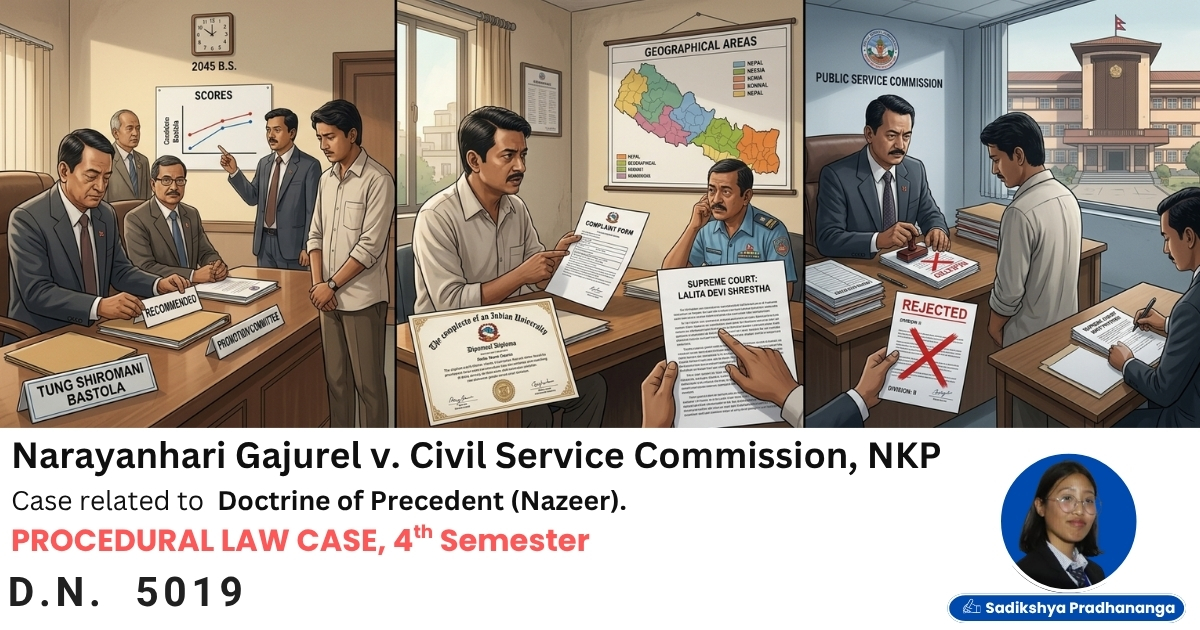
Procedural Law Case: Narayanhari Gajurel v. Civil Service Commission, NKP 2051, No. 10, DN: 5019
Case: Civil Service Case
Plaintiff: Dr. Narayan Hari Gajurel
Defendant: Lok Sewa Aayog, Promotion Committee
Decision Number: 5019
This case examines the Doctrine of Precedent (Nazeer) and clarifies when an earlier Supreme Court decision can or cannot be applied to a later case.
Facts of the Case:
Dr. Narayan Hari Gajurel was an assistant statistical officer in agro-statistics, and as per the government’s decision, he was granted a scholarship to attain a Ph.D. in agricultural statistics in India under the Colombo Plan from 2041 to 2045 B.S.
The petitioner had applied for the vacancy for promotion to the post of statistical officer in the agro-statistics department; however, the Promotion Committee recommended another candidate, Tung Shiromani Bastola. Here, the petitioner challenged the promotion and argued that the authorities had failed to grant him marks entitled to service in a classified geographical area during his study leave. He further claimed that his Ph.D. degree should have been evaluated as a first-division qualification, which would have increased his overall score in the promotion assessment.
The respondent, Public Service Commission, rejected his complaint, holding that classified-area marks could only be awarded for periods during which an employee had worked in a designated geographical area. That time spent on study leave could not be counted for that purpose. It also held that since the class or division of his Ph.D. degree was not specified, he had correctly been awarded marks equivalent to a second-division qualification.
Dr. Gajurel, dissatisfied with the decisions, filed a writ petition before the Supreme Court seeking the annulment of the decisions of the Promotion Committee and the Public Service Commission and requesting appropriate orders for reconsideration of his promotion with reference to the earlier precedent established by the Supreme Court in Lalita Devi Shrestha, where leave has been counted for awarding classified-area marks.
Legal Issues:
- Whether a civil servant on study leave is entitled to receive marks for classified geographical area service during the leave period?
- Regardless of the precedent established, can a court decline the precedent?
- Is the precedent established in the case of Lalita Devi Shrestha applicable to the issue raised by the petitioner?
Different Courts’ Decisions:
Supreme Court:
The Supreme Court dismissed the writ petition, endorsing the decisions made by the Promotion Committee, the Public Service Commission, and the Secretary-level meeting, and held that:
- There was no legal provision granting classified area marks for the period spent on study leave; therefore, the petitioner was not entitled to those marks,
- The present case is in concern of study leave, whereas Lalita Devi’s case was in concern of house leave and transfer-related benefits. Since the factual and legal situations were different, there was no conflict between the two decisions.
Principle Established:
Courts may refuse to follow an earlier decision if:
- The facts are different,
- The reasoning is unsound,
- The decision is irrational or impractical,
- It causes public inconvenience.
Study leave and house leave are legally different categories of leave and cannot automatically receive identical treatment for promotion-related benefits. Unless the law expressly provides otherwise, an employee on study leave cannot claim classified geographical area marks for the leave period.
Final Holding:
Supreme Court held that the issue raised by the petitioner did not conflict with the precedent established in Lalita Devi Shrestha v. HMG because the facts and legal issues were different. Therefore, the writ petition was dismissed, and no further relief was granted to the petitioner.