

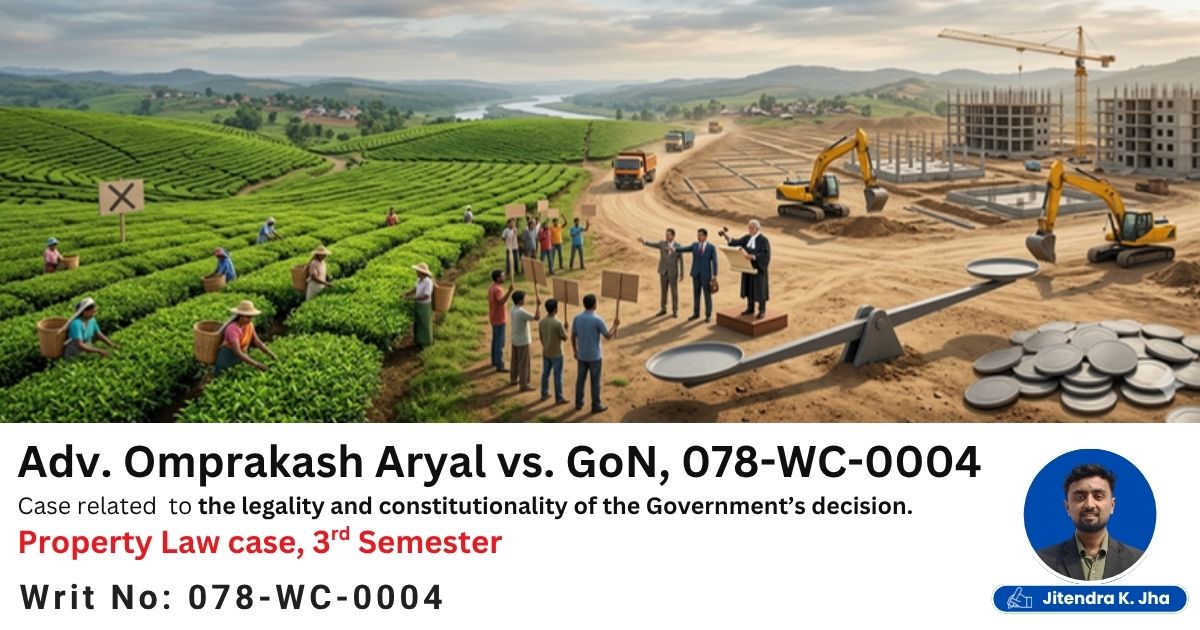
Property Law Case: Adv. Omprakash Aryal vs. GoN, 078-WC-0004, Decision. Date 2080-10-24
Case:Writ of certiorari
Plaintiff: Om Prakash Aryal, Bhakta Raj Bharti and others, Om Prakash Mishra
Defendant: Government of Nepal and et.al
Writ Number: 078-WC-0004 (Along with 078-WC-0012 and 076-WC-0030)
This case is related to the legality and constitutionality of the Government’s decision.
Facts of the Case:
Under the Lands Act, 1964, landowners are not allowed to own land beyond the legal ceiling limit. However, the Government of Nepal may grant exemption from the ceiling limit for agricultural industries and specific public purposes. Under this provision, Giribandhu Tea Estate Pvt. Ltd. was granted permission to hold a large area of land in Jhapa for operating a tea industry. Later, the Lands Act was amended through the Eighth Amendment, 2076 B.S., and new provisions were introduced allowing land that had received ceiling exemption to be exchanged, transferred, sold, or relocated under certain conditions. After this amendment, the Council of Ministers on 2078/1/13 B.S. approved the exchange and relocation of around 343 bighas of Giribandhu Tea Estate land within Province No. 1. The petitioners argued that the amendment and Cabinet decision were made mainly to benefit Giribandhu Tea Estate and some limited private interests. According to them, valuable tea estate land was being converted into residential and commercial land for plotting and business purposes. They claimed that this violated constitutional principles such as land reform, social justice, public welfare, environmental protection, and the socialism-oriented character of the Constitution.
The petitioners further argued that land exempted for tea industry purposes could only be used for that original purpose and could not legally be sold, exchanged, or transferred for private commercial benefit. They also claimed that if the industry could no longer operate, the excess land should return to the Government of Nepal. Therefore, they filed writ petitions seeking to invalidate the amended legal provisions and cancel the Cabinet decision.
Legal Issues:
- Whether the provisions added by the Eighth Amendment to the Lands Act allowing the exchange, transfer, relocation, or sale of ceiling-exempted land were constitutional or not.
- Whether land originally exempted for operating a tea industry could later be used for residential or commercial purposes through exchange or transfer.
- Whether the Cabinet decision dated 2078/1/13 approving the exchange and relocation of Giribandhu Tea Estate land was lawful and consistent with the Constitution, public interest, and land reform policies.
Different Level of Court Decision:
Preliminary Order of the Supreme Court::
At the preliminary stage, the Supreme Court issued a show-cause order asking the respondents to explain why the requested writ orders should not be issued. The Court also issued an interim order maintaining the status quo and temporarily preventing the transfer or exchange of the disputed land until final hearing. The basis of the interim order was that immediate implementation of the decision could cause irreversible consequences and possible misuse of public property.
Written Replies and Arguments of the Respondents:
The Government of Nepal and related authorities argued that the amendments to the Lands Act and Rules were constitutional and legally valid. According to them, industries and companies may need relocation in special circumstances, and therefore the law allowing exchange or relocation of exempted land was necessary. The respondents further argued that the law itself contained safeguards against misuse. If exempted land was not used according to the approved purpose, the Government could confiscate it under the Lands Act. Therefore, they claimed that the amended provisions did not violate the Constitution. Giribandhu Tea Estate Pvt. Ltd. also argued that it only intended to relocate the tea industry according to law and did not intend to destroy the tea estate or misuse the land commercially. The company argued that the amendment was a legislative policy matter within Parliament’s authority.
Constitutional Bench of the Supreme Court:
The Constitutional Bench held that the disputed legal provisions themselves were not unconstitutional. The Court ruled that Section 12(G), Section 12(E), Rule 16(A), and Schedule 5A of the Lands Act and Rules were enacted under lawful authority and were not inconsistent with the Constitution. Therefore, the Court refused to invalidate those legal provisions.
However, the Court held that the Cabinet decision dated 2078/1/13 allowing Giribandhu Tea Estate Pvt. Ltd. to exchange 343 bighas 19 kattha 12 dhur of land was not in accordance with the Lands Act and related legal provisions. The Court found the decision to be premature and legally improper. Therefore, the Constitutional Bench quashed the Cabinet decision and all related actions and correspondence through a writ of certiorari. The Court also directed the Government to identify land that was not being used according to the purpose for which ceiling exemption had originally been granted and to bring such excess land under Government ownership according to the Lands Act.
Principle Established:
- Land receiving ceiling exemption must be used only for the purpose for which the exemption was originally granted.
- Even if the law allows transfer or relocation in certain circumstances, the Government must strictly follow legal procedures, conditions, and public interest requirements before approving such actions.
- The case also established that although Parliament may amend land laws, executive decisions taken under those laws can still be reviewed and cancelled by the Court if they are arbitrary, premature, or contrary to the purpose of the law.
- The Court further emphasized the importance of protecting public resources, agricultural land, land reform policies, social justice, and constitutional public welfare principles.