

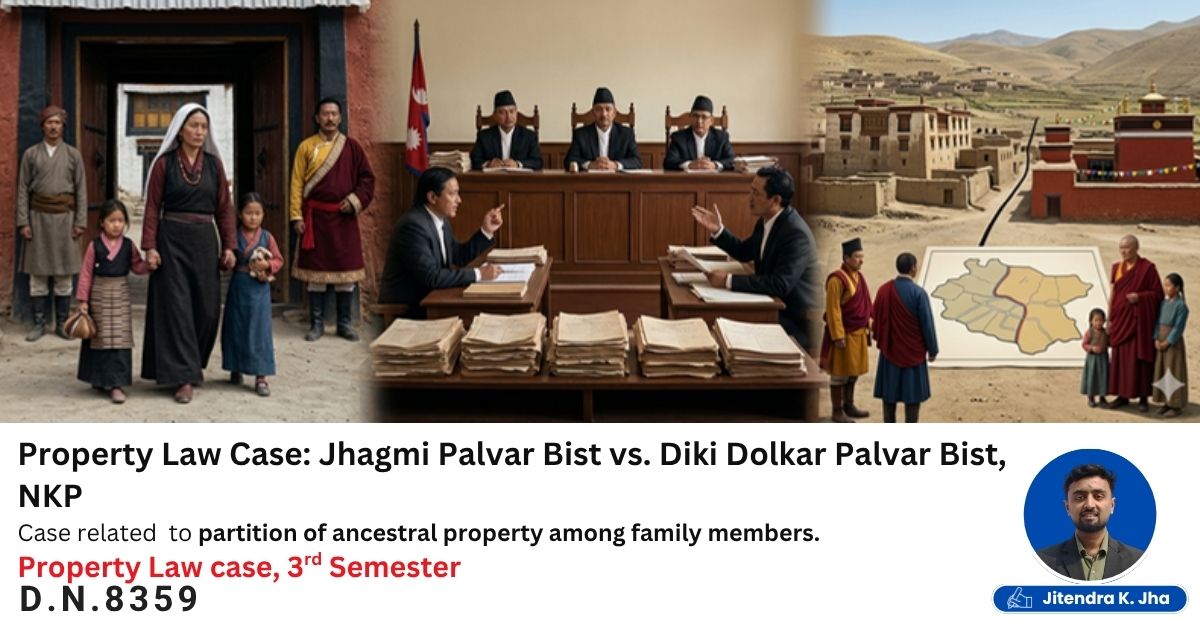
Property Law Case: Jhagmi Palvar Bist vs. Diki Dolkar Palvar Bist, NKP 2067 B.S, D.N. 8359.
Case: Partition and Separate Possession of Ancestral Property among Coparceners
Plaintiff: Karsang Lawang, acting on behalf of Diki Dolkar Palvar Bist
Defendant: Jhigmi Palvar Bist and others
Decision Number: 8359
This case is about partition of ancestral property among family members.
Facts of the Case:
This case concerns the partition of ancestral property of the Mustang royal family. The plaintiff, Diki Dolkar Palvar Bist, was the widow of the late Mustang King. After her husband’s death in 2015 B.S., she and her two daughters were allegedly removed from the Mustang Palace by defendant Jhigmi Palvar Bist, who later became the Mustang King. The plaintiff claimed that she had never received her share of the ancestral property and filed a partition case demanding her legal share.
The defendants argued that partition had already taken place privately in 2017 B.S. and that the plaintiff had already received property, which was later transferred to her daughters’ names. However, the defendants failed to produce the original partition deed before the Court.
Another issue was whether Thukden Gyacho Bist, the middle brother who had become a Buddhist Lama, still had partition rights. The Supreme Court held that becoming a Lama did not end his partition rights because he still had wives and children. Therefore, the Court recognized three coparceners in the family and held that the plaintiff was entitled to one-third share of the ancestral property.
The Court further held that the Charang Monastery could not be partitioned because it was a religious property, while the Mustang Palace, though historically important, remained ancestral property subject to partition with preservation of its historical and cultural character.
Legal Issues
- Whether it could legally be held that partition had already taken place between the plaintiff and defendants in 2017 B.S.
- The Court had to determine how many coparceners existed in the family.
- The Court had to determine which properties were subject to partition and which were not.
Different Level of Court Decisions:
Mustang District Court:
The case was first filed before the Mustang District Court. Court required the defendants to produce strong evidence proving that partition had already taken place. Although the Court ordered them to produce the original partition deed of 2017 B.S., the defendants failed to submit it. Court found that there was no dispute that the plaintiff was a coparcener and that there was no reliable evidence proving she had already received partition. Therefore, the Court ordered submission of detailed property statements (Tayadati) of all family properties. Later, by order of the Supreme Court, the case was transferred to the Baglung Appellate Court.
Baglung Appellate Court:
Baglung Appellate Court held that there was insufficient proof that a lawful partition had already taken place between the parties. Therefore, it recognized the plaintiff’s right to partition. However, Court excluded Thukden Gyacho from the list of coparceners and recognized only two coparceners. On that basis, it granted the plaintiff half share of the property. The Court also held that the Mustang Palace, monastery, and Kathmandu property were special properties not subject to partition.
Supreme Court:
The Supreme Court partially reversed the decision of the Appellate Court. It held that the alleged partition deed of 2017 B.S. was not proven because the original document had never been produced and conduct evidence was also insufficient to prove prior partition. The Court further held that Thukden Gyacho could not be deprived of partition rights merely because he became a Lama, as he had not performed “Mudii Vijaya Hom,” which legally terminates partition rights. The Court also held that his wives and children retained legal rights in the ancestral property. Therefore, the Court recognized three coparceners in the family and granted the plaintiff one-third share of the property.
The Supreme Court held that the Mustang Palace was ancestral property and therefore subject to partition. However, due to its historical and cultural importance, the property had to be partitioned while preserving its historical and cultural character.
The Court also held that the monastery could not be partitioned because it was a religious property of public nature. Similarly, the Kathmandu property was held not subject to partition because it had been acquired through government assistance as a special property.
Principle Established
- Partition cannot be presumed merely on the basis of photocopies or assumptions. Strong evidence such as registration, transfer, possession, and sale transactions is necessary to prove partition under No. 30 of the Chapter on Partition.
- Even if a family member gives up his own claim to partition, the partition rights of his wife and children do not automatically end.
- Religious properties such as monasteries, being connected with public religious faith, cannot be partitioned.