

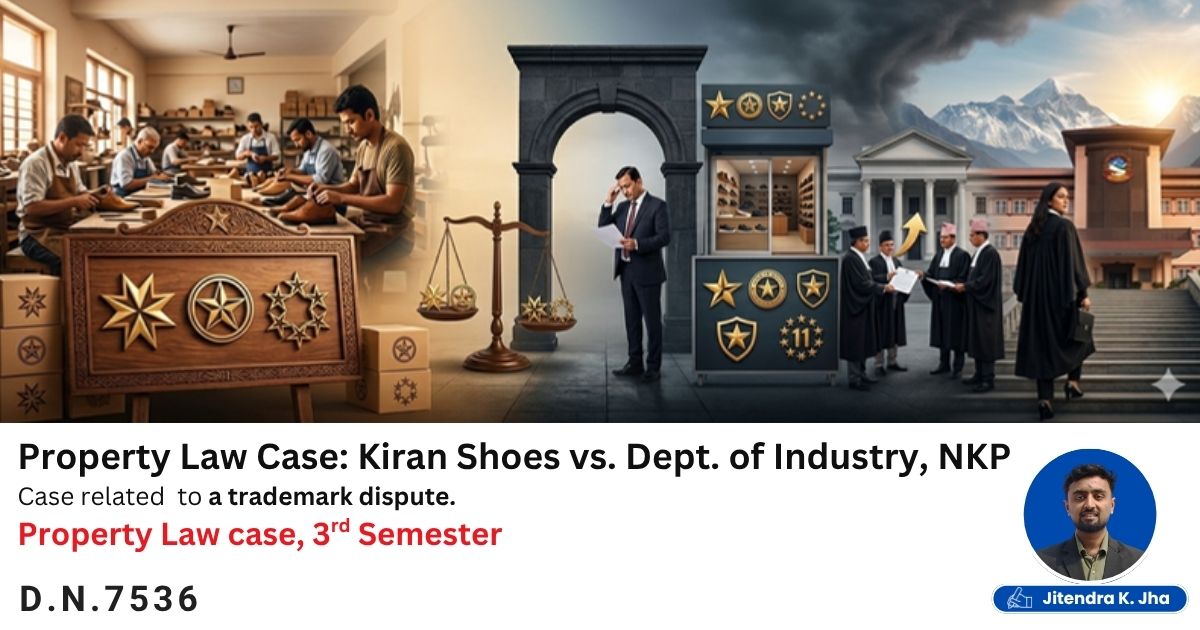
Property Law Case: Kiran Shoes vs. Dept. of Industry, NKP 2062 B.S, D.N. 7536
Case: Trademark Dispute Case
Plaintiff: Kiran Shoes Manufacturers, Maharajgunj, Kathmandu (represented through Noor Pratap Rana)
Defendant: Department of Industry, Tripureshwor, Kathmandu and Basnet Footwear Industries
Decision Number: 7536
This case is related to a trademark dispute.
Facts of the Case:
Kiran Shoes Manufacturers had been producing and selling shoes for many years using the trademarks “Gold Star,” “Super Star,” and “Seven Star.” These trademarks were already registered and had gained a strong reputation and public trust in the market. Later, Basnet Footwear Industries applied to register the trademarks “Gold Super,” “Good Star,” and “Eleven Star.” The Department of Industry refused to register those trademarks because they were very similar to the trademarks already registered by Kiran Shoes. The Department believed that consumers could be confused and that the reputation of Kiran Shoes could be harmed. Basnet Footwear then filed an appeal before the Patan Appellate Court. The Appellate Court reversed the Department’s decision and ordered the registration of those trademarks, stating that similarity in names alone was not enough to refuse registration.
After this, Kiran Shoes filed a writ petition before the Supreme Court. The petitioner argued that the decision was made without giving them an opportunity to be heard and that the new trademarks were visually and phonetically similar to their registered trademarks. They also argued that the registration of such trademarks would confuse consumers and damage their business reputation.
Legal Issue:
- Whether a trademark similar to an already registered trademark can legally be registered.
- Whether the trademarks “Gold Super,” “Good Star,” and “Eleven Star” were similar enough to confuse consumers.
- Whether the registration of similar trademarks violated Sections 16 and 18 of the Patent, Design and Trademark Act, 2022.
- Whether the affected party should have been given an opportunity to be heard before the decision was made.
Different Level of Court Decision:
Department of Industry:
Department of Industry refused to register the trademarks requested by Basnet Footwear. It held that the trademarks were very similar to the already registered trademarks of Kiran Shoes. According to the Department, the names, pronunciation, and overall appearance of the trademarks could confuse consumers and damage the reputation of Kiran Shoes. Therefore, registration was refused under the Patent, Design and Trademark Act, 2022.
Patan Appellate Court:
Basnet Footwear challenged the Department’s decision before the Patan Appellate Court. The Court reversed the Department’s decision and allowed the registration of the trademarks. The Court stated that similarity in names alone was not sufficient to refuse registration and held that the trademarks would not seriously affect the reputation of another company.
Joint Bench of the Supreme Court:
In the Joint Bench of the Supreme Court, judges delivered different opinions.
Opinion of Justice Anoop Raj Sharma:
Justice Sharma held that the Appellate Court’s decision was incorrect. He stated that the trademarks were visually and phonetically similar and could easily confuse consumers. He also held that deciding the matter without hearing Kiran Shoes violated the principle of natural justice. Therefore, he concluded that the Appellate Court’s decision should be quashed.
Opinion of Justice Parmananda Jha:
Justice Jha held that the writ petition should be dismissed because the petitioner had alternative legal remedies available under the law. According to him, the petitioner should have used those remedies instead of directly filing a writ petition before the Supreme Court.
Since the judges disagreed, the case was referred to the Full Bench.
Final Decision of Full Bench of the Supreme Court:
Supreme Court held that the disputed trademarks were visually and phonetically similar to the trademarks of Kiran Shoes. The Court explained that the main purpose of a trademark is to distinguish one company’s goods from another and that similar trademarks could confuse consumers. The Court further held that a trademark already registered and famous in the market must be protected by law.
Therefore, Supreme Court quashed the decision of the Patan Appellate Court and restored the original decision of the Department of Industry.
Principle Established:
- A trademark similar to an already registered and reputed trademark cannot be registered.
- While comparing trademarks, the court must consider pronunciation, appearance, and overall impression.
- A trademark that may confuse consumers or harm the reputation of an existing trademark should not be registered.
- Registered trademarks are legally protected as intellectual property rights.
- The Supreme Court may exercise writ jurisdiction when alternative legal remedies are ineffective.