

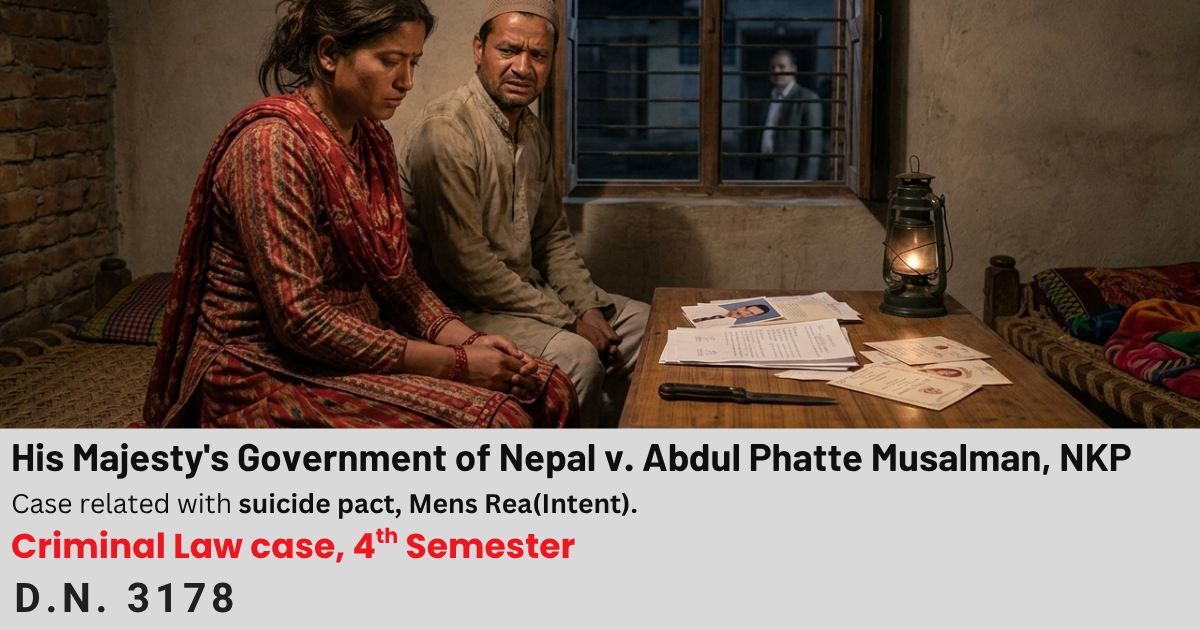
Criminal Law Case: His Majesty’s Government of Nepal v. Abdul Phatte Musalman, NKP (2044), No. 8, DN: 3178
Case: Homicide/ Suicide
Plaintiff: HMG on behalf of Fulmati FIR
Defendant: Abdul Phatte Musalman
Decision Number: 3178
This case is related with suicide pact, Mens Rea(Intent).
Fact of the case:
In this case, deceased Indra, a 27 year old woman, was living with her mother, Fulmati, in Kapilvastu. Accused, Abdul Fatte Musalman (also known as Bhunnu), was from same village and had been in a love relationship with Indra for about 7 years. Their relationship was very close, and for about 3 years, even Indra’s mother was aware of it. Accused used to visit and stay at girlfriend house, and they lived like husband and wife.
However, some time before the incident, accused came to know that Indra had a relationship with another man, Dr. Rameshwar. This created tension between them. Accused asked Indra whether she wanted to live with him or with doctor, and Indra replied that she would stay with him and even die together if necessary.
Despite this, she continued to talk with the doctor, and her grandmother was also trying to arrange her marriage with doctor.
Due to this emotional stress, insecurity, and social pressure, both Indra and accused decided to commit suicide together.
On 2039/05/03, accused stayed whole day at Indra’s house. In evening, Indra after having dinner with her mother, at around 11:30 PM, went inside a room, locked the door from inside, and lay down on a bed together.
Indra took out a knife and, after both agreed to die, she placed the knife in accused’s hand and brought it to her own neck. She held his hand and pressed it firmly against her throat, pulling it in such a way that the knife cut deeply into her neck, causing her death due to severe bleeding.
After this, accused used same knife to stab himself multiple times in abdomen in an attempt to commit suicide. His injuries were severe, and even his intestines had come out. He became unconscious and remained lying on the same bed.
At around midnight, Indra’s mother heard cries of pain from inside the house. When she found the door locked from inside, she became suspicious and called neighbors. Since the door could not be opened, a person climbed onto the roof and looked inside with a torch. He saw Indra lying with her throat cut and another man (the boyfriend) lying injured. They informed the police and Indra’s mother filed a FIR against Abdul Phatte Musalman.
Legal Issues:
- Whether the death of Indra was suicide or homicide (murder)?
- Whether the accused had the intention to kill or only to die together.
- What is the appropriate punishment in such circumstances.(Life imprisonment or less)
Decision of Courts:
Kapilbastu District Court:
District Court held that accused had caused the death of Indra by stabbing her with a knife, which amounted to murder. Court stated that even if there was mutual agreement to die, taking another person’s life is still a criminal act under the law. Therefore, accused was sentenced to life imprisonment. However, considering social background, love relationship, and mental condition of the parties, court expressed that punishment might be harsh and forwarded the case with its opinion to the higher court.
Western Regional Court:
Regional Court agreed that accused had committed murder and upheld main finding of District Court. However, it took into special circumstances such as love relationship between the parties, their mutual decision to die together, and fact that accused had also attempted to kill himself. Considering these factors, court found that life imprisonment was too severe and reduced sentence to 6 years of imprisonment.
Supreme Court:
Supreme Court confirmed that death of Indra was caused by act of accused and thus amounted to homicide. Court also observed that since both parties had discussed dying together and were sitting with a knife, there was clear intention to kill. However, Court also considered mitigating factors such as emotional distress due to love relationship, mental weakness, mutual agreement to commit suicide, and accused’s own serious self-inflicted injuries. Based on these circumstances, Court held that life imprisonment would be excessively harsh. Therefore, it upheld the Regional Court’s decision and maintained the sentence of 6 years imprisonment. It also ordered that the accused be released after completing 6 years from the date of detention.
Principle Established:
Even if there is mutual consent to commit suicide, actively causing the death of another person amounts to murder.
It also clarifies that intention can be inferred from circumstances, not only from words.
Furthermore, case highlights that courts may consider mental condition, emotional factors, and surrounding circumstances while determining punishment.