
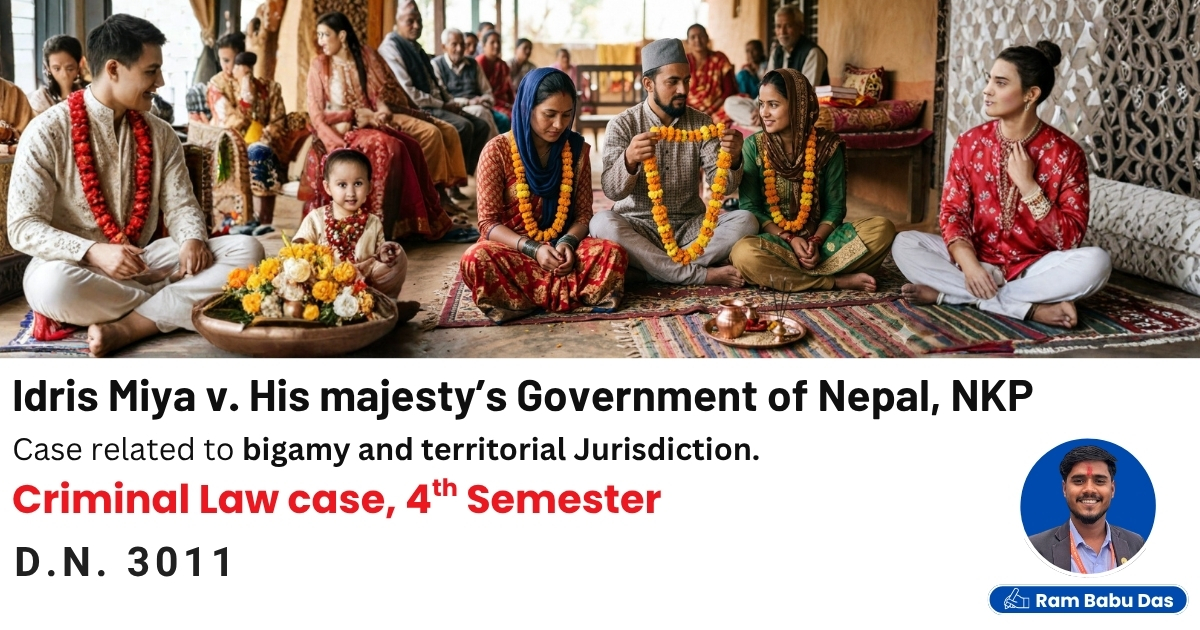
Criminal Law Case: Idris Miya v. His majesty’s Government of Nepal, NKP (2044), NO.2, DN: 3011
Case: Bigamy
Plaintiff: HMG on behalf of Md. Najibulla Miyan
Defendant: Idris Miyan & Bachcha Miyani
Decision Number: 3011
This case is related with Bigamy & Territorial Jurisdiction.
Fact of the case:
Bilmohammad Miya, the resident of Jhapa, had been raising his niece, Bachcha Miyani. Later, Bachcha Miyani became pregnant. So he took her to India in Baisakh 2037, and on Jestha 11, 2037, she was married to his own son Idris Miya according to Indian law.
Indris Miya had already been married about 10 years earlier and had a daughter. His first wife was still alive, and there had been no legal divorce performed at the time of the second marriage.
After learning about this, Ward Chairman Najibulla Miya filed a complaint on Shrawan 23, 2037, alleging that Bilmohammad Miya had impregnated his niece and married her to his son Indris Miya in order to conceal his illicit relationship; since Indris was already married, this constituted bigamy, and he requested legal action.
Bilmahmad Miya admitted that his son Indris was already married and that he had taken Bachcha Miyani to India and arranged her marriage with his son. However, he denied any involvement in her pregnancy and stated that the child belonged to his son.
Indris Miya admitted that he is already married and had another marriage with Bachcha Miyani. He stated that Bachcha Miyani’s pregnancy belonged to him and that he married her in India on Baisakh 17, 2037, in the presence of her father according to customary rites of India. He brought her to Nepal on Jestha 17, 2037.
Legal Issue:
- Does Nepali law on bigamy apply if a Nepali citizen marries a second wife in a foreign country?
- Is it an offence to marry another woman while the first marriage is still valid?
Decision of Courts:
Jhapa District Court:
District Court acquitted defendants. It held that marriage was not clearly proven in and that the case did not fall under the category of government cases. Therefore, bigamy was not established.
Mechi Zonal Court:
Appellate Court reversed District Court’s decision. It found that Indris Miya had indeed committed bigamy and that Bachcha Miyani knowingly entered into marriage.
Court sentenced both defendants to 1 month imprisonment and a fine of Rs. 1000 each.
Eastern Regional Court:
Regional Court overturned Appellate Court’s decision and dismissed case. It reasoned that since the marriage took place in India, there was no clear legal provision allowing Nepali courts to decide on such a matter.
Supreme Court:
Supreme Court held that Regional Court’s decision was incorrect. It ruled that Indris Miya is a Nepali citizen, and therefore Nepali law applies to him regardless of where the marriage took place. Court clarified that Nepali law prohibits a man from marrying another woman while his first wife is still alive and without legal divorce. This restriction applies even if the second marriage is conducted abroad.
Therefore, the dismissal of the case by the Regional Court was improper.
Principle Established:
Nepali law on bigamy applies to Nepali citizens wherever they are, even if the second marriage takes place outside Nepal.
In other words, a Nepali citizen cannot escape liability for bigamy by going abroad to marry again while the first marriage is still valid.