

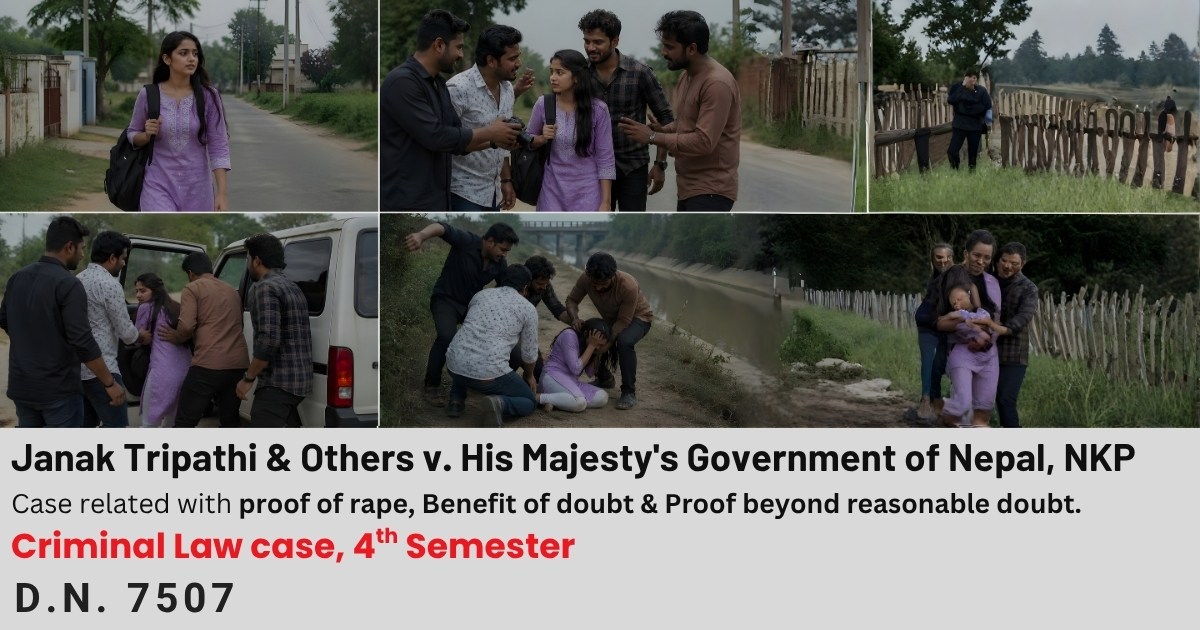
Criminal Law Case: Janak Tripathi & Others v. His Majesty’s Government of Nepal, NKP 2062, No. 9, DN: 7507
Case: Rape
Plaintiff: Government of Nepal on the complaint of Lekh Kumari Giri
Defendant: Janak Tripathi, Sanjay Adhikari, Raj Kumar Chaudhary, et al.
Decision Number: 7507
This case is related with proof of rape, Benefit of doubt & Proof beyond reasonable doubt.
Facts of the case:
This incident took place on Kartik 1, 2054 in Chitwan District. A 14 years girl, Januka Giri, left her home to visit her uncle. On the way, she met 25 years Sanjay Adhikari, who convinced her to go to a place called Mohana on the pretext of taking photographs. At that location, other accused Janak Tripathi, Rajkumar Chaudhary and others were also present. According to the allegation, accused took her to a secret canal bank where one of them covered her mouth, another held her hands, and they pushed her to the ground. Then, one by one, they committed forcible rape on her. Due to severe pain and injuries, she became unconscious and was later rescued by local villagers and taken to police. Then, on Kartik 3, 2054 (two days after the incident), her medical examination was conducted.

Medical examination revealed bruises on her left breast and around eye, bleeding from the vagina, and torn hymen. However, no sperm was found.
During investigation, victim initially identified defendants. One defendant, Janak Tripathi, also confessed before police. However, later in court, victim changed her statement, saying, “I don’t know who committed rape.” Her mother Lekh Kumari Giri also changed her statement, saying she had filed complaint based on what villagers told her. Witnesses stated in court that they had not seen incident. Everyone hostile before the court.
Serious flaws were found in investigation, including delays (victim’s medical examination was not done immediately, It was done only two days after the incident), corrections in documents, and failure to conduct tests on time.
Legal Issue:
- Is there sufficient, beyond reasonable doubt evidence to prove that the defendants committed rape without consent?
- Whether the decision of the Appellate Court convicting the accused was legally correct.
Decision of the Courts:
Chitwan District Court:
Chitwan District Court acquitted all the accused. Court observed that victim and her mother changed their statement before court and did not support their claim. Witnesses also hostile before court and failed to support the occurrence of the incident. Court further noted that there was no strong, consistent, and reliable evidence identifying accused as the perpetrators. Although medical report indicated that rape had occurred, it was not sufficient to establish identity of offenders. Therefore, due to the lack of credible evidence, court gave benefit of doubt to accused and acquitted them.
Appellate Court Hetauda:
Appellate Court Hetauda, disagreed with findings of District Court and reached a different conclusion. It held that medical report clearly confirmed that rape had occurred and that initial statements given during investigation identified accused persons. Court also considered confession made by Janak Tripathi before police as an important piece of evidence. It reasoned that minor procedural errors should not be used to acquit accused in serious offences like rape. On this basis, Appellate Court reversed District Court’s decision, convicted all accused, sentenced each of them to three years’ imprisonment, and ordered compensation to be paid to victim from accused’s property.
Supreme Court(Full Bench):
Supreme Court overturned Appellate Court’s ruling and upheld District Court’s acquittal. Court found that investigation process was seriously flawed and not conducted in accordance with legal standards. It pointed out that there were delays in medical examination, failure to properly examine accused, concealment of important facts, and alteration of official documents. Court also emphasized that victim and her mother had changed their statements during trial, and witnesses were not reliable. As a result, evidence lacked consistency and credibility.
Supreme Court reiterated that in criminal law, conviction cannot be based on mere suspicion. Since there was reasonable doubt regarding involvement of accused, they were entitled to benefit of doubt. Therefore, Court acquitted all accused.
Principle Established:
This case establishes that in criminal law, a person can only be convicted on the basis of clear, reliable, and legally obtained evidence, to establish conviction the evidence must be proved beyond reasonable doubt. A complaint or initial accusation alone is not sufficient to prove guilt.
The case also highlights that a proper, fair, and lawful investigation is essential, as any serious defect in investigation can weaken the entire prosecution case. Most importantly, if there is any reasonable doubt in evidence, accused must be given benefit of doubt, and cannot be convicted.