

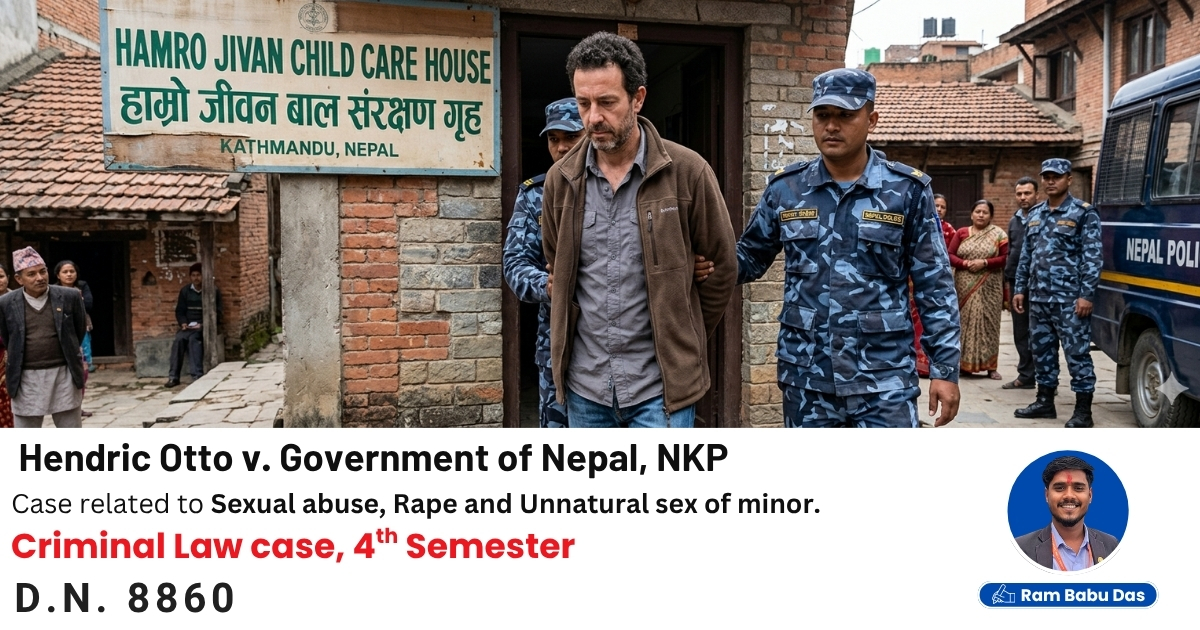
Criminal Law Case: Hendric Otto v. Government of Nepal, NKP 2069, No. 7, P. 1076, DN: 8860
Case: Rape of Minor Boys
Plaintiff: Government of Nepal (Victims are called “A” and “B” to protect their identity)
Defendant: Molhuysen Hendrik Otto and Resham Raj Sinkhada
Decision No: 8860
This case is related to Sexual abuse, Rape and Unnatural sex of the children(Minor boys).
Facts of the case:
Resham Raj Simkhada ran a children’s home called “Hamro Jeevan Child Care House” in Galkopakha, Kathmandu. The home sheltered orphaned and helpless children. A Dutch national named Molhuysen Hendrik Otto worked as the Director of this home and was responsible for bearing all its operational expenses.
Two children living in the home, referred to as A and B, filed a complaint against Otto. They stated that Otto would call them to his room at different times, make them remove all their clothes, touch and suck their private parts, apply ointment to their anal area, and forcibly insert his penis into their anus.
When police searched Otto’s room on 24 Kartik 2063, they found Otto and another person lying naked together. The search recovered ointments, an opened condom, identity cards, a computer, and a television. Otto’s laptop contained a browsing history of pornographic material showing unnatural sexual acts between men, along with printed copies of such images.
Many people living in the child care home such as staff member Bala Giri, former employee Prakash Khatri, foreign volunteers Elisabeth Wilhelmus and Eveline Clara Smit, and several children gave supportive statement that Otto had committed the crime.
A particularly important piece of evidence came from Interpol. Interpol Madrid sent a message to Interpol Kathmandu on March 12, 2007(2063/11/28 BS), confirming that a court in Spain had previously convicted Otto of child abuse and rape and sentenced him to six years in prison. This showed that Otto had a history of sexually abusing children.
Otto denied everything. He claimed the complaint was part of a conspiracy between a rival children’s home operator and the police. Simkhada also denied knowing about Otto’s conduct.
Legal Issues:
-
- Whether the offence under Section 9(a) of the Chapter on Rape of the Muluki Ain, attracts punishment under Section 3 of the same Chapter.
- Whether an act of unnatural sexual intercourse with a minor falls under Section 4 of the Chapter on Bestiality (Pashu Karani) of the Muluki Ain.
Decision of the Courts:
Kathmandu District Court:
District Court found Otto guilty. The court relied on the clear and consistent complaints of the victims, their testimony in court, the items recovered during the police search, the pornographic material found on Otto’s computer, and the supporting statements of many witnesses. The court was satisfied that the evidence was strong enough to prove that Otto had committed the offence. Otto was sentenced to eight years in prison under Section 3(2) of the Rape Chapter and an additional one year under Section 9(a) of the same Chapter, making a total of nine years in prison. He was also ordered to pay Rs. 25,000 in compensation to each victim. Simkhada was acquitted because there was not enough evidence to prove that he had knowingly helped Otto to commit the crime.
Patan Appellate Court:
Both Otto and Government of Nepal appealed. Otto wanted to be acquitted, and Government wanted Simkhada to be convicted. Appellate Court carefully reviewed all the evidence and legal arguments and agreed with the District Court’s findings. So appellate court upheld the district court decision.
Supreme Court:
Otto filed a petition before Supreme Court asking for a review of the lower courts’ decisions. Supreme Court granted permission to review the case on the limited question of whether the lower courts had wrongly interpreted Sections 3 and 9(a) of the Rape Chapter. After hearing both sides and examining all the case records such as police search report, testimonies, and Interpol messages, Supreme Court rejected Otto’s petition and upheld the decision of lower courts to impose 9 years imprisonment and to pay rs. 25,000 compensation to each victim.
Supreme Court firmly rejected Otto’s argument that Section 4 of the Bestiality Chapter should apply to his case instead of the Rape Chapter. The court explained that the Bestiality Chapter was created to deal with sexual acts involving animals, and had nothing to do with acts committed against human beings. The court further said that treating a human minor under the same legal framework as an animal would be deeply offensive to human dignity and was legally impossible. The court also clarified that just because two different chapters of a law use the same words like “unnatural sexual intercourse”, it does not mean those words carry the same meaning in both places, especially when the two chapters deal with entirely different situations.
The court also held that Section 9(a) of Rape Chapter is a clear and complete legal provision on its own. When the legislature added Section 9(a) through the Eleventh Amendment in 2059, it deliberately decided that unnatural sexual intercourse with any minor, whether a boy or a girl, would be treated as rape.
Principle Established:
- Same words can mean different things in different legal contexts: Just because two chapters of a law use the same term does not mean the term carries the same legal meaning in both places. If the two chapters deal with different subjects and do not refer to each other, they must be interpreted separately and independently.
- Criminal law must be interpreted strictly: A person cannot be punished for an act that is not clearly defined as a crime under the law in force at the time the act was committed. Courts cannot use broad or creative interpretation to create new offences. If there is genuine doubt about whether an act is a crime, that doubt must be resolved in favour of the accused.
- Unnatural sexual intercourse with a minor is rape under the law: Once the legislature has clearly classified unnatural sexual intercourse with a minor as rape under Section 9(a), courts cannot downgrade such conduct to merely child abuse through interpretation. The legislature’s intention is clear and binding.
- Interpol communications are admissible in court: Since Nepal is a member of Interpol, its law enforcement agencies are entitled to seek and use information from Interpol during criminal investigations. While such communications may not be conclusive proof on their own, they are relevant and can be used to establish the character and criminal history of an accused person.