
Property Law Case: Ramdulari Sravan Baishnav vs. Saligram Sravan Baishnav, NKP 2065 B.S, D.N. 7939
Case: Cancellation of Registration and Request for Registration
Plaintiff: Saligram Sravan Baishnav and Others
Defendant: Ramdulari Sravan Baishnav
Decision No: 7939
This case concerns with adverse possession and land ownership.
Facts of the Case:
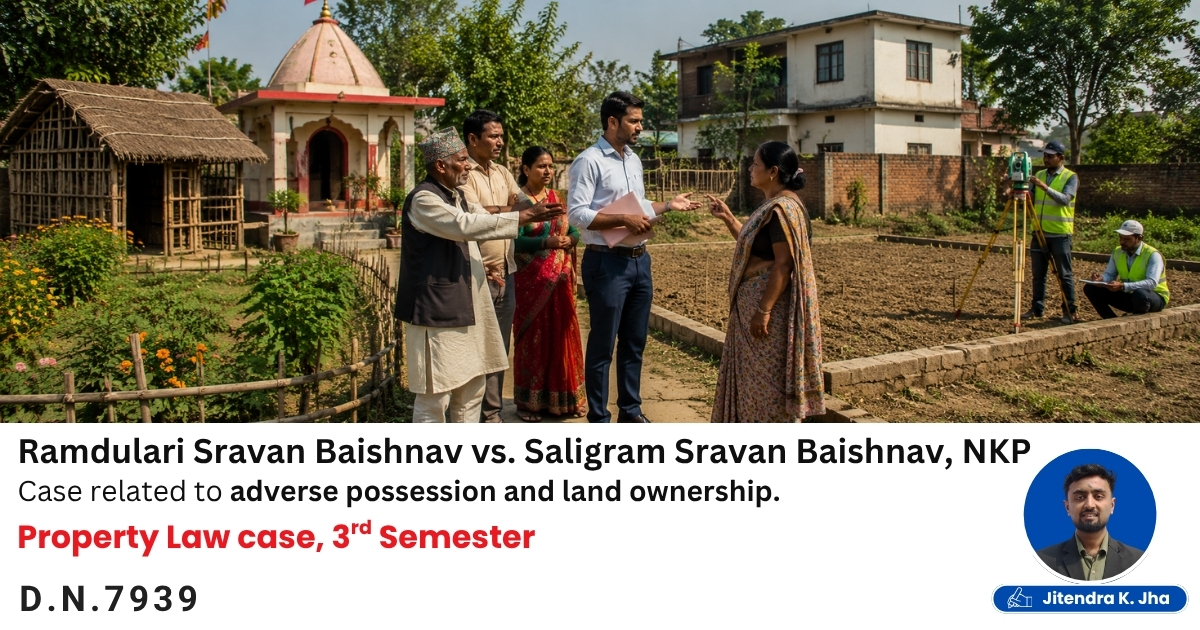
This case concerned a dispute regarding ownership and possession of land situated at Ward No. 8(E), Janakpur Municipality, Dhanusha District, Kitta No. 9. The plaintiffs claimed that they had been in continuous possession and enjoyment of the disputed land for a very long period of time. According to the record, a temple, kuti (religious hut), and garden existed on the land, and the plaintiffs were using and possessing the property continuously.
The defendant, Ramdulari Sravan Baishnav, claimed that she was the lawful owner of the land on the basis of a deed of gift (Bakashpatra) executed in 2007 B.S. in her favor by Ramdas Baishnav. Later, during the land survey process, Janakpur Urban Survey Camp temporarily registered the disputed land in my name in 2046 B.S.
The plaintiffs challenged that registration and filed the present case seeking cancellation of the registration made in the defendant’s name and requesting registration in their own names. They relied upon their long and uninterrupted possession of the property and also referred to an earlier “obstruction and possession” case filed by defendant in which the courts had refused to evict them from the land because they had been possessing and using it for many years.
The defendant argued that although the plaintiffs might have been in possession of the land, possession alone could not create ownership rights. She maintained that she remained the lawful owner because the land had legally come to her through the deed of gift.
The main dispute before the court was whether long and continuous possession (adverse possession) could create ownership rights over land under Nepali law.
Legal Issues:
- Whether ownership of land can be acquired through adverse possession. The court had to determine whether long and uninterrupted possession by a person who is not the legal owner can extinguish the ownership rights of the lawful owner and create ownership rights in favor of the possessor.
Decision of the Courts:
Dhanusha District Court:
Dhanusha District Court held that the decision of the Janakpur Urban Survey Camp to temporarily register the disputed land in defendant’s name was not lawful. The court found that the plaintiffs had long been in possession and enjoyment of the disputed property and that their possession had already been recognized in the earlier litigation.
On that basis, the District Court cancelled the registration made in the defendant’s name and ordered that the land be registered in the names of plaintiffs. The court mainly relied on the plaintiffs’ long and continuous possession of the property.
Janakpur Appellate Court:
Janakpur Appellate Court affirmed the judgment of the District Court. Appellate Court observed that in the earlier obstruction case, defendant had failed to remove the plaintiffs from disputed land and that the plaintiffs’ long possession had effectively been recognized by the court. The basis of the decision was the plaintiffs’ long standing and uninterrupted possession.
Supreme Court:
Supreme Court reversed the decisions of both the District Court and the Appellate Court. Supreme Court held that Nepalese law does not recognize acquisition of ownership merely on the basis of adverse possession, except in limited circumstances specifically provided by law.
The Court clearly distinguished between possession rights and ownership rights. It held that continuous possession may create a right of possession, but it does not automatically transfer legal ownership from the lawful owner to the possessor.
The Court further stated that ownership can only be transferred through legally recognized methods such as a registered deed, sale deed, gift, deed, or other lawful transfer process.
Supreme Court also clarified that earlier obstruction case had only protected the plaintiffs’ possession and had not transferred ownership of the land to them.
Accordingly, Court concluded that the defendant, Ramdulari Sharan Baishnav, remained the lawful owner of the disputed land and that the registration in her name could not be cancelled merely because the plaintiffs had long been in possession of the property.
Principle Established:
This case established an important legal principle regarding adverse possession under Nepali law.
- Supreme Court held that mere long and continuous possession of land does not create ownership rights. Adverse possession may create possessory rights, but it cannot extinguish the lawful owner’s title unless ownership is legally transferred according to law.
- The judgment clarified that the lawful owner continues to remain the real owner of the property unless ownership is legally transferred through recognized legal procedures.
The Court also explained that for adverse possession to exist, the possession must be:
- open,
- continuous,
- uninterrupted,
- and known to the lawful owner.
However, even such possession alone cannot create legal ownership under Nepali law.
This judgment is considered a leading precedent in Nepal regarding the doctrine of adverse possession.