

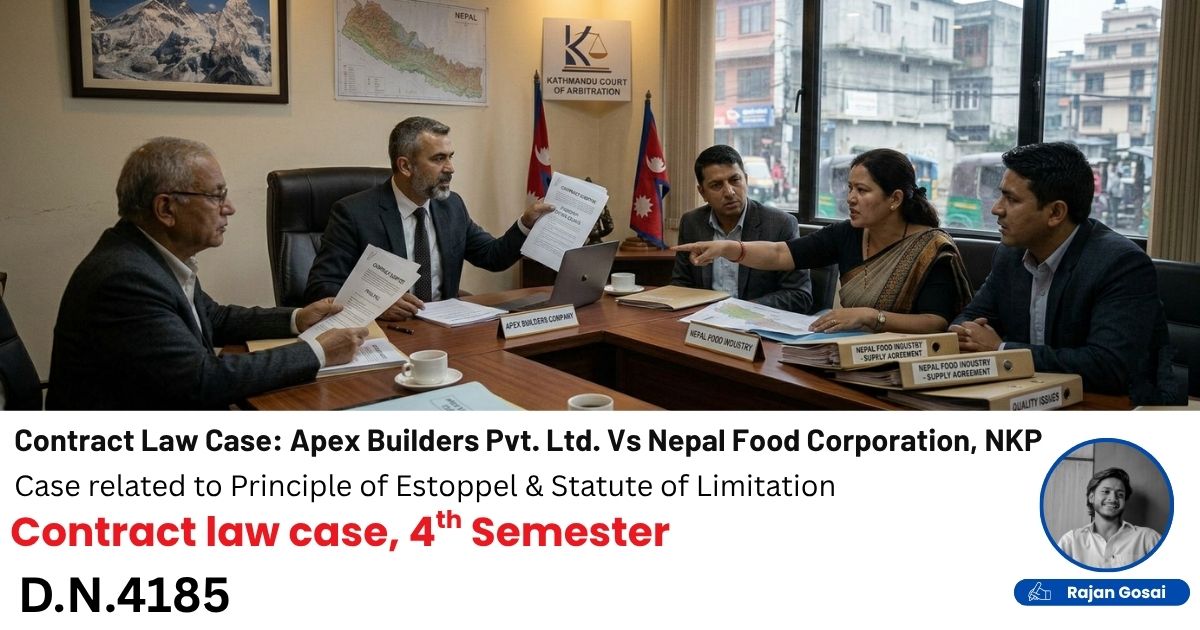
Contract Law Case: Apex Builders Pvt. Ltd. Vs Nepal Food Corporation. NKP, 2047, No.7, P.553, D.N.4185.
Case: Recover of dues amount.
Plaintiff: Apex Builders Pvt. Ltd.
Defendant: Nepal Food Corporation
Decision No: 4185
This case is related with Principle of Estoppel & Statute of Limitation.
Facts of the Case:
On January 3, 1978, Apex Builders Engineers Pvt. Ltd. entered into a contract with Nepal Food Corporation to demolish old warehouses and construct new buildings at designated sites (initially Biratnagar and Birgunj). According to Clause 2(2)&(3) of original agreement, all demolished materials were to become the property of the contractor. However, on January 9, 1978, the Corporation issued an amendment letter signed by construction official W.D. Alston on official letterhead. This letter altered two major terms:
-
- Site Change: Project locations were shifted from Birgunj and Biratnagar to Hetauda and Itahari.
- Ownership of Materials: The demolished materials were now designated to remain the property of the Corporation, not the contractor.
The contractor proceeded with the work at the newly amended sites (Hetauda and Itahari) but later claimed that the Corporation obstructed them from taking the demolished materials. Additionally, Corporation claimed Rs. 66,405/- from Nepal Bank Limited under a bank guarantee for cement dues.
The contractor filed various administrative complaints to the Ministry of Commerce and Supplies. On 2040/01/13, the Corporation officially notified the plaintiff that their administrative claim was rejected based on the January 9, 1978 amendment. Following this final notice, plaintiff approached to court.
Plaintiff’s Claim:
Under the original contract, all materials from the demolished warehouses legally belong to the contractor. The total value of these materials is Rs. 2,53,812/- The Corporation unlawfully seized Rs. 66,405/- from Nepal Bank Limited via a bank guarantee, which must be refunded. plaintiff argued their lawsuit was filed within the 3-month limitation period under Contract Act, 2023 BS, counting from 2040/01/13 BS the date they were formally notified of the Corporation’s final internal decision rejecting their request. plaintiff asserted that the individual who signed the amendment letter (W.D. Alston) was not an authentic authorized entity to amend the contract.
Defendant’s Arguments:
The contract was validly amended on January 9, 1978. Since the demolished materials became the Corporation’s property under this amendment, plaintiff has no legal right to claim them. Plaintiff willingly accepted the site changes mentioned in the amendment letter and performed work there, so they cannot selectively reject other part of the same amendment regarding ownership of materials. The deduction of Rs. 66,405/- was lawfully executed for cement supplied to the contractor. Nepal Bank Limited confirmed that the guarantee amount was fully paid and settled. If the contractor was aggrieved by the January 9, 1978 amendment, they should have filed a lawsuit to invalidate it within 3 months of that date. Filing a suit many years later based on an administrative response is time-barred.
Legal Issues:
- Can a party selectively accept and execute one part of a contract amendment while rejecting another part of the exact same document years later?
- Does the legal deadline to sue over an disputed amendment begin immediately upon its notification, or can it be reset years later by a final administrative rejection letter?
Decisions of the Courts:
Bagmati District Court: Dismissed the lawsuit, ruling it was time-barred. It held that plaintiff should have sued within 3 months of receiving the amendment notice under Section 18(2)(c) of the Contract Act, 2023 BS, rather than waiting years to sue based on an administrative decision.
Central Regional Court: Upheld the decision of Bagmati Court, stating that physical obstruction of material transport constituted a breach that should have triggered an immediate lawsuit within the legal timeframe.
Supreme Court: Upheld the decisions of both lower courts. The Supreme Court ruled that the plaintiff’s lawsuit was invalid due to expiration of the statute of limitations, and dismissed the appeal.
Established Legal Principles
Loss of Ownership by Amendment: Once a amended contract terminates a contractor’s ownership over certain materials, the contractor cannot claim that the employer created an “unlawful obstruction” by preventing them from taking those items.
Principle of Estoppel: A party cannot accept and profit from one portion of an amendment package (such as shifting working sites) and simultaneously claim years later that they do not accept another clause in the very same document.