

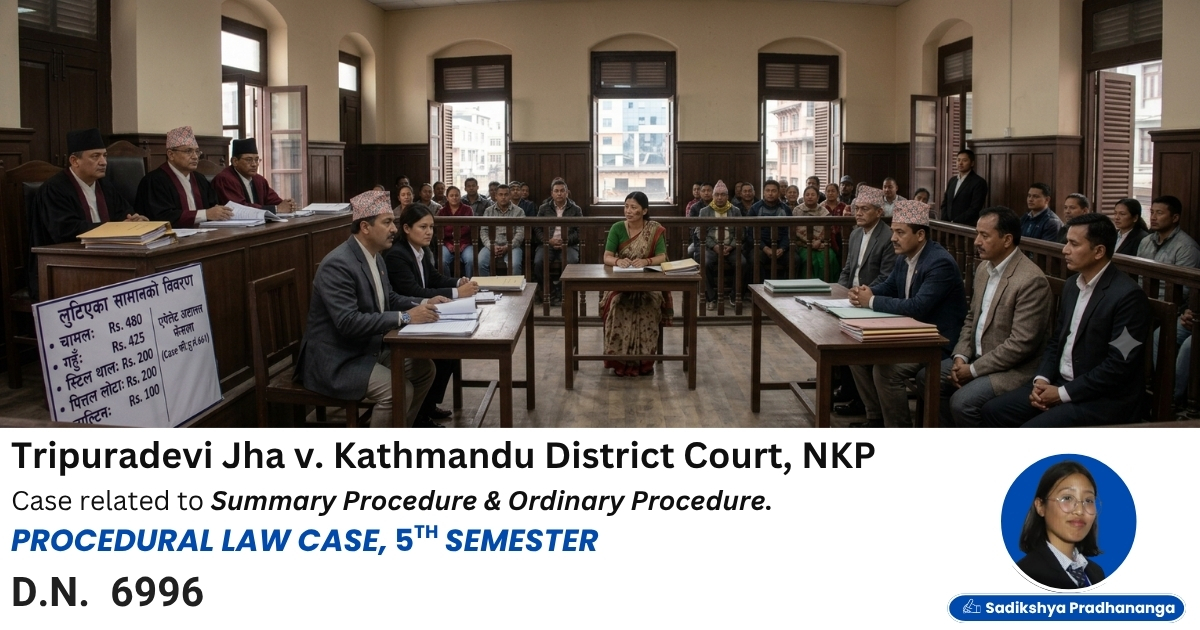
Procedural Law Case: Tripuradevi Jha v. Kathmandu District Court, NKP 2057 B.S., DN: 6996
Case: Robbery-related case
Plaintiff/Applicant: Tripuradevi Jha
Defendant/Respondent: Kathmandu District Court
Decision Number: 6996
This case is concerned with robbery, where the Supreme Court examined the sufficiency of evidence to establish the punishable act.
Facts of the Case:
On 2049/09/09 at 10:30 AM, in the absence of the plaintiff’s husband, the defendants entered the courtyard of the plaintiff and physically and verbally assaulted the plaintiff and her daughter. When they became unconscious, the defendants looted the plaintiff’s house goods worth Rs. 1,405, including:
- 480 worth of rice (Manasuli variety)
- 425 worth of wheat
- 200 worth of two steel plates
- 200 worth of two brass pots (lota)
- 100 worth of one bucket (walteen)
The plaintiff filed the case seeking compensation for the looted goods and punishment of the defendants. The defendants denied the allegations of robbery, stating that they are purely the outcome of personal enmity. Upon analyzing the evidence and witness testimonies, including a separate assault (Kutpit) case (Criminal. Reg. No. 661) arising from the same incident had already been decided by the Janakpur Appellate Court on 2052/3/1, holding the defendants guilty of assaulting the plaintiff, and that decision had become final. This prior judgment served as corroborative evidence in the looting case.
So, District Court had ruled in favor of the plaintiff, finding the defendants guilty of robbery, the Janakpur Appellate Court reversed this decision and acquitted the defendants. The plaintiff then appealed to the Supreme Court.
Here, due to the dissatisfaction of the plaintiff with the decisions delivered, the case was appealed to the Supreme Court.
Legal Issues:
- Did the prosecution prove the offence of robbery beyond the required standard of proof?
- Was the Appellate Court mistaken in dismissing the looting charge despite corroborating evidence?
- Are proceedings conducted under the ordinary procedure instead of the Summary Procedure Act, 2028, invalid?
Different Courts’ Decisions:
District Court:
District Court found the defendants guilty of looting and ordered the defendants to pay compensation and imposed the prescribed punishment. This decision was based on the categorical testimony of the plaintiff’s witnesses, Birendra Mitra and Maharudra Jha, who had clearly stated the date, time, and details of the stolen goods, thereby corroborating the plaintiff’s claim.
Appellate Court:
The Appellate Court reversed the decision of the District Court, stating insufficiency of evidence to establish the crime.
Supreme Court:
The Supreme Court allowed the plaintiff’s appeal and set aside the Appellate Court’s judgment. It held that Section 14 of the Summary Procedure Act, 2028, provides that proceedings are not invalid merely because the ordinary procedure was followed instead of the summary procedure.
The court reinstated the decision of the district court, stating that the plaintiff has provided sufficient evidence alongside the corroborated evidence from a related case of assault, finding the five defendants guilty of robbery and charging them with the prescribed punishment and compensation for stolen property.
Principle Established:
- Proceedings are not merely invalid due to procedural technicalities (summary vs. general procedure), as this does not invalidate substantive justice.
- A conviction for robbery can be based on credible and consistent eyewitness testimony when supported by corroborating evidence.
- A final judgment in a related criminal case may be relied upon as corroborative evidence to establish the occurrence of the incident.
- Mere denial by the accused, without supporting evidence, is insufficient to rebut credible prosecution evidence.
This case is significant because it clarifies that procedural irregularities do not automatically invalidate criminal proceedings where the law expressly provides otherwise. It also reinforces that consistent eyewitness testimony corroborated by independent evidence, including findings from a related criminal case, is sufficient to establish the offence of robbery.