
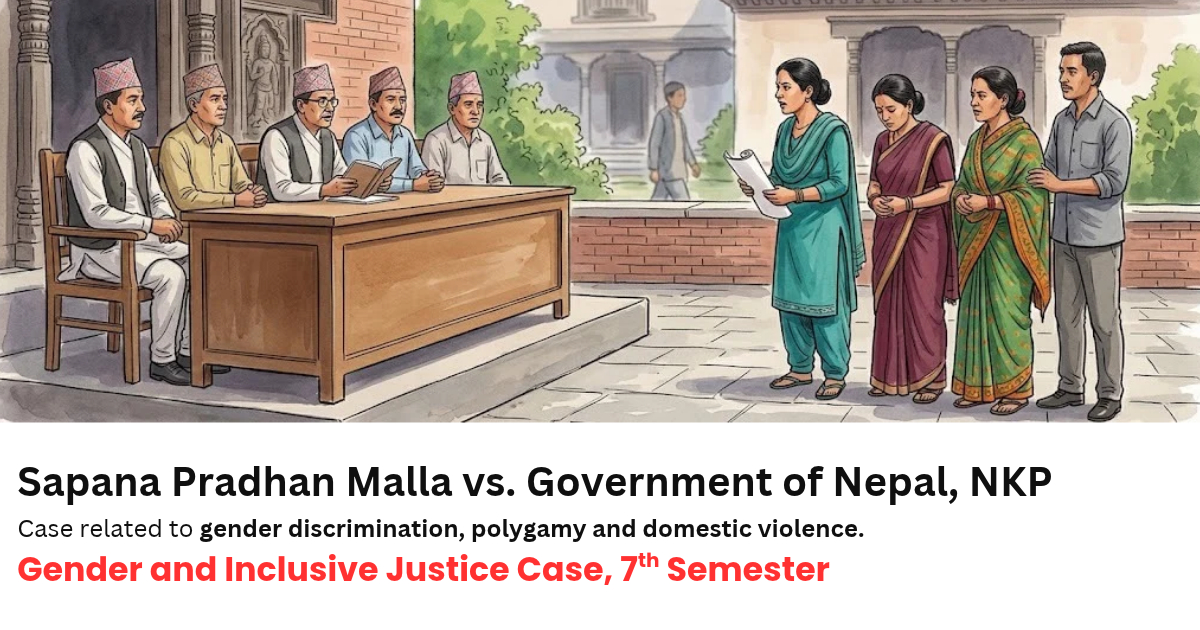
Gender and Inclusive Justice Case: Sapana Pradhan Malla vs. Government of Nepal & Others, (NKP) (2065), No. 8, P. 917, DN: 7997
Case: Certiorari and Mandamus
Plaintiff: Sapana Pradhan Malla
Defendant: Government of Nepal et.al.
Decision Number: 7997
This case is relating to gender discrimination, polygamy, domestic violence, and equality of spouses under marriage law.
Facts of the Case:
Sapana Pradhan Malla and other lawyers connected with the Forum for Women, Law and Development filed a public-interest petition before the Supreme Court of Nepal. They challenged Sections 9 and 9A of the Marriage Chapter of the Muluki Ain.
Section 9 allowed a husband to marry another woman while his wife was still alive in certain situations. These situations included when the wife had an incurable sexually transmitted disease, was incurably mentally ill, could not have children because of her own condition, could not walk, was blind in both eyes, or had taken her share of the property and lived separately.
Section 9A required the wife’s consent before the husband could marry again in some of these situations. However, her consent was not required when she was incurably mentally ill or when she had taken her share of the property and lived separately.
The petitioners argued that these provisions treated the husband and wife unequally. They placed the burden on the woman because of her illness, disability, inability to have children, or decision to live separately after taking her share of property.
The petitioners also argued that the provisions could encourage domestic violence. A husband might pressure, threaten, or harm his wife to obtain her consent for another marriage. The provisions could also make a woman choose between her property rights and her marital relationship.
The challenge was made under the Interim Constitution of Nepal, 2007. The petitioners also relied on the Convention on the Elimination of All Forms of Discrimination against Women (CEDAW), the Universal Declaration of Human Rights, and other international human-rights instruments.
Plaintiff’s Claims:
The petitioners argued that Sections 9 and 9A discriminated against women and violated their rights to equality, dignity, liberty, family life, property, and freedom from violence.
They argued that a woman’s illness or disability should not become a legal ground for her husband to marry another woman.
They also argued that requiring the wife’s consent could expose her to pressure, threats, or domestic violence.
The petitioners asked the Court to strike down the discriminatory provisions and direct the Government to make laws consistent with gender equality.
Defendants’ Arguments:
The Government argued that Section 9 was intended to regulate and discourage polygamy by allowing it only in limited situations.
It argued that Section 9A protected women by requiring their consent in most cases. It also stated that women could seek legal protection if force or violence was used.
The Government further argued that striking down the provisions completely could create a legal gap. It stated that legal reform was already being considered.
Legal Questions:
- Whether Sections 9 and 9A discriminated against women?
- Whether a husband could marry another woman because of his wife’s illness, disability, infertility, or separate residence?
- Whether the consent requirement could expose women to pressure or domestic violence?
- Whether the provisions were consistent with the Interim Constitution and CEDAW?
Different Court Decisions:
Supreme Court Decision:
The Supreme Court examined the disputed provisions in light of gender equality, women’s dignity, freedom from violence, and Nepal’s international obligations under CEDAW.
The Court observed that most of the grounds in Section 9 related to the wife’s health or disability. A wife suffering from serious illness, mental illness, blindness, or physical disability usually needed greater care and support from her husband. Her condition should not automatically become an opportunity for the husband to marry another woman.
The Court also noted that Section 9A did not require the wife’s consent when she was incurably mentally ill or when she had taken her share of property and lived separately. These exceptions could expose vulnerable women to further harm.
The Court held that the possibility of pressure, threats, and domestic violence had to be taken seriously. A legal provision should not be used in a way that allows a husband to obtain consent through fear or force.
The Court did not immediately declare all of Sections 9 and 9A void. It considered that striking down the entire provisions could create a legal gap. The Court also considered the Government’s stated commitment to reform gender-discriminatory laws.
Instead, the Court used its constitutional power to issue a directive order. It ordered the Government to amend Sections 9 and 9A so that they would be consistent with the Interim Constitution and CEDAW. The amended law had to remove discrimination between husbands and wives and prevent women from experiencing further violence or unequal treatment.
Principles Established:
- Marriage laws must provide equal treatment to men and women.
- A woman’s illness, disability, or infertility cannot by itself justify discriminatory treatment.
- Consent must be free and voluntary.
- Laws should not expose women to pressure, threats, or domestic violence.
- The State must remove discriminatory laws and practices against women.
- CEDAW must be reflected in Nepal’s domestic laws and legal practice.
- Equality applies to marriage, family life, property, and personal dignity.