
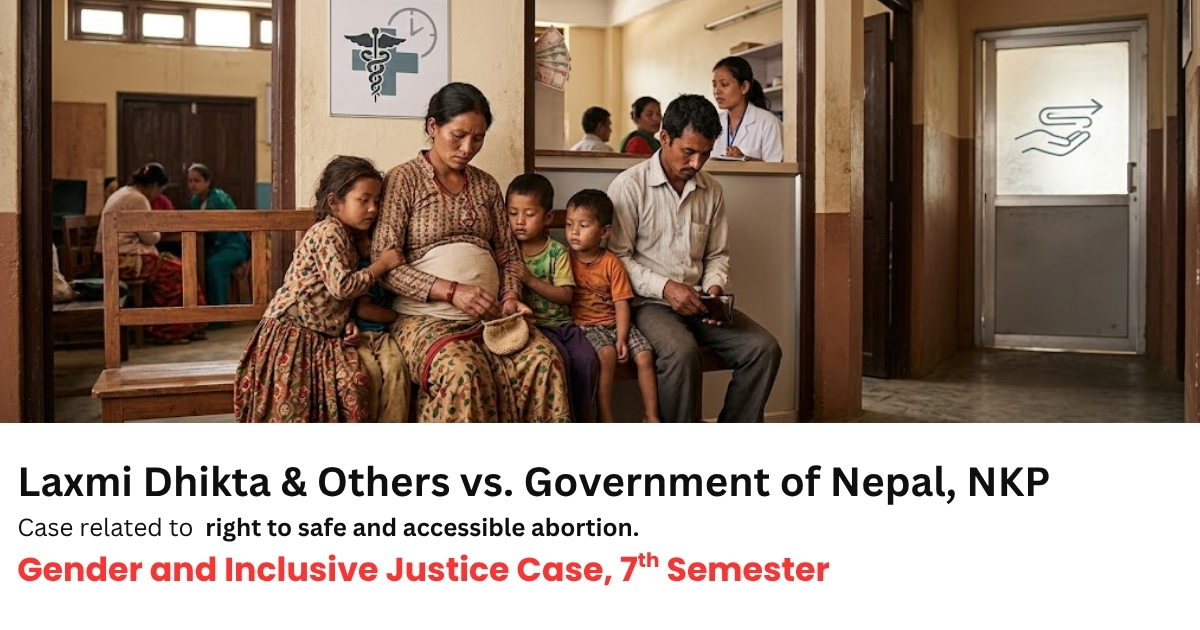
Gender and Inclusive Justice Case: Laxmi Dhikta & Others vs. Government of Nepal, NKP (2067), P. 1551, DN: 8464
Case: Mandamus
Plaintiff: Laxmi Dhikta
Defendant: Government of Nepal, Office of the Prime Minister and Council of Ministers
Decision Number: 8464
The case is relating to the right to safe and accessible abortion, reproductive rights, and the State’s duty to provide legal abortion services.
Facts:
Lakshmi Devi Dhikta, a woman from Ajayameru, Dadeldhura, had already given birth to five children. She later became pregnant again but did not want to continue the pregnancy.
At that time, Nepalese law permitted abortion in certain circumstances and required the service to be provided through approved health workers and institutions. Lakshmi and her husband therefore went to Dadeldhura Hospital to obtain an abortion.
The hospital required her to pay Rs. 1,130 for the service. Lakshmi was unable to pay the amount because of her financial condition. As a result, she could not obtain the abortion and was compelled to continue the pregnancy and give birth to another child.
The case was brought before the Supreme Court as a public-interest petition concerning access to abortion services. The petition also raised concerns about the practical availability of abortion services in Nepal. At the time, safe abortion services were not equally available in all districts, particularly in rural areas. Women could also face difficulties in obtaining information about legal abortion, finding trained service providers, and paying the required fees.
The petition further concerned the need for proper regulation of abortion services, including service fees, confidentiality of women seeking abortion, availability of trained health workers and health facilities, and public awareness about the legal availability of abortion.
Plaintiff’s Claims:
The petitioners claimed that legalising abortion was not sufficient if women could not actually access safe and affordable services. They argued that the State had a duty to make abortion services accessible, affordable, confidential and properly regulated, particularly for poor and rural women. Lakshmi also sought compensation for the harm she suffered after being unable to obtain the abortion.
Defendants’ Arguments:
The Government argued that Nepalese law had already legalised abortion in specified circumstances and that procedures had been established for providing safe abortion services. It stated that trained health workers and approved institutions were providing the service and that free services were available to poor women in appropriate cases. The Government also maintained that patient confidentiality was protected and that making or changing laws was primarily the responsibility of the legislature.
Legal Issues:
- Whether access to safe abortion is part of women’s reproductive rights?
- Whether the State has a duty to make legally permitted abortion services accessible and affordable?
- Whether failure to provide affordable abortion services violates women’s constitutional rights?
- Whether the existing legal and institutional framework was sufficient to protect women’s reproductive rights?
Different Court Decisions:
Supreme Court:
A Joint Bench of the Supreme Court, comprising Justices Kalyan Shrestha and Rajendra Prasad Koirala, allowed the petition in important respects.
The Court recognised reproductive rights as including a woman’s right to make decisions concerning whether and when to have children. This included the right to decide not to continue an unwanted pregnancy. The Court therefore treated abortion not merely as a matter of criminal law but also as a matter connected with women’s reproductive rights and health.
The Court held that merely recognising abortion as a legal right was not sufficient. Women had to be able to actually access the service. The State therefore had a responsibility to ensure that legal abortion services were safe, affordable, accessible and of proper quality.
The Court directed the authorities to improve the availability of abortion services, establish appropriate and consistent fees, protect the confidentiality of women seeking abortion, and conduct public-awareness programmes about the service.
The Court also directed the Government to take necessary steps towards developing a separate and adequate legal framework concerning abortion.
However, the Court did not award compensation to Lakshmi. It found that there was insufficient objective evidence to determine the amount of compensation for the loss claimed.
Principles Established:
- Reproductive rights include the right to decide whether and when to have children.
- Reproductive choice includes the right not to continue an unwanted pregnancy.
- A legally recognised right must be practically accessible to those entitled to exercise it.
- The State has a duty to provide accessible, affordable and safe abortion services.
- Poverty should not prevent a woman from accessing a legally available health service.
- Women seeking abortion are entitled to protection of their privacy and confidentiality.
- Abortion is not only a criminal-law issue but also a matter of reproductive health and women’s rights.
- The State has a duty to provide proper information, trained health workers and adequate health facilities for legal abortion services.
- Where compensation is claimed, the loss must be supported by sufficient evidence to determine the amount.