
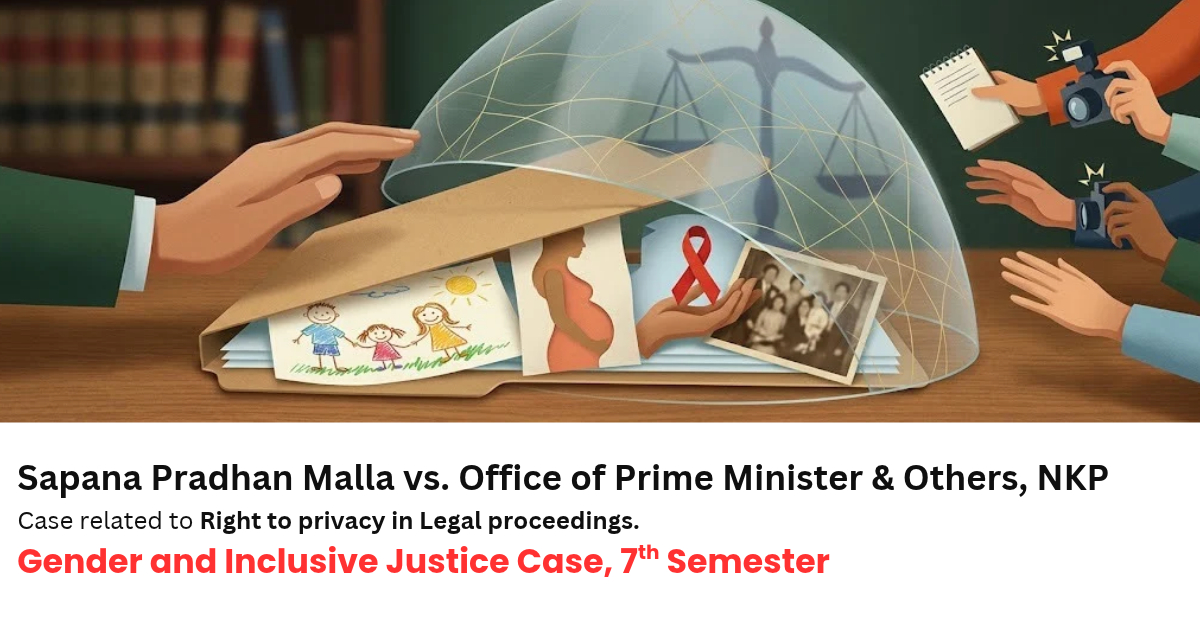
Gender and Inclusive Justice Case: Sapana Pradhan Malla vs. Office of Prime Minister & Others, ΝΚΡ (2064) No. 9, P. 1208, DN: 7880
Case: Mandamus and others
Plaintiff: Sapana Pradhan Malla
Defendant: Office of Prime Minister & Others
Decision Number: 7880
This case is relating to the right to privacy, confidentiality in legal proceedings, protection of vulnerable victims, and the balance between privacy and fair trial rights.
Facts of the Case:
Sapana Pradhan Malla filed a public-interest writ petition on behalf of the Forum for Women, Law and Development. The petition concerned privacy protection for women, children, and people living with HIV/AIDS involved in legal proceedings.
Although the Constitution recognised the right to privacy, there was no detailed system to protect the names, identities, addresses, health information, family details, and other personal information of vulnerable persons involved in cases.
Women involved in sexual or domestic violence cases could face social stigma, discrimination, threats, and further harm if their identities were disclosed. Children could face long-term stigma from the disclosure of personal or family information. People living with HIV/AIDS could also face discrimination affecting their employment, property, family relationships, and access to treatment.
Existing law allowed some cases to be heard in camera. However, the petitioners argued that this did not protect privacy during investigation, registration of cases, inspection of records, copying of documents, media reporting, judgment publication, and enforcement.
Plaintiff’s Claims:
The petitioners claimed that privacy was closely connected with dignity, equality, liberty, and access to justice. They argued that people may avoid reporting crimes or seeking legal remedies if their personal information is exposed. They asked the Court to order a comprehensive system protecting confidentiality throughout the legal process, along with remedies for unlawful disclosure.
Defendants’ Arguments:
The Government argued that the petitioners had not shown a specific violation of their own rights and that law-making was mainly Parliament’s responsibility. The Ministry of Law argued that privacy was already protected by the Constitution and that existing court rules allowed some cases to be heard in camera. It also argued that a person whose privacy was violated could seek a legal remedy.
Legal Questions:
- Whether the right to privacy includes protection of personal identity and confidential information?
- Whether women, children, and people living with HIV/AIDS require special privacy protection in legal proceedings?
- Whether an in-camera hearing alone is sufficient to protect privacy?
- Whether the Government should establish detailed laws and procedures to protect confidentiality throughout legal proceedings?
Different Court Decisions:
Supreme Court:
The Supreme Court held that the right to privacy protects not only physical privacy but also personal identity, health information, family details, character, address, and other confidential information.
The Court recognised that disclosure of such information could expose women, children, and people living with HIV/AIDS to stigma, discrimination, violence, and other harm. Such risks could also discourage victims from reporting crimes or seeking legal remedies.
The Court held that an in-camera hearing means more than simply preventing the public from entering the courtroom. Judges, court staff, lawyers, police, prosecutors, and others involved in the case must also maintain confidentiality. Privacy protection may be necessary throughout the legal process, including investigation, hearing, judgment, publication, and enforcement.
The Court also held that privacy must be balanced with the accused’s right to a fair trial. Protecting a victim’s identity does not remove the accused’s right to know and challenge the evidence necessary for their defence.
The Court directed the Government to form a committee with representatives from relevant institutions and civil society to study the issue and help prepare detailed legislation. Until such legislation was made, the Court directed the Government and relevant courts to follow interim guidelines for protecting privacy and confidentiality.
Principles Established:
- The right to privacy includes protection of personal identity and confidential information.
- Privacy covers information relating to health, family, address, character, custody, and other personal matters.
- Vulnerable groups may require special privacy protection against stigma and discrimination.
- Privacy is closely connected with dignity, equality, liberty, and access to justice.
- An in-camera hearing involves confidentiality beyond simply closing the courtroom to the public.
- Privacy protection should begin from investigation and case registration, not only during trial.
- Confidentiality may need to continue through judgment publication and enforcement.
- The right to information and freedom of expression do not automatically override privacy rights.
- Privacy must be balanced with the accused’s right to a fair trial.
- Courts can take measures to protect the identity and privacy of victims and parties when necessary.
- The Government has a duty to establish effective laws and procedures for protecting privacy.
- Courts may issue interim guidelines where detailed legislation is not yet available.