
Gender and Inclusive Justice Case: Advocate Basundhara Thapa vs. Council of Ministers, NKP (2060), No. 5/6, P. 389, DN: 7217
Case: Certiorari
Plaintiff: Basundhara Thapa
Defendant: Council of ministers
Decision Number: 7217
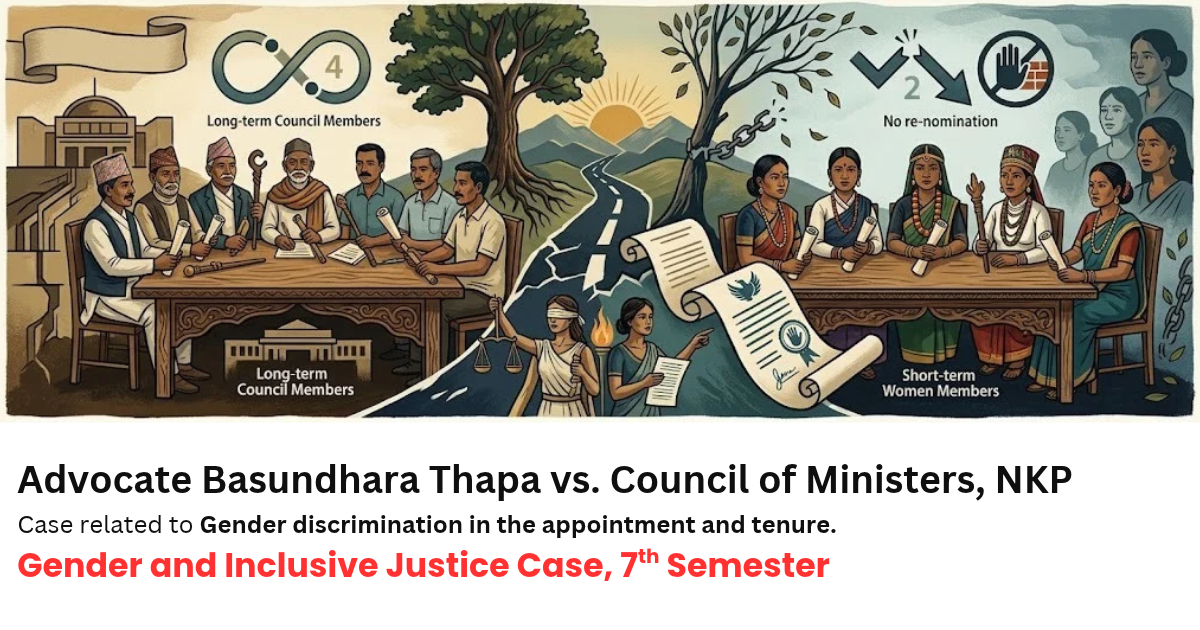
The case is relating to gender discrimination in the appointment and tenure of Indigenous women members of a government council.
Facts of the Case:
Basundhara Thapa, a lawyer and a woman from an Indigenous national community, filed a constitutional petition before the Supreme Court. She challenged a provision of the Indigenous Nationalities Development and Promotion Act, 2002.
The Act created a Council for the Indigenous Nationalities Development and Promotion Foundation. The Council included several nominated members. It also required the Government to nominate ten Indigenous women, two from each development region, who had contributed to the development of Indigenous communities.
Under Section 7(3) of the Act, most nominated members could remain in office for four years and could be nominated again once. However, the special proviso applied to the nominated Indigenous women members. Their term was limited to two years, and they could not be nominated again.
The women members had the same general status, duties, and responsibilities as the other nominated members. The only major difference was the shorter term and the prohibition on re-nomination.
The petition was based on Nepal’s obligations under the Convention on the Elimination of All Forms of Discrimination Against Women (CEDAW). The petitioner argued that Nepal could not maintain a discriminatory legal provision after accepting international obligations on gender equality.
Plaintiff’s Claims:
The petitioner claimed that the proviso to Section 7(3) was discriminatory and unconstitutional. She argued that members with similar duties and responsibilities should have the same term of office.
She said that giving women members only two years instead of four years, and preventing them from being nominated again, placed them in a weaker position than other nominated members.
She also argued that the provision was contrary to the equality guarantee under Article 11 of the Constitution of the Kingdom of Nepal, 1990. She relied on CEDAW and asked the Court to declare the discriminatory part of the law invalid.
Defendants’ Arguments:
The Government argued that the Act was created to improve the social, economic, and cultural position of Indigenous communities. It said that the special provision for women was intended to increase women’s participation.
The Government claimed that limiting the term to two years and preventing re-nomination would allow more Indigenous women to receive the opportunity to serve on the Council. It argued that the provision was a positive measure, not discrimination.
Legal Issues:
- Whether the petitioner had the right to challenge the constitutionality of the Act?
- Whether Section 7(3) of the Act discriminated against nominated Indigenous women members?
- Whether a shorter term and a ban on re-nomination violated the constitutional right to equality?
- Whether the provision could be justified as a measure to increase women’s participation?
Different Court Decisions:
Supreme Court Decision:
The Supreme Court held that the petitioner had sufficient legal standing. She was an Indigenous woman covered by the Act and was entitled to challenge a law that allegedly violated the constitutional right to equality.
The Court accepted that special provisions could be made to protect and promote women. However, the Court found that the disputed proviso did not provide a genuine protective benefit. It imposed a disadvantage on women who were appointed as members.
The Court compared the nominated women members with other nominated members. Their roles and responsibilities were substantially similar. Other nominated members could serve for four years and could be nominated again. The women members, however, could serve for only two years and could never be nominated again.
The Court held that this made the women members’ position inferior. It treated their representation as if it were of a lower category. The Government’s explanation that the rule would provide opportunities to more women did not justify taking away the equal term and re-nomination opportunity of women who had already been appointed.
The Court also referred to the Universal Declaration of Human Rights, the International Covenant on Civil and Political Rights, and CEDAW. It held that Nepal’s constitutional guarantee of equality must be understood consistently with its international obligations against gender discrimination.
The Court declared the proviso to Section 7(3) unconstitutional and invalid to the extent that it gave nominated Indigenous women members a shorter term and prevented their re-nomination.
Principles Established:
- A person from an affected group can challenge a law that allegedly violates constitutional rights.
- Persons in similar situations should receive equal treatment.
- A law cannot place women at a disadvantage merely because they are women.
- Special measures for women must genuinely promote equality.
- Equal duties and responsibilities should generally receive equal terms and conditions.
- A shorter term and ban on re-nomination can amount to gender discrimination.
- Legislative classifications must have a reasonable and constitutional basis.
- International human-rights instruments such as CEDAW can guide the interpretation of constitutional rights.
- A law inconsistent with the Constitution is invalid to the extent of the inconsistency.