
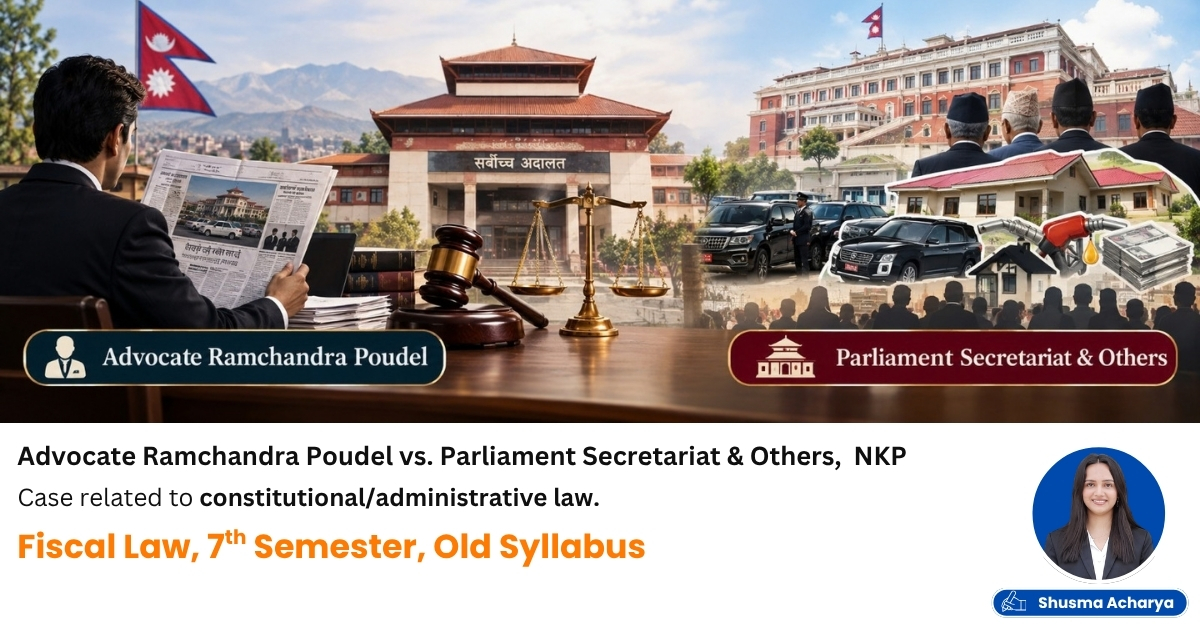
Fiscal Law Case: Advocate Ramchandra Poudel vs. Parliament Secretariat & Others, NKP (2068), DN:8675, No.8, P.1420.
Case: Writ of Certiorari and Mandamus
Plaintiff/Applicant: Advocate Ramchandra Poudel
Defendant/Respondent: Parliament Secretariat & others
Decision Number: 8675
This case is related to constitutional/administrative law.
Facts of the Case:
The petitioner after reading news reports in Kantipur Daily and Naya Patrika learned that a Council of Ministers decision of 2061/08/21 had granted former officials vehicles with drivers, fuel, maintenance costs and housing rent from state funds. When he approached the respondents for information about this decision he was denied access under the right to information. He then filed the writ petition in the Supreme Court asking the Court to quash the Cabinet’s decisions that gave these lifetime perks to former officials and stop the government from continuing to hand out such benefits since they were being provided using taxpayer’s money without any legal basis.
Plaintiff’s Claim:
The Council of Ministers’ decision of 2061/08/21 and similar decisions before and after it illegally burdened the state treasury by granting vehicles, fuel, maintenance, and housing benefits to former Prime Ministers, Deputy Prime Ministers and Home Ministers without legal authority. This violated Article 13 (Right to Equality) of the Interim Constitution since ordinary citizens do not receive such treatment creating unjustified discrimination. The petitioner sought certiorari to quash these decisions and mandamus to stop further disbursement of such benefits.
Defendant’s arguments:
Parliament Secretariat argued that it was wrongly named as a respondent since the disputed decisions were made by the Council of Ministers not the Secretariat. The Ministry of Home Affairs stated that it was merely implementing decisions made by the Government of Nepal. The Prime Minister and Council of Ministers argued that the decision was a policy matter concerning the security arrangements of former PM, Deputy PM and Home Ministers as approved in Cabinet meeting No. 55/061 dated 2061/08/21 and sought dismissal of writ.
Legal Issues:
- Does the Council of Ministers have discretionary authority to make payments or grant government property or benefits to any person or institution causing a charge on the state treasury in absence of statutory authorization?
- If the Council of Ministers can grant benefits what are the limits, conditions and scope of that authority?
- Should the order be issued as requested for in the petition?
Different Courts Decision:
Supreme Court:
The Court held that the ultimate and real ownership of state property and the treasury though nominally in the government’s name rests with the sovereign Nepali people. Without authorization from a law enacted by Parliament the Council of Ministers has no jurisdiction to grant benefits or government property to anyone. The Council of Ministers has no power to grant benefits to current or former government employees or officials beyond what the law prescribes as doing so violates the constitutional principles of limited government, rule of law and democratic values.
The Council of Ministers decisions of 2060/04/14, 2061/08/10, 2061/08/21 and others were found to grant benefits beyond what service related laws e.g., Ministers’ Remuneration and Facilities Act 2049, Members of Parliament’s Remuneration Act 2052, Supreme Court Justices’ Remuneration Act 2026 allowed. The Court cited the precedent of Bhojraj Ghimire v. Ramprasad Nayak, NKP 2068, Decision No. 8533 and reaffirmed that the Council of Ministers cannot decide to provide facilities beyond what is clearly fixed by law.
All such decisions of the Council of Ministers were declared void issued directive orders to stop misuse of expensive project vehicles by non-project personnel and several other orders were issued.
Principle Established:
- State property and the treasury though legally in the government’s name are ultimately owned by the sovereign people.
- The Council of Ministers cannot grant financial benefits, subsidies, gifts to any person without express statutory authorization and doing so is an act without jurisdiction (ultra vires) and unlawful.
- Where service related law explicitly fixes the remuneration or benefits payable to persons in the government service the Council of Ministers cannot grant more than what the law prescribes.
- Decisions that grant disproportionate, inconsistent benefits to certain classes of former officials while excluding others in equivalent or higher constitutional positions e.g., a former Speaker of Parliament are discriminatory and violate Article 13 (Right to Equality) of the Interim Constitution.
- Actions or decisions of the executive that fall outside the scope of authority granted by law are automatically null and void.
Relevancy of the Case:
This decision is a significant precedent in Nepalese constitutional and administrative law on the doctrine of limited government and rule of law.