
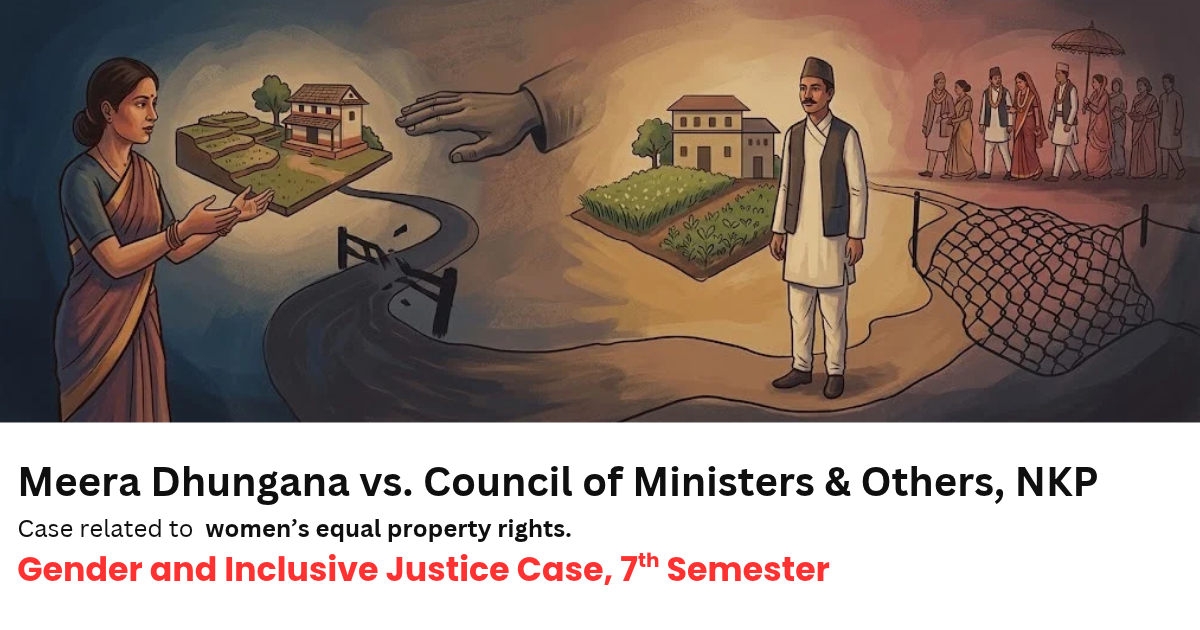
Gender and Inclusive Justice Case: Meera Dhungana vs. Council of Ministers & Others, NKP (2063), No. 8, P. 972, DN: 7743
Case: Voidance of the unconstitutional law
Plaintiff: Meera Dhungana
Defendant: Council of Ministers & Others
Decision Number: 7743
The case is relating to women’s equal property rights and the freedom to marry a person of their choice.
Facts:
Meera Dhungana, on behalf of the Forum for Women, Law and Development and in her own capacity, filed a constitutional petition before the Supreme Court. She challenged Section 7 of the Stri Ansh Dhan chapter of the Muluki Ain.
Section 7 provided that if a woman transferred property belonging to her, other than dowry or personal property, by any methods, and later married the same man who received the property, the earlier transaction would not be valid. The person who would otherwise have inherited the property could take it back.
The provision applied only when the transfer was made by a woman to a man and the woman later married that man. It did not apply in the same way when a man transferred his property to a woman and later married her.
The law therefore affected a woman’s right to deal freely with her own property. It also created a connection between the validity of a property transaction and the woman’s later decision to marry the person who received the property.
Plaintiff’s Claims:
The petitioner claimed that Section 7 discriminated against women and violated the constitutional right to equality. She argued that women should have the same right as men to use, sell, gift or otherwise transfer their own property.
She also argued that a woman should be free to marry a person of her choice without losing the legal effect of an earlier property transaction. She asked the Court to declare the discriminatory part of Section 7 unconstitutional and invalid.
Defendants’ Arguments:
The Government argued that the provision was based on Nepal’s traditional system of family property and inheritance. It said the rule was intended to prevent dishonest property transactions and protect family interests and social morality.
The respondents also argued that Parliament was responsible for making and changing laws. They pointed out that other discriminatory provisions had already been changed through legal reform and asked the Court to dismiss the petition.
Legal Questions:
- Whether Section 7 discriminated against women and violated the right to equality?
- Whether a woman had the same right as a man to freely transfer her own property?
- Whether a later marriage could invalidate an earlier lawful property transaction?
- Whether Section 7 unlawfully restricted a woman’s freedom to marry a person of her choice?
Different Court Decisions:
Supreme Court Decision:
The Supreme Court examined Section 7 in light of the constitutional guarantee of equality and Nepal’s international obligations.
The Court found that the law treated women and men differently. If a woman transferred her own property to a man and later married him, the transaction could be cancelled and the property could be recovered by another heir. The same restriction did not apply when a man transferred his property to a woman and later married her.
The Court held that the woman’s property was her own. Ownership includes the right to use, sell, gift, or otherwise transfer property. A woman does not lose that right because she later marries the person who received the property.
The Court also held that the right to own property and the right to marry are separate and important rights. A lawful property transaction could not be made invalid only because the woman later chose to marry the recipient. This placed an unreasonable restriction on both property rights and the freedom to marry.
The Court noted that dowry and personal property were excluded from the wording of the provision. However, it found no reasonable basis for treating other property differently or for imposing this restriction only on women.
The Court relied on the constitutional principles of equality and equal protection. It also considered CEDAW, the International Covenant on Civil and Political Rights, and the International Covenant on Economic, Social and Cultural Rights. These instruments protect women’s equal rights to property, marriage, and personal freedom.
The Supreme Court declared the disputed provision of Section 7 unconstitutional, invalid, and void from the date of the judgment.
Principles Established:
- Women and men are entitled to equal protection of the law.
- A woman has the same right as a man to own and transfer property.
- Ownership includes the right to sell, gift or otherwise transfer one’s property.
- Marriage does not cause a woman to lose her property rights.
- A later marriage cannot by itself invalidate an earlier lawful property transaction.
- The right to property and the right to marry are separate rights.
- A woman cannot be penalised for marrying a person of her choice.