
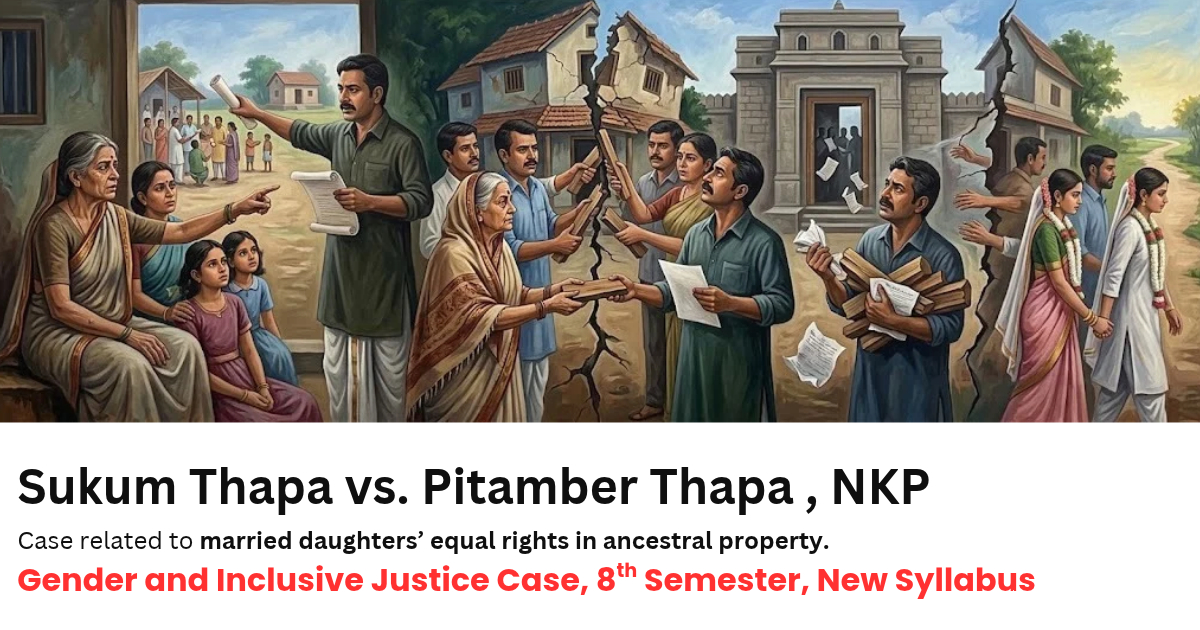
Gender and Inclusive Justice Case: Sukum Thapa vs. Pitamber Thapa NKP 2076 B.S No. 9, DN: 10346
Case: Certiorari and Mandamus
Plaintiff: Sukum Thapa et.al.
Defendant: Pitamber Thapa et.al.
Decision Number: 10346
The case is relating to married daughters’ equal rights in ancestral property and whether marriage can end their status as shareholders.
Facts of the Case:
Sukum Thapa and Chitrakumari Thapa were wives of Pitambar Thapa. They had been living separately after being removed from the family home. They filed a partition case against Pitambar Thapa in 2052 B.S.
In an earlier judgment dated 25 Baisakh 2065 B.S., the Supreme Court held that the wives and daughters were also entitled to shares in the family property. The Court treated the family as having nine shareholders for the purpose of partition.
The partition was delayed for several years. Before the property could be divided, Nandamaya Thapa, an original shareholder and Pitambar’s mother, died. Pitambar then produced a posthumous gift deed showing that Nandamaya had given her share to him. A partition memorandum was prepared in a way that gave Nandamaya’s share to Pitambar and divided only the remaining property among the other shareholders.
That partition memorandum was later cancelled by the District Court and the High Court. The Supreme Court also dismissed Pitambar’s challenge to those orders and held that the property received by Pitambar from his mother was still subject to partition among the joint family members.
After this, another partition date was fixed. Pitambar then argued that his daughters, Manisha Thapa and Nisha Thapa, should no longer be treated as shareholders because they had married in 2070 B.S. A further posthumous gift deed was also produced in favour of Raksha Thapa. On the basis of that deed, the petitions were filed.
Plaintiff’s Claims:
The petitioners argued that Manisha and Nisha had already been recognised as shareholders by the Supreme Court. Their marriage could not take away their existing ancestral property rights. They also challenged the later gift deed in favour of Raksha, arguing that it was being used to defeat the rights of other shareholders. They asked the Supreme Court to cancel the High Court’s order and include all entitled shareholders in the partition.
Defendants’ Arguments:
Pitambar and Raksha argued that Raksha’s registered posthumous gift deed should prevail because it was registered earlier than the other document. They also argued that Manisha and Nisha had lost their shareholder status after marriage under the law applicable at the time. They therefore asked the Court to uphold the High Court’s order.
Legal Questions:
- Whether married daughters could be excluded from ancestral property only because of their marriage?
- Whether the daughters’ right to partition had already been recognised by the Supreme Court?
- Whether a posthumous gift deed could defeat the rights of other joint family shareholders?
- Whether the High Court’s order excluding the daughters should be quashed?
Different court decisions:
Rupandehi District Court:
The District Court refused to give Nandamaya’s share exclusively to Raksha. It treated the property as joint family property subject to partition.
Tulsipur High Court:
The High Court reversed the District Court’s decision. It excluded Manisha and Nisha because they had married and ordered Nandamaya’s share to be dealt with according to the gift deed relied upon by Raksha.
Supreme Court Decision:
The Supreme Court held that the property received by Pitambar from his mother through a posthumous gift deed was still subject to partition because the family remained joint and the property had not yet been divided.
The Court also rejected the argument that the earlier gift deed in favour of Raksha should automatically prevail because it was registered first. The Court noted that Raksha had remained silent when Pitambar’s earlier gift deed was relied upon. The later deed was produced only after the earlier attempt had failed. The Court therefore did not accept the argument based on the first registration.
The main issue concerned the daughters’ marriage. The Court referred to the Constitution, which guarantees women equal rights in ancestral property and prohibits discrimination based on sex and marital status. It also considered the constitutional guarantee that sons and daughters have equal rights in ancestral property.
The Court held that a woman’s identity and property rights do not depend on whether she is married. An ancestral property right begins from birth and cannot be taken away merely because a daughter later marries.
The Court stated that telling a woman to choose either marriage or ancestral property is discrimination against women. The purpose of the Constitution and the property laws is to treat daughters as equal shareholders with sons.
The Supreme Court therefore quashed the High Court’s order. It directed that Nandamaya’s share should remain part of the joint family property and that a fresh partition should be made among all entitled shareholders.
Principles Established:
- Daughters have equal rights with sons in ancestral property.
- Marriage does not remove a daughter’s right to ancestral property.
- A woman cannot be forced to choose between marriage and property rights.
- Property rights cannot be determined only by marital status.
- An ancestral property right cannot be taken away merely because a daughter marries.
- Treating married daughters differently from sons amounts to discrimination.
- Constitutional equality protects women’s equal property rights.
- A daughter already recognised as a shareholder cannot later be excluded only because of marriage.