
Gender and Inclusive Justice Case: Indu Tuladhar vs Election Commission, NKP 2078 B.S No. 8, DN: 10716
Case: Certiorari
Plaintiff: Indu Tuladhar et.al.
Defendant: Election Commission et.al.
Decision Number: 10716
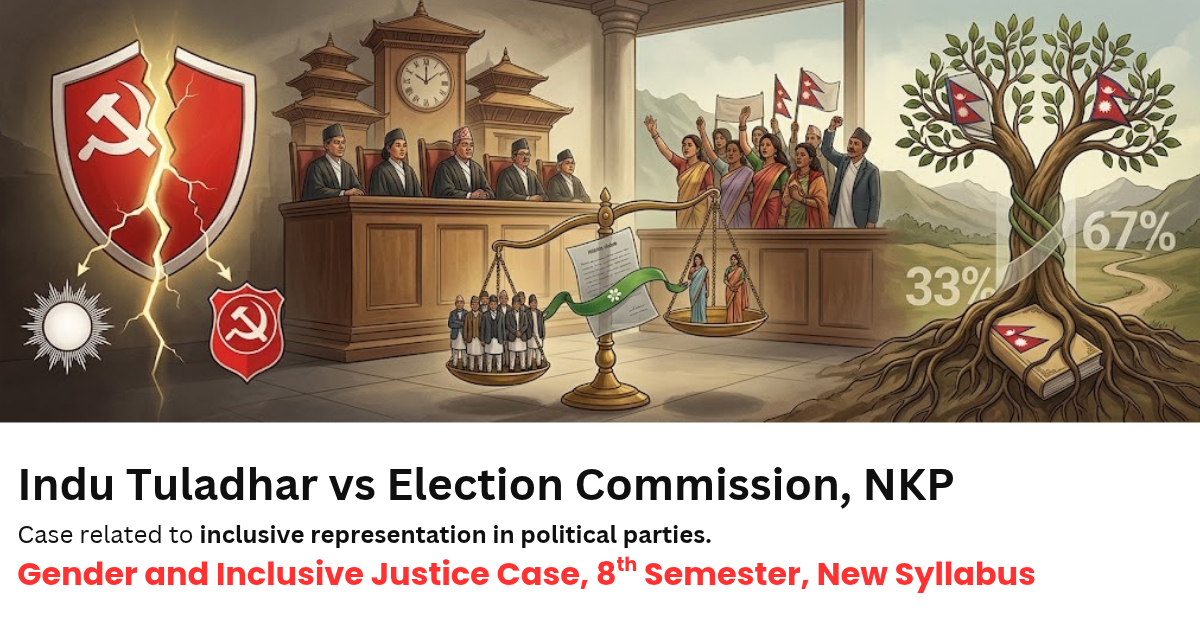
This case is related to inclusive representation in political parties, women’s participation, and the duty of the Election Commission to enforce constitutional and legal requirements when registering political parties.
Facts of the Case:
The petitioners were Nepali citizens and voters who believed in democracy and the rule of law. They challenged the registration of the Nepal Communist Party, which was formed after the merger of the Communist Party of Nepal (Unified Marxist–Leninist) and the Communist Party of Nepal (Maoist Centre).
The Election Commission registered the merged party on 23 May 2018. The petitioners argued that the party did not have the required 33 percent representation of women in its central committee and other party committees. They also claimed that the party was registered on the basis of an interim statute, although the law required a proper party statute for registration.
The petitioners relied on the Constitution and the Political Parties Act, 2017. These laws require political parties to be democratic and inclusive. They also require at least one-third women members in committees at every level.
During the case, the Supreme Court had already cancelled the registration of the Nepal Communist Party in another case. The two original parties therefore continued as separate political parties. However, the Court still considered the broader question of inclusive representation in political parties.
Petitioners’ Claim:
The petitioners said that the Election Commission had registered the merged party without ensuring 33 percent women’s representation and other inclusive requirements. They asked the Court to cancel the registration and order the Commission to ensure inclusive representation in that party and in all other political parties.
Election Commission’s Argument:
The Election Commission said that the two parties were already registered parties and had legally merged under the Political Parties Act. It argued that the merger process was different from the registration of a completely new party.
The Commission also stated that the merged party had an interim committee and had promised to fulfil the legal requirements at its general convention. It further said that it had already written to all political parties to maintain 33 percent women’s representation and comply with other legal conditions. Therefore, it asked the Court to dismiss the petition.
Legal Issues:
- Whether the Election Commission could register a merged political party without checking the required inclusive representation?
- Whether political parties must have at least one-third women members in committees at every level?
- Whether inclusion under the Constitution is based on the total population or on the membership of the political party?
- Whether the Election Commission has a duty to check these requirements when registering new parties and updating existing parties?
Decision of the Different courts:
Supreme Court:
The Supreme Court held that the challenge to the registration of the Nepal Communist Party had become unnecessary because the Court had already cancelled that registration in an earlier case. The original parties had returned to their previous status.
However, the Court decided the wider legal issue. It held that inclusion is an important constitutional principle. Political parties must reflect Nepal’s diversity and must provide meaningful representation to women and other relevant groups.
The Court clarified that every group mentioned in the Constitution does not have to be represented in every committee in all situations. Representation depends on the nature of the body and the membership available in the party.
The Court also held that people cannot be forced to join a political party merely to fulfil an inclusion requirement. Inclusion within a party is generally based on the party’s actual membership. If women are members of a party, they must be included in the party committees in a proportionate manner. In any event, at least one-third of the positions must be reserved for women.
The Court directed the Election Commission to check whether political parties have made proper arrangements for inclusion when registering them. For existing parties, the Commission must ensure that the required arrangements are made through their national conventions and party statutes.
The Court therefore issued an order of mandamus against the concerned authorities. The petition was allowed to this extent. There was no criminal punishment because this was a constitutional writ case.
Principle Established:
- Political parties must be democratic and inclusive.
- At least one-third of the positions in party committees must be reserved for women.
- Women’s representation must be considered at the central, provincial, district and local levels of a political party.
- Inclusion is generally based on the membership of the party, not simply on Nepal’s total population.
- The Election Commission must check constitutional and legal inclusion requirements before registering political parties.
- Political parties cannot force citizens to become members only to fulfil inclusion requirements.